Introduction
Java has remained one of the dominant enterprise development platforms for more than a decade, powering banking systems, insurance platforms, telecommunications infrastructure, government applications, and countless mission-critical enterprise solutions. As hardware architectures evolve toward increasing processor parallelism and applications process ever-larger datasets, developers require language features that simplify concurrent programming while improving code maintainability.
Java 8 represents one of the most substantial platform updates since the introduction of generics. Rather than focusing solely on incremental library improvements, Java 8 introduces functional programming concepts through Lambda Expressions, a new Streams API for collection processing, interface enhancements, and important JVM runtime improvements including the replacement of Permanent Generation (PermGen) memory with Metaspace.
From the perspective of March 2014, Java 8 signals a significant evolution of the Java language while maintaining the backward compatibility expected by enterprise organizations.
Industry Background
Enterprise Java applications continue increasing in both scale and complexity.
Organizations routinely develop:
- ◆Enterprise Resource Planning systems.
- ◆Financial transaction platforms.
- ◆Web application servers.
- ◆Service-oriented architectures.
- ◆Distributed middleware.
- ◆Big data processing solutions.
Meanwhile, server hardware has shifted toward multicore processors rather than dramatic increases in individual processor speed. Leveraging parallelism efficiently has become an important objective for modern software development.
Earlier versions of Java often required verbose anonymous inner classes and explicit iteration when processing collections, leading to repetitive code and increased maintenance effort.
Java 8 addresses many of these concerns through language-level enhancements.
The Business Problem
Traditional enterprise Java development introduces several challenges.
Organizations commonly encounter:
- ◆Verbose callback implementations.
- ◆Repetitive collection processing.
- ◆Complex concurrent programming.
- ◆Difficult code maintenance.
- ◆Memory management limitations associated with PermGen.
- ◆Limited expressiveness for functional operations.
As software systems continue growing, reducing boilerplate code while improving scalability and maintainability becomes increasingly valuable.
Understanding the Technology
Java 8 introduces multiple complementary platform improvements.
Major capabilities include:
- ◆Lambda Expressions.
- ◆Streams API.
- ◆Functional Interfaces.
- ◆Method References.
- ◆Default Interface Methods.
- ◆New Date and Time API.
- ◆Metaspace replacing PermGen.
Together these enhancements modernize the Java programming model without abandoning its established object-oriented foundation.
Core Architecture
Java 8 extends both the language and the Java Virtual Machine.
| Component | Responsibility |
|---|---|
| Java Compiler | Compiles Java 8 language features |
| Java Virtual Machine | Executes compiled bytecode |
| Lambda Runtime Support | Executes functional expressions |
| Streams API | Collection processing pipeline |
| Metaspace | Class metadata storage |
| Collections Framework | Data structures and iteration |
The new language features integrate directly with the existing Java platform rather than requiring separate execution environments.
Key Features
Lambda Expressions
Lambda Expressions provide a concise syntax for representing executable behavior, reducing the need for anonymous inner classes in many programming scenarios.
They simplify event handling, callbacks, and collection processing while improving overall code readability.
Streams API
The Streams API introduces a declarative approach to processing collections.
Developers can express filtering, transformation, aggregation, and traversal operations as processing pipelines instead of explicit loops.
Functional Interfaces
Interfaces containing a single abstract method become natural targets for lambda expressions, encouraging reusable programming models.
Method References
Method references further simplify code by allowing existing methods to be referenced directly where compatible functional interfaces are expected.
Default Methods
Interfaces may now provide default implementations, allowing API evolution while reducing compatibility concerns for existing implementations.
Metaspace Replacing PermGen
One of the most important JVM improvements is the removal of the Permanent Generation memory space.
Class metadata is now stored within Metaspace, reducing many of the tuning challenges historically associated with PermGen sizing.
How It Works
A simplified processing workflow appears below.
Application
      |
Collection
      |
Stream Pipeline
      |
Filter
      |
Map
      |
Aggregate
      |
Result
Rather than explicitly iterating through every element, developers describe the processing pipeline while the Streams framework manages execution.
Enterprise Use Cases
Java 8 provides value across numerous enterprise environments.
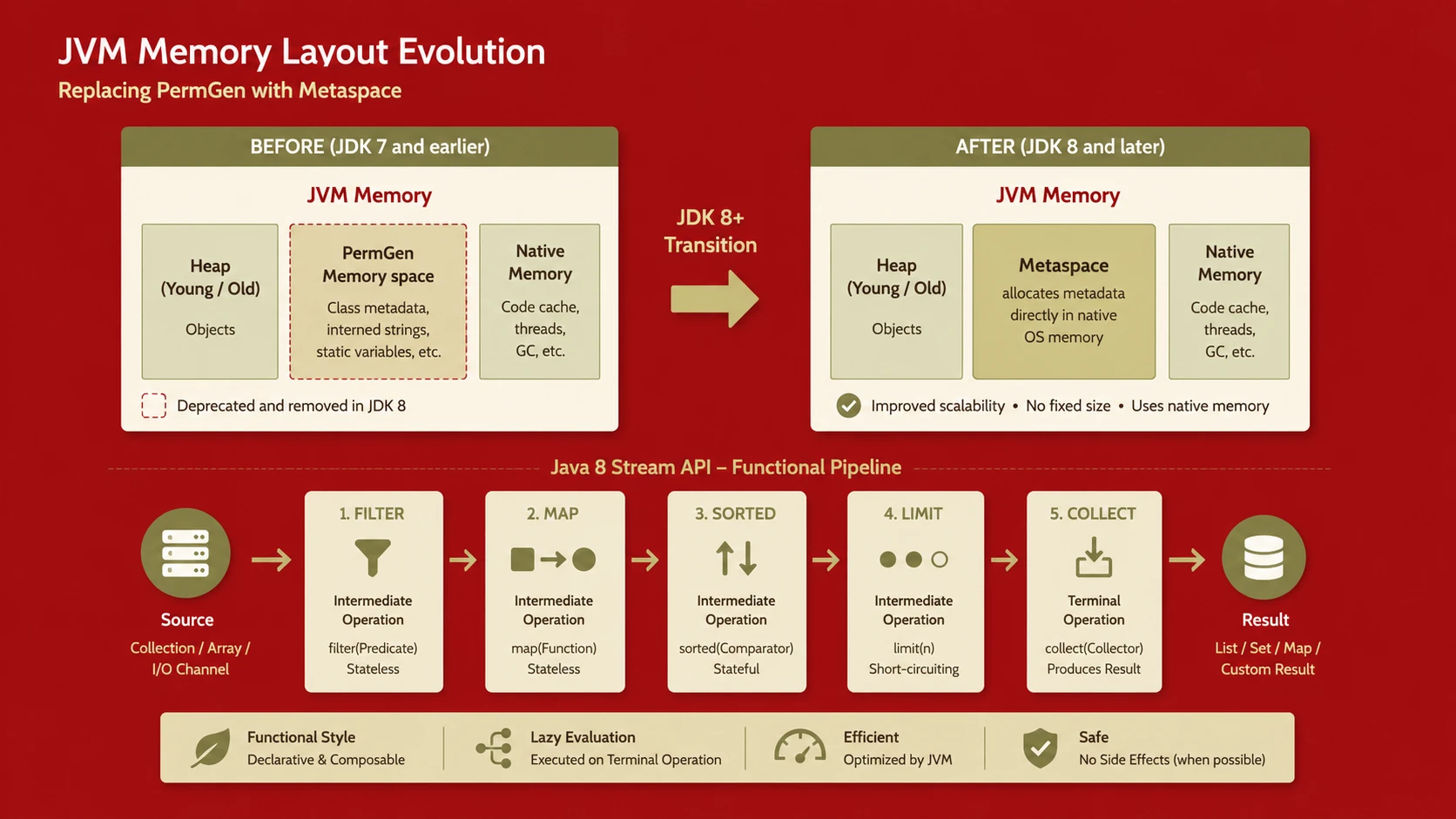
System architecture diagram and conceptual workflow layout for Java 8: Lambda Expressions, Streams API, and the End of PermGen Memory.
Financial Services
Large collections of transactional data can be processed using concise stream operations.
Enterprise Web Applications
Business logic becomes easier to maintain through cleaner callback and collection-processing code.
Middleware Platforms
Framework developers benefit from default interface methods when evolving public APIs.
Analytics Applications
Data transformation pipelines become more readable and maintainable.
Large Development Teams
Reduced boilerplate code improves consistency and simplifies long-term maintenance.
Performance Considerations
Java 8 introduces opportunities for improved application performance, particularly when processing collections.
Important considerations include:
- ◆Stream pipeline efficiency.
- ◆Memory allocation behavior.
- ◆Parallel processing opportunities.
- ◆JVM optimization.
- ◆Appropriate use of functional programming constructs.
Developers should benchmark representative workloads rather than assuming automatic performance improvements for every application.
Security Considerations
Java 8's new language features do not fundamentally alter established enterprise security practices.
Organizations should continue implementing:
- ◆Authentication.
- ◆Authorization.
- ◆Secure communication.
- ◆Input validation.
- ◆Exception management.
- ◆Secure deployment procedures.
Application security remains primarily an architectural responsibility rather than a language feature.
Scalability
Several Java 8 improvements support scalable enterprise development.
Benefits include:
- ◆Cleaner concurrent programming models.
- ◆Improved collection processing.
- ◆Simplified API evolution.
- ◆Better JVM memory management.
- ◆Reduced maintenance overhead.
These characteristics align well with modern multicore server environments.
Best Practices
Organizations adopting Java 8 should:
- ◆Introduce lambda expressions where they improve readability.
- ◆Use Streams for collection-oriented business logic.
- ◆Benchmark performance before large-scale refactoring.
- ◆Understand functional interfaces thoroughly.
- ◆Review JVM memory configuration following migration.
- ◆Maintain comprehensive automated testing.
- ◆Adopt Java 8 incrementally across projects.
Measured adoption minimizes migration risk while allowing teams to gain practical experience.
Common Mistakes
| Mistake | Business Impact |
|---|---|
| Rewriting entire applications immediately | Increased migration risk |
| Overusing streams for simple operations | Reduced readability |
| Ignoring performance benchmarking | Unexpected production behavior |
| Misunderstanding lambda scope | Logic defects |
| Continuing outdated PermGen tuning practices | Inefficient JVM configuration |
| Inadequate developer training | Slower adoption |
Successful migration depends on disciplined engineering rather than simply adopting new syntax.
Technology Comparison
| Characteristic | Java 7 | Java 8 |
|---|---|---|
| Lambda Expressions | Not available | Supported |
| Streams API | Traditional collection iteration | Declarative stream processing |
| Interface Evolution | Abstract methods only | Default methods supported |
| Functional Programming | Limited | Integrated language support |
| JVM Metadata Storage | PermGen | Metaspace |
Java 8 modernizes both the programming language and the runtime while maintaining compatibility with existing enterprise applications.
Adoption Strategy
Organizations should approach Java 8 migration incrementally.
Recommended roadmap:
- 1.Upgrade development environments.
- 2.Validate third-party library compatibility.
- 3.Introduce Java 8 for new development.
- 4.Refactor selected modules using lambda expressions.
- 5.Benchmark application performance.
- 6.Review JVM monitoring and memory configuration.
This phased approach reduces operational risk while allowing engineering teams to benefit from the platform's new capabilities.
Limitations
Although Java 8 introduces major improvements, organizations should recognize several considerations.
- ◆Existing codebases may require developer training.
- ◆Functional programming concepts introduce a learning curve.
- ◆Not every collection-processing task benefits from streams.
- ◆Third-party libraries should be evaluated for compatibility.
- ◆Migration planning remains essential for mission-critical applications.
These considerations should be addressed as part of a structured modernization strategy.
Looking Ahead
From the perspective of March 2014, Java 8 represents one of the most important milestones in the platform's evolution. By introducing Lambda Expressions, the Streams API, interface enhancements, and replacing PermGen with Metaspace, Oracle has modernized the Java ecosystem while preserving the stability expected by enterprise organizations.
These enhancements position Java to better utilize multicore hardware, simplify enterprise application development, and improve long-term maintainability. Organizations that adopt Java 8 through carefully planned migration strategies are likely to benefit from cleaner code, more expressive programming models, and a more capable JVM while continuing to leverage the mature Java platform that underpins countless enterprise systems.