The Technology Conversation Is Changing
Every few months, a new programming language, framework, or development platform starts trending across the technology industry.
And whenever that happens, familiar questions return:
“Is ASP.NET Core still relevant?”
“Should companies still build new applications with .NET?”
“Should development teams move everything to JavaScript or Python?”
The short answer is:
Yes. ASP.NET Core remains highly relevant in 2026, particularly for enterprise-grade, secure, scalable, and mission-critical systems.
But the more important answer requires understanding how modern software architecture has changed.
Today, successful software engineering is not about finding one programming language or framework that can solve every problem.
It is about selecting the right technology for the right workload.
JavaScript and TypeScript ecosystems provide excellent options for interactive web applications, SaaS platforms, and rapid product development.
Python has become a central technology for artificial intelligence, machine learning, data engineering, LLM applications, and automation.
ASP.NET Core continues to provide a powerful foundation for enterprise APIs, business platforms, distributed systems, and applications where performance, security, scalability, and long-term maintainability are critical.
The future is not about one framework replacing every other framework.
The future is about intelligent architecture.
---
Why the “Best Framework” Debate Is Outdated
Technology discussions often try to identify a single winner.
Developers compare:
- ◆.NET vs Node.js
- ◆C# vs Python
- ◆React vs Angular
- ◆SQL vs NoSQL
- ◆Monoliths vs microservices
- ◆Cloud vs on-premise infrastructure
These comparisons can be useful, but real-world architecture decisions are more complex.
A technology that is excellent for one business requirement may be inefficient for another.
For example, a startup building an MVP may prioritize:
- ◆Rapid development
- ◆Fast experimentation
- ◆Flexible architecture
- ◆A small development team
- ◆Short release cycles
A financial institution building a transaction platform may prioritize:
- ◆Security
- ◆Reliability
- ◆Auditability
- ◆Regulatory compliance
- ◆Predictable performance
- ◆Long-term maintainability
An AI company building intelligent automation may prioritize:
- ◆Machine learning libraries
- ◆LLM integration
- ◆Data processing
- ◆Model orchestration
- ◆Vector databases
- ◆Experimentation speed
These are different problems.
Therefore, they should not automatically have the same technology solution.
The right question is not:
“Which framework is the best?”
The better question is:
“Which technology solves this specific business and engineering problem most effectively?”
---
Where ASP.NET Core Fits in the Modern Technology Landscape
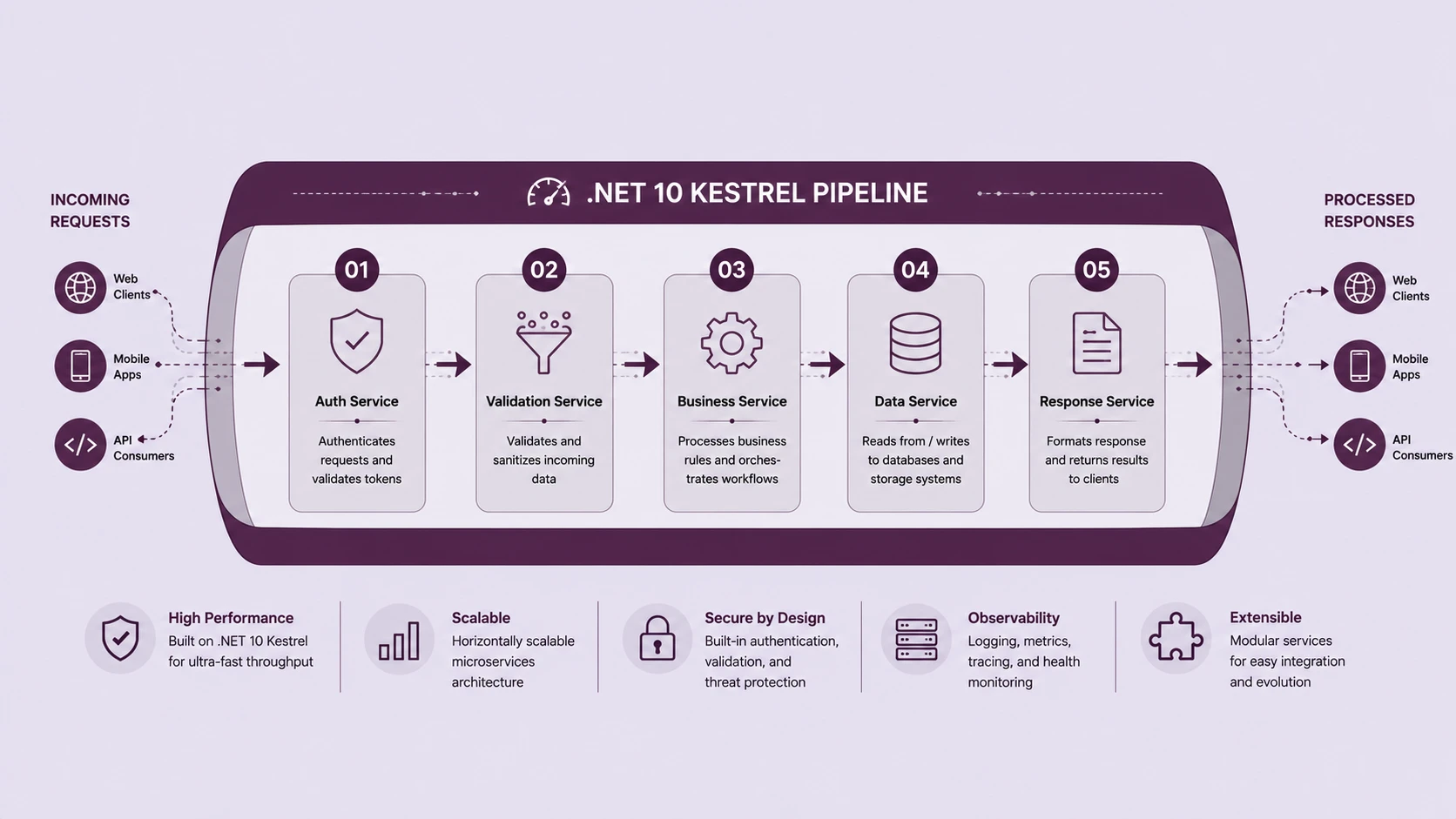
ASP.NET Core is a modern, cross-platform framework designed for building web applications, APIs, cloud services, distributed systems, and enterprise platforms.
Its continued relevance comes from a combination of technical capabilities and ecosystem maturity.
For organizations building long-term software platforms, several characteristics remain particularly important.
1. Performance and Scalability
// Minimal API configuration showing performance-optimized endpoint in .NET Core
var builder = WebApplication.CreateBuilder(args);
var app = builder.Build();

app.MapGet("/api/v1/health", () => new {
    Status = "Healthy",
    Timestamp = DateTime.UtcNow,
    Platform = ".NET Core"
});

app.Run();
Performance matters when applications process large numbers of concurrent requests, execute complex business operations, or support critical services.
ASP.NET Core is designed for high-performance server-side applications and provides capabilities suitable for:
- ◆REST APIs
- ◆High-traffic web applications
- ◆Internal enterprise platforms
- ◆Real-time applications
- ◆Microservices
- ◆Distributed systems
- ◆Cloud-native workloads
But performance should never be evaluated through benchmark numbers alone.
Real-world scalability depends on the complete architecture, including:
- ◆Database design
- ◆Caching strategy
- ◆Network architecture
- ◆Application code
- ◆Infrastructure configuration
- ◆Observability
- ◆Horizontal scaling
- ◆Deployment architecture
ASP.NET Core provides a strong foundation, but good engineering decisions remain essential.
---
2. Security for Enterprise Applications
Security is one of the most important requirements for enterprise software.
Modern applications need more than a login page. They require a complete security architecture.
ASP.NET Core provides a mature ecosystem for implementing:
- ◆Authentication
- ◆Authorization
- ◆Role-based access control
- ◆Policy-based authorization
- ◆Identity management
- ◆Secure API development
- ◆Token-based authentication
- ◆Integration with enterprise identity providers
For organizations operating in regulated industries, the framework is only one part of the solution.
Secure systems also require proper infrastructure configuration, secrets management, logging, encryption, vulnerability management, access policies, and security monitoring.
The advantage of ASP.NET Core is that development teams can build these requirements on top of a mature and structured application ecosystem.
---
3. Long-Term Support and Predictable Evolution
Enterprise applications often remain in production for many years.
For these systems, long-term maintainability matters more than short-term popularity.
Organizations need predictable upgrade paths, supported runtime versions, security updates, documentation, and a stable development ecosystem.
The .NET platform provides a structured release and support lifecycle that helps engineering teams plan application maintenance and modernization.
This is especially valuable for organizations maintaining:
- ◆ERP platforms
- ◆Banking systems
- ◆Insurance applications
- ◆Healthcare software
- ◆Government platforms
- ◆Manufacturing systems
- ◆Logistics applications
- ◆Internal business platforms
In these environments, technology decisions must consider the next five or ten years, not only the next development sprint.
---
Why Enterprises Continue to Choose ASP.NET Core
Enterprise software development involves challenges that are often invisible during small prototypes.
A prototype may work successfully with a few users and limited data.
An enterprise system may need to support:
- ◆Thousands of users
- ◆Complex authorization policies
- ◆Multiple business departments
- ◆External system integrations
- ◆Regulatory requirements
- ◆Detailed audit trails
- ◆Large databases
- ◆Background processing
- ◆High availability
- ◆Disaster recovery
- ◆Continuous monitoring
ASP.NET Core is frequently selected for these environments because it combines modern development capabilities with a mature enterprise ecosystem.
Strong Typing and Large Codebase Maintainability
C# provides strong typing, modern language features, asynchronous programming support, and powerful development tooling.
In large projects involving multiple teams, these characteristics can help developers identify certain categories of errors earlier and make large codebases easier to understand and refactor.
Strong typing does not automatically create good software architecture.
However, combined with:
- ◆Clear coding standards
- ◆Automated testing
- ◆Code reviews
- ◆Dependency management
- ◆Architecture guidelines
- ◆Continuous integration
it can contribute significantly to long-term maintainability.
---
The Role of JavaScript and TypeScript in 2026
The continued relevance of ASP.NET Core does not reduce the importance of JavaScript and TypeScript.
Modern web applications frequently use technologies such as:
- ◆React
- ◆Next.js
- ◆Node.js
- ◆TypeScript
- ◆Modern frontend build systems
These technologies are particularly useful for:
- ◆SaaS products
- ◆Interactive applications
- ◆Customer-facing platforms
- ◆Real-time applications
- ◆Rapidly evolving products
- ◆JavaScript-first development teams
For some applications, a complete TypeScript stack may be the right architecture.
For others, React or Next.js may provide the frontend experience while ASP.NET Core powers backend APIs and business services.
The technologies do not have to compete.
They can work together.
---
Python’s Role in AI and Automation
The rapid growth of artificial intelligence has made Python an increasingly important part of enterprise technology stacks.
Python provides a strong ecosystem for:
- ◆Machine learning
- ◆Generative AI applications
- ◆LLM integration
- ◆AI agents
- ◆Data science
- ◆Data processing
- ◆Automation
- ◆Model serving
- ◆Retrieval-Augmented Generation
- ◆Vector database integration
FastAPI has also become a popular option for exposing Python-based AI and data services through APIs.
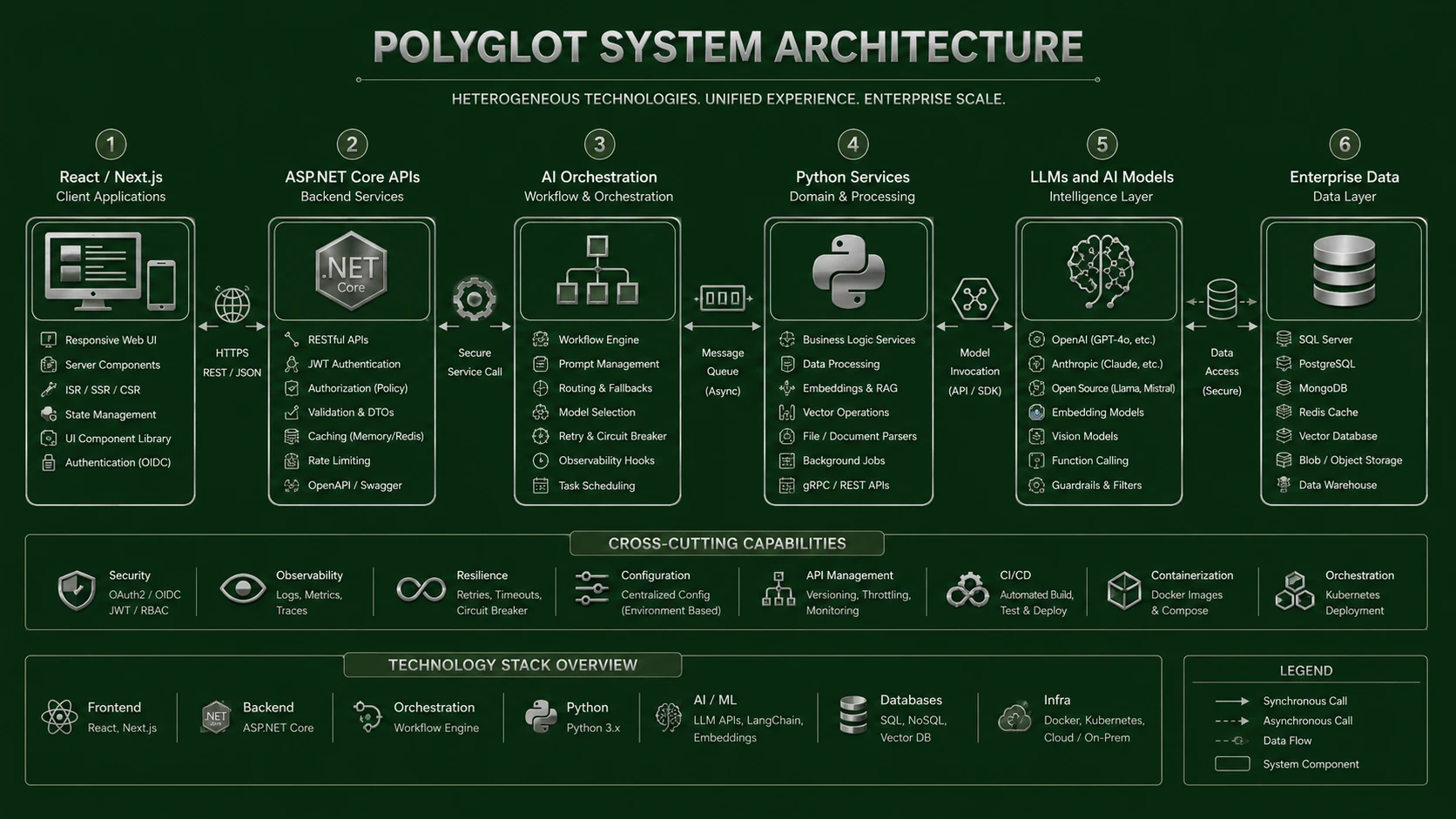
System architecture diagram and conceptual workflow layout for Is ASP.NET Core Still Relevant in 2026? Yes, and Here’s Why.
However, the rise of Python does not mean every enterprise backend needs to be rewritten in Python.
A common architecture can combine:
ASP.NET Core for core business services and enterprise APIs
with:
Python and FastAPI for AI, machine learning, and data workloads
This allows each technology to operate where its ecosystem provides the greatest value.
---
The Biggest Architectural Shift: Polyglot Systems
One of the most important software architecture trends is the increasing use of polyglot architectures.
A polyglot architecture intentionally uses multiple technologies within the same platform.
The goal is not to add unnecessary complexity.
The goal is to use technologies according to their strengths.
A modern enterprise platform might look like this:
Frontend Layer
- ◆React
- ◆Next.js
- ◆Angular
- ◆TypeScript
The frontend layer manages user experience, interaction, and client-side application behavior.
Enterprise Backend Layer
- ◆ASP.NET Core
- ◆C#
- ◆REST APIs
- ◆gRPC services
- ◆Background services
This layer can manage business logic, authorization, integrations, workflows, and enterprise APIs.
AI and Automation Layer
- ◆Python
- ◆FastAPI
- ◆LLM services
- ◆AI agents
- ◆MCP integrations
- ◆Machine learning models
- ◆Automation workflows
This layer handles intelligent processing, AI orchestration, model integration, and data-intensive workflows.
Data Layer
- ◆SQL Server
- ◆PostgreSQL
- ◆Document databases
- ◆Caching systems
- ◆Vector databases
- ◆Object storage
Different data technologies can be selected based on consistency, query patterns, scale, and AI retrieval requirements.
Infrastructure Layer
- ◆Docker
- ◆Kubernetes
- ◆Azure
- ◆CI/CD pipelines
- ◆Observability platforms
- ◆Infrastructure automation
The infrastructure layer supports deployment, scaling, reliability, monitoring, and operations.
This architecture demonstrates an important principle:
Modern technology stacks are becoming collaborative rather than competitive.
---
ASP.NET Core in the Age of AI
AI is changing how applications are designed, but it does not eliminate the need for traditional backend engineering.
An AI-powered enterprise application still needs:
- ◆Authentication
- ◆Authorization
- ◆User management
- ◆Business rules
- ◆Database transactions
- ◆API security
- ◆Audit logging
- ◆Payment processing
- ◆Workflow management
- ◆External integrations
- ◆Monitoring
- ◆Compliance controls
AI models can provide intelligence, but enterprise platforms still require reliable software architecture around them.
For example, an AI-powered business application might use ASP.NET Core to:
- 1.Authenticate the user.
- 2.Verify permissions.
- 3.Retrieve approved business data.
- 4.Call an AI orchestration service.
- 5.Validate the AI response.
- 6.Execute approved business actions.
- 7.Store an audit record.
- 8.Return a controlled response to the user.
In this architecture, AI becomes a powerful capability within the application rather than an uncontrolled replacement for the entire software platform.
---
Building AI-Native Applications with .NET and Python
One of the strongest architectural patterns for modern enterprise AI systems is combining established enterprise platforms with specialized AI services.
A simplified flow could look like:
React / Next.js → ASP.NET Core APIs → AI Orchestration → Python Services → LLMs and AI Models → Enterprise Data
In this architecture:
- ◆The frontend manages the user experience.
- ◆ASP.NET Core manages business rules, security, and enterprise workflows.
- ◆Python services manage specialized AI processing.
- ◆AI orchestration selects appropriate models and tools.
- ◆Enterprise databases provide controlled business context.
- ◆Observability systems monitor the complete workflow.
This approach allows organizations to adopt AI without discarding years of investment in stable enterprise platforms.
---
When Should You Choose ASP.NET Core?
ASP.NET Core can be a strong choice when the project requires:
- ◆Complex business logic
- ◆Long-term maintainability
- ◆Strong authentication and authorization requirements
- ◆Large development teams
- ◆High-performance APIs
- ◆Microsoft ecosystem integration
- ◆Azure-based infrastructure
- ◆Enterprise identity integration
- ◆Structured application architecture
- ◆Long-term platform development
However, this does not mean ASP.NET Core should automatically be selected for every project.
Technology selection should consider:
- ◆Business requirements
- ◆Existing team expertise
- ◆Infrastructure strategy
- ◆Development speed requirements
- ◆Security requirements
- ◆Integration needs
- ◆Long-term maintenance costs
- ◆Deployment environment
A framework should be selected because it fits the problem—not because it is currently popular or because a social media trend says another technology has replaced it.
---
What Matters More Than the Framework
Framework discussions often receive more attention than architecture fundamentals.
But a poorly designed application does not become scalable simply because it uses a fast framework.
Similarly, a well-designed system can often deliver excellent results across different technology stacks.
The factors that matter most include:
- ◆Clear system boundaries
- ◆Good database design
- ◆Secure authentication and authorization
- ◆Effective caching
- ◆Proper error handling
- ◆Automated testing
- ◆Observability
- ◆Deployment automation
- ◆Scalability planning
- ◆Maintainable code
- ◆Strong engineering practices
Technology is an important decision.
But technology alone does not guarantee business success.
---
The Real Question for Technology Leaders
The question technology leaders should ask in 2026 is not:
“Is ASP.NET Core still relevant?”
The better questions are:
- ◆Does this technology fit our business requirements?
- ◆Can our team build and maintain it effectively?
- ◆Does it meet our security and compliance requirements?
- ◆Can it integrate with our AI and cloud strategy?
- ◆Will the architecture remain maintainable as the organization grows?
- ◆Can we evolve individual components without rebuilding the entire platform?
For many enterprise applications, ASP.NET Core continues to answer these questions effectively.
For other workloads, Node.js, Python, FastAPI, or another platform may be a better fit.
That is not a weakness in any framework.
It is the reality of modern software engineering.
---
The Future Is AI-Native, Cloud-Native, and Architecture-Driven
The software industry is moving toward platforms that combine traditional software engineering with AI capabilities.
The modern enterprise technology stack is increasingly built around:
- ◆Cloud-native infrastructure
- ◆Containerized applications
- ◆Distributed services
- ◆AI agents
- ◆LLM integration
- ◆Intelligent automation
- ◆Strong APIs
- ◆Secure identity
- ◆Modern data platforms
- ◆Observability and governance
ASP.NET Core can play an important role in this ecosystem, particularly as the secure and scalable foundation for enterprise APIs, business workflows, and mission-critical systems.
At the same time, Python can power specialized AI services, modern frontend frameworks can deliver rich user experiences, and cloud platforms can provide scalable infrastructure.
The winning architecture is not necessarily the one built entirely with a single technology.
It is the one where technologies are selected deliberately and integrated effectively.
---
Final Thoughts: Is ASP.NET Core Still Relevant in 2026?
Yes.
But not because every application should be built with it.
ASP.NET Core remains relevant because it continues to solve important enterprise engineering problems: building secure, scalable, maintainable, high-performance, and long-lived software platforms.
The software industry is no longer simply choosing between .NET, Node.js, and Python.
Modern platforms increasingly combine them.
A startup may choose a JavaScript-first stack for rapid product development.
An AI platform may rely heavily on Python and FastAPI.
A complex enterprise platform may use ASP.NET Core for its core business services while integrating React, Python AI services, containerized infrastructure, and cloud platforms.
The key lesson is simple:
Technology evolves, but the right choice is the one that delivers sustainable business value.
The future belongs to engineering teams that understand not only how to use frameworks, but also where each technology belongs within the larger architecture.
At SHIVAM ITCS, we build modern enterprise and AI-powered solutions using ASP.NET Core, .NET, React, Next.js, FastAPI, AI agents, MCP, Docker, Kubernetes, Azure, and cloud-native architectures.
Our focus is not on chasing technology trends.
Our focus is on building secure, scalable, intelligent systems designed to solve real business problems and evolve with the future of technology.