Why Semantic Kernel Matters for Enterprise .NET
As AI becomes a core capability of enterprise software, developers need more than simple API calls to large language models. Business applications require planning, memory, tool execution, plugin orchestration, and seamless integration with existing .NET services.
Microsoft Semantic Kernel provides a modular AI orchestration framework that enables developers to embed cognitive capabilities directly into enterprise applications while maintaining clean architecture and production-grade scalability.
Architecture Principle: AI should become a reusable application capability rather than isolated prompts scattered throughout the codebase.
---
What Is Microsoft Semantic Kernel?
Semantic Kernel is Microsoft's open-source SDK for integrating Large Language Models into .NET applications. It provides a structured framework for orchestrating prompts, plugins, planners, memory, and native code into intelligent workflows.
Core capabilities include:
- ◆AI orchestration
- ◆Prompt functions
- ◆Native functions
- ◆AI plugins
- ◆Memory management
- ◆Planning
- ◆Function calling
- ◆Multi-model support
---
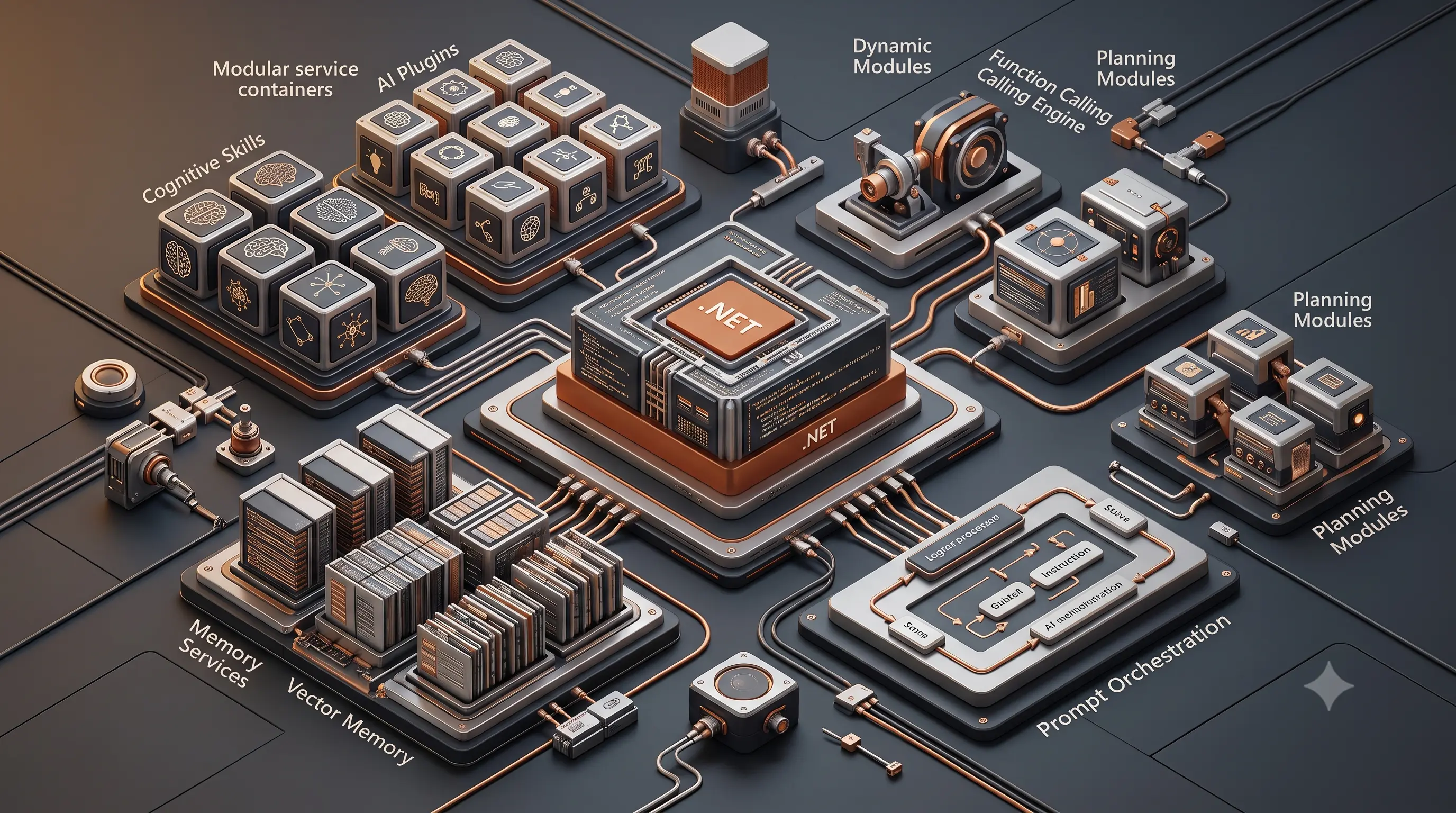
Core Architecture
A typical Semantic Kernel implementation follows this architecture:
Enterprise Application
         │
         ▼
Semantic Kernel
         │
──────────────────────────────
│ Planner │ Skills │ Memory │
│ Plugins │ Native │ Prompt │
──────────────────────────────
         │
LLM Providers
         │
Enterprise APIs
---
Cognitive Skills
Semantic Kernel organizes reusable AI capabilities as skills.
Examples include:
- ◆Document summarization
- ◆Content generation
- ◆Code analysis
- ◆Data extraction
- ◆Translation
- ◆Classification
- ◆Email drafting
- ◆Workflow automation
Skills can be combined to build sophisticated enterprise workflows.
---
AI Plugins and Native Functions

Beyond prompt execution, Semantic Kernel allows developers to expose business logic as callable functions.
Common integrations include:
- ◆CRM systems
- ◆ERP platforms
- ◆Databases
- ◆REST APIs
- ◆Internal microservices
- ◆File storage
- ◆Search systems
- ◆Authentication services
This enables AI to interact safely with enterprise applications.
---
Memory and Context
Long-running business workflows require persistent context.
Semantic Kernel supports memory capabilities that help AI:
- ◆Recall previous interactions
- ◆Retrieve business knowledge
- ◆Personalize responses
- ◆Maintain workflow state
- ◆Improve reasoning
Memory can be backed by vector databases or enterprise knowledge repositories.
---
Enterprise Deployment
Organizations commonly deploy Semantic Kernel within:
- ◆ASP.NET Core applications
- ◆Blazor platforms
- ◆Microservices
- ◆Azure environments
- ◆Kubernetes clusters
- ◆AI gateways
- ◆Internal developer platforms
Its modular design fits naturally into existing .NET architectures.
---
Best Practices
- ◆Keep skills focused and reusable
- ◆Separate prompts from business logic
- ◆Secure plugin execution
- ◆Use memory selectively
- ◆Monitor token usage
- ◆Validate AI outputs
- ◆Log function execution
- ◆Version prompts and skills
---
Conclusion
Microsoft Semantic Kernel enables .NET developers to build enterprise-grade AI applications using a structured cognitive architecture. By combining planners, skills, plugins, memory, and LLM orchestration, organizations can create intelligent software that integrates seamlessly with existing business systems while remaining scalable, maintainable, and production-ready.