Introduction
Enterprise software development has undergone significant transformation over the past decade. Organizations increasingly depend on web applications for customer portals, internal business systems, online commerce, financial transactions, healthcare platforms, and government services. While these applications deliver tremendous business value, they also expand the organization's attack surface.
Traditional network security controls such as firewalls, intrusion detection systems, and VPNs remain important, but they cannot fully protect applications that contain insecure code. As attackers increasingly target application-layer vulnerabilities, development teams must take greater responsibility for security throughout the software lifecycle.
The Open Web Application Security Project (OWASP) continues to provide valuable guidance through its OWASP Top 10, an industry-recognized awareness document highlighting the most critical web application security risks. The 2010 edition emphasizes several persistent vulnerabilities, with SQL Injection and Cross-Site Scripting (XSS) continuing to affect organizations across industries.
For enterprise architects, development managers, and security professionals, understanding these risks is essential for building resilient applications. This article examines the 2010 OWASP Top 10 from the perspective of today's enterprise challenges, with particular attention to SQL Injection and XSS prevention using technologies and practices currently available in 2010.
Understanding the OWASP Top 10 (2010)
The OWASP Top 10 represents a consensus view from security experts regarding the most significant application security risks affecting modern web applications.
The 2010 list includes:
| Risk | Description |
|---|---|
| A1 | Injection |
| A2 | Cross-Site Scripting (XSS) |
| A3 | Broken Authentication and Session Management |
| A4 | Insecure Direct Object References |
| A5 | Cross-Site Request Forgery (CSRF) |
| A6 | Security Misconfiguration |
| A7 | Insecure Cryptographic Storage |
| A8 | Failure to Restrict URL Access |
| A9 | Insufficient Transport Layer Protection |
| A10 | Unvalidated Redirects and Forwards |
While every organization should evaluate all ten risks, Injection and XSS deserve immediate attention because they are among the most common and potentially devastating vulnerabilities found during security assessments.
Why SQL Injection Remains a Critical Threat
SQL Injection occurs when user input is incorporated into SQL queries without proper validation or parameterization.
Instead of treating user input as data, vulnerable applications allow the database engine to interpret it as executable SQL.
Typical attack objectives include:
- ◆Reading confidential customer data
- ◆Modifying database records
- ◆Deleting business information
- ◆Bypassing authentication
- ◆Executing administrative operations
- ◆Escalating application privileges
Applications written using PHP, ASP.NET, Java, JSP, Perl, Python, Ruby, or other web technologies are all susceptible if database queries are constructed insecurely.
A Vulnerable Example
Many legacy applications build SQL statements through string concatenation.
SELECT *
FROM Users
WHERE Username = " + username + "
AND Password = " + password + "
An attacker may manipulate the input so that the resulting SQL no longer performs the intended authentication check.
The vulnerability is not tied to any specific database platform. Microsoft SQL Server, Oracle Database, MySQL, PostgreSQL, and IBM DB2 applications can all be affected if insecure coding practices are used.
Secure Database Access
The preferred mitigation is parameterized queries (prepared statements).
Example using parameterized SQL:
SqlCommand cmd = new SqlCommand(
    "SELECT * FROM Users WHERE Username=@user AND Password=@pass",
    connection);

cmd.Parameters.AddWithValue("@user", username);
cmd.Parameters.AddWithValue("@pass", password);
Parameterized queries ensure user input is treated strictly as data rather than executable SQL.
Additional defensive measures include:
- ◆Stored procedures where appropriate
- ◆Least privilege database accounts
- ◆Input validation
- ◆Output encoding where applicable
- ◆Error handling that avoids exposing database details
Enterprise Impact of SQL Injection
SQL Injection is far more than a technical issue. Successful attacks may result in:
- ◆Exposure of confidential customer information
- ◆Financial fraud
- ◆Regulatory compliance issues
- ◆Service interruption
- ◆Data integrity problems
- ◆Damage to organizational reputation
Applications processing payment information, healthcare records, financial transactions, or government data deserve particular attention during secure code reviews.
Understanding Cross-Site Scripting (XSS)
Cross-Site Scripting allows attackers to inject malicious client-side scripts into web pages viewed by other users.
Rather than attacking the server directly, XSS targets users interacting with vulnerable applications.
Common objectives include:
- ◆Session hijacking
- ◆Credential theft
- ◆Cookie theft
- ◆Browser redirection
- ◆Defacement
- ◆Malware delivery
Modern web applications increasingly rely on JavaScript for interactive user experiences, making output validation and encoding even more important.
Types of XSS
Reflected XSS
Malicious input is immediately returned in the application's response.
This commonly occurs in:
- ◆Search pages
- ◆Error messages
- ◆Login failures
- ◆Query string parameters
Stored XSS
Malicious scripts are stored inside the application database and later presented to other users.
Typical targets include:
- ◆Discussion forums
- ◆Product reviews
- ◆Blog comments
- ◆Customer feedback systems
Stored XSS often presents greater organizational risk because every visitor may execute the malicious script.
Example of Unsafe Output
Welcome, <%= Request["name"] %>If user input is displayed without encoding, attackers may inject executable JavaScript into the page.
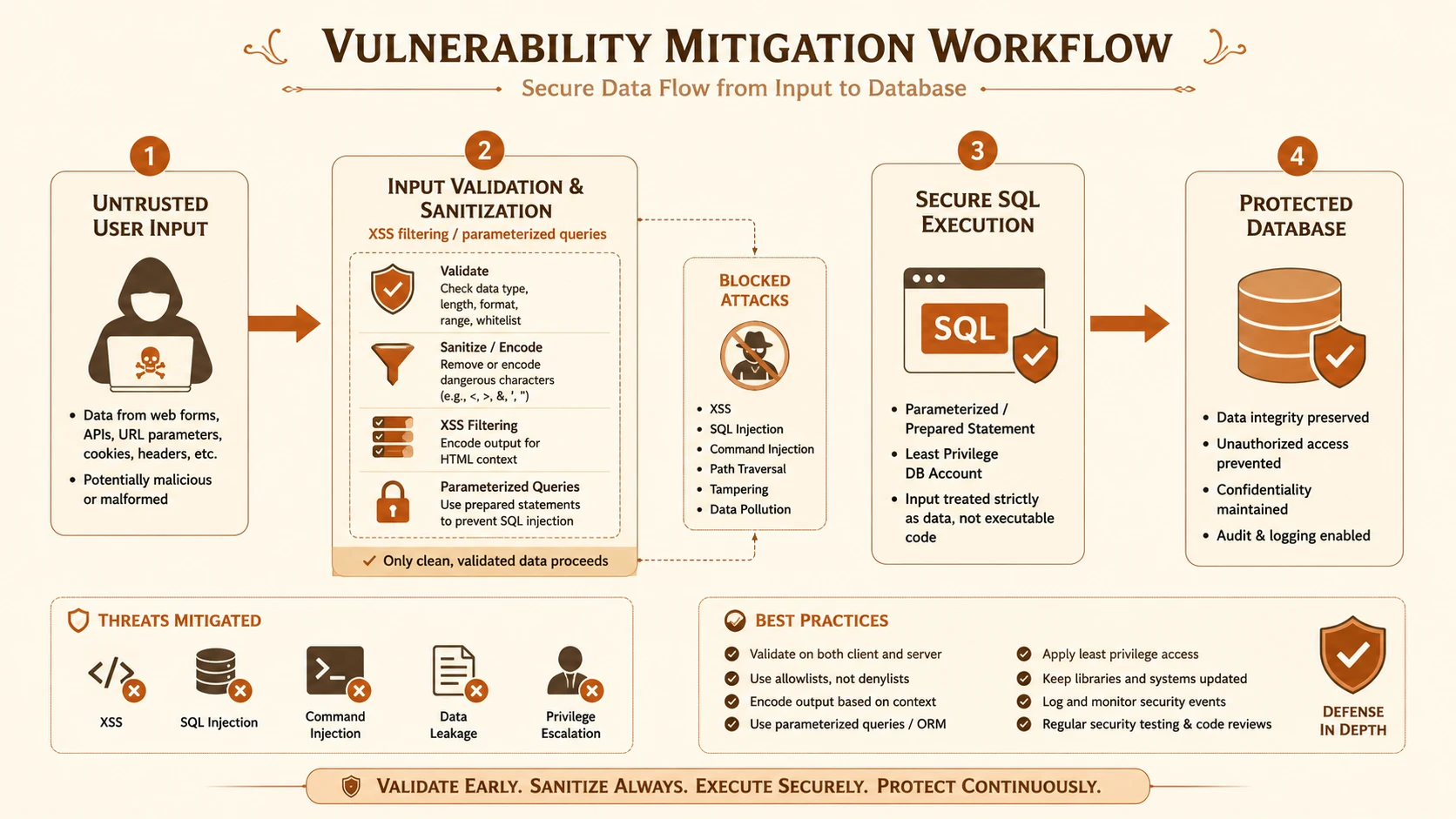
System architecture diagram and conceptual workflow layout for The OWASP Top 10 for 2010.
Proper output encoding significantly reduces this risk.
SQL Injection vs XSS
| Characteristic | SQL Injection | Cross-Site Scripting |
|---|---|---|
| Primary Target | Database | Browser |
| Execution Location | Server | Client |
| Typical Goal | Access or modify data | Execute malicious scripts |
| Main Cause | Dynamic SQL | Unencoded output |
| Primary Defense | Parameterized queries | Output encoding |
| Risk | Data compromise | User compromise |
Although technically different, both vulnerabilities originate from insufficient handling of untrusted input.
Secure Development Practices
Organizations should integrate security throughout the Software Development Lifecycle (SDLC).
Recommended practices include:
- ◆Security requirements during project planning
- ◆Threat modeling during architecture design
- ◆Secure coding standards
- ◆Code reviews
- ◆Static analysis where available
- ◆Penetration testing
- ◆Security regression testing
Security should become a continuous engineering activity rather than a final testing phase.
Architecture Considerations
Enterprise architects should avoid relying on a single defensive layer.
A layered security architecture may resemble:
Users
   |
Web Browser
   |
Load Balancer
   |
Web Server
   |
Application Layer
   |
Input Validation
   |
Business Logic
   |
Parameterized Database Access
   |
Database Server
Each layer contributes to reducing overall application risk.
Enterprise Use Cases
Online Banking
Financial institutions must protect authentication systems and transaction processing against SQL Injection while ensuring customer portals properly encode user-generated content.
Healthcare Applications
Electronic medical record systems contain highly sensitive patient information. Strong database protections and secure session management are essential.
E-Commerce Platforms
Retail systems frequently process product reviews, shopping carts, payment information, and customer accounts, making them common targets for Injection and XSS attacks.
Government Portals
Public-facing services handling citizen records should implement secure coding standards alongside comprehensive security testing.
Best Practices
Organizations seeking to reduce application security risks should adopt several core practices.
- ◆Use parameterized queries exclusively.
- ◆Validate all user input.
- ◆Encode all output before rendering HTML.
- ◆Apply least privilege to database accounts.
- ◆Store credentials securely.
- ◆Use HTTPS for sensitive applications.
- ◆Review source code regularly.
- ◆Conduct penetration testing before production deployment.
- ◆Patch frameworks and application servers promptly.
- ◆Educate developers on secure coding principles.
Common Mistakes
Many successful attacks exploit preventable implementation errors.
Trusting Client-Side Validation
JavaScript validation improves usability but cannot replace server-side validation.
Displaying Detailed Error Messages
Verbose database exceptions may reveal table names, query structures, or configuration details useful to attackers.
Building SQL Dynamically
Even simple string concatenation introduces unnecessary risk.
Ignoring User-Generated Content
Comments, forums, and profile pages often become entry points for Stored XSS attacks if output encoding is overlooked.
Delaying Security Testing
Finding Injection vulnerabilities after deployment significantly increases remediation costs.
Integrating Security into Development Teams
Enterprise organizations should encourage collaboration between developers, architects, quality assurance teams, and security specialists.
Recommended organizational practices include:
- ◆Secure coding training
- ◆Security-focused design reviews
- ◆Application threat modeling
- ◆Periodic vulnerability assessments
- ◆Security checklists for code reviews
- ◆Incident response planning
Security becomes considerably more effective when it is treated as a shared engineering responsibility.
Evaluating Existing Applications
Many organizations maintain applications developed several years ago using older frameworks and coding standards. These systems deserve careful review because they may predate modern secure development guidance.
Priority should be given to:
- ◆Internet-facing applications
- ◆Customer portals
- ◆Financial systems
- ◆Administrative interfaces
- ◆Applications handling confidential business information
Security assessments should identify high-risk vulnerabilities before new features are introduced.
Looking Ahead
Application security continues to receive increasing attention as enterprises expand their reliance on web-based systems. The OWASP Top 10 provides an effective framework for prioritizing security improvements and fostering awareness among development teams.
As organizations continue evaluating their software development practices throughout 2010, SQL Injection and Cross-Site Scripting should remain among the highest remediation priorities. By adopting secure coding standards, performing regular security testing, implementing layered defenses, and integrating security into every phase of the development lifecycle, enterprises can significantly reduce their exposure to common application attacks while building greater confidence in their web applications.