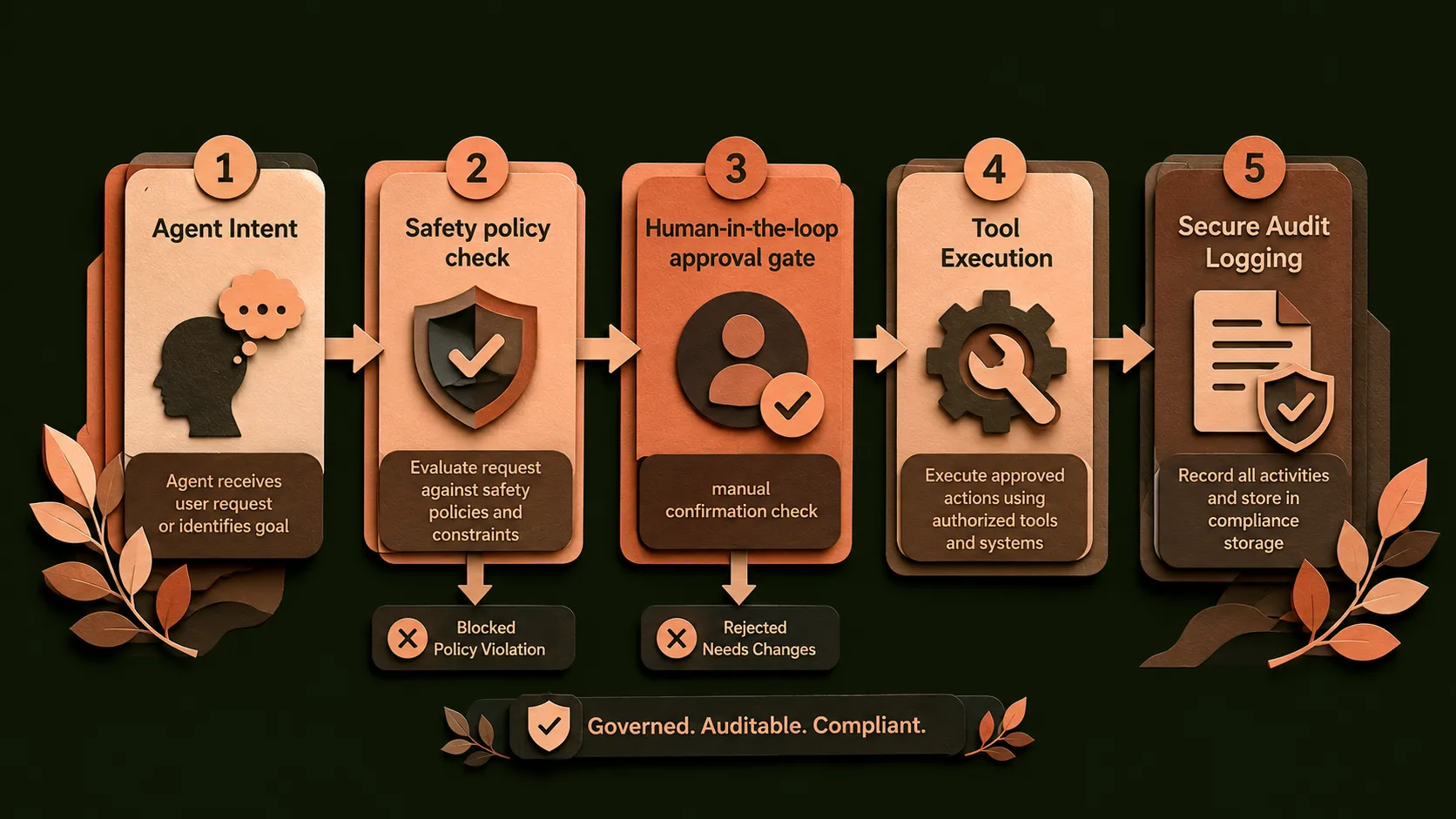
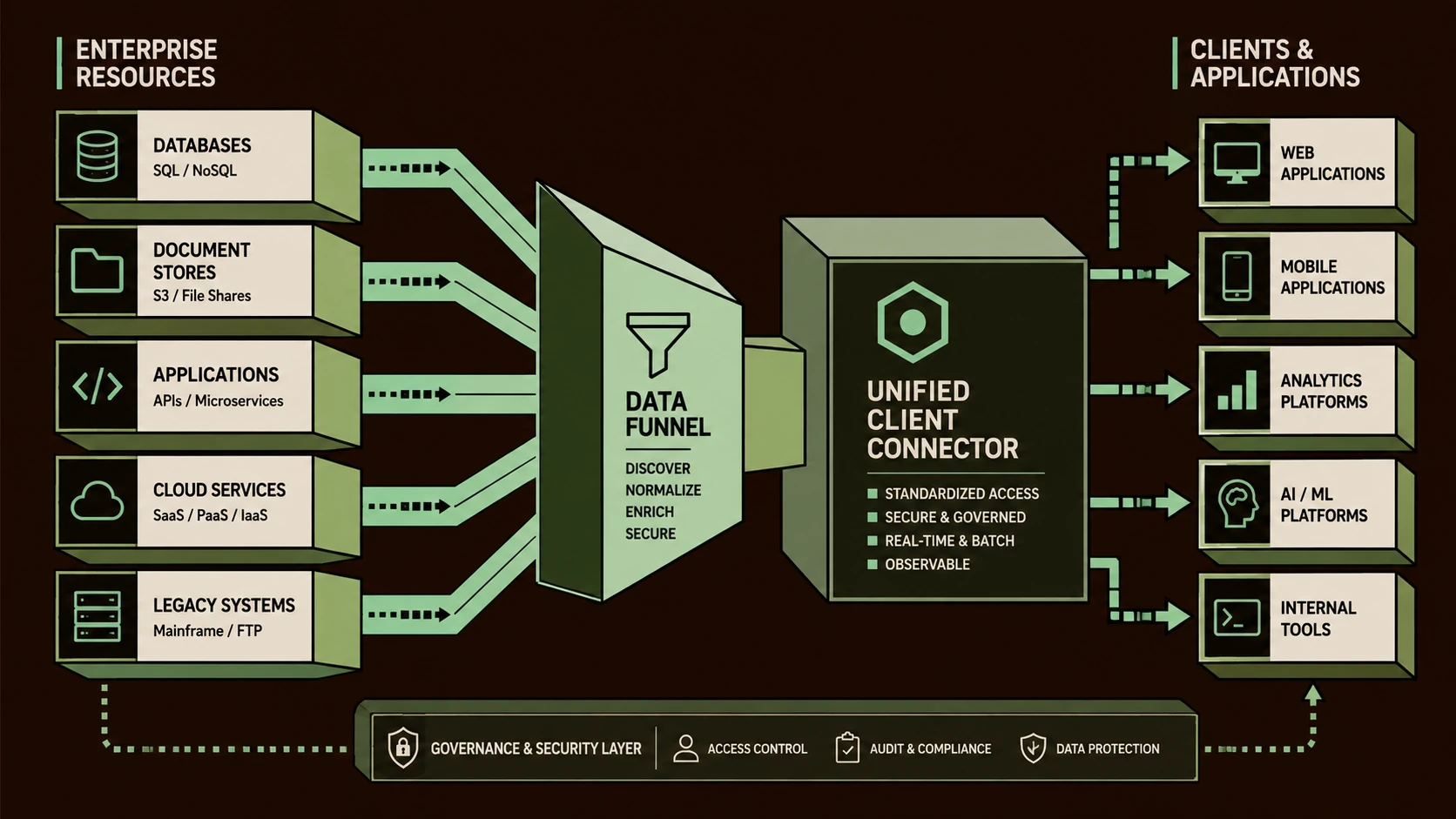
Imagine a symphony orchestra where every musician is a virtuoso, yet they play without a conductor, without sheet music, and without any shared understanding of the piece. The result, despite individual brilliance, would be chaos. This vivid analogy perfectly describes the current challenge facing many enterprises deploying advanced AI agents.
While individual AI agents, powered by large language models (LLMs) and advanced Tool Calling capabilities, are becoming incredibly intelligent and capable, their true enterprise value often remains elusive without a robust framework to coordinate their efforts. The emergent behavior of unmanaged agents can be unpredictable, leading to inconsistent results, increased operational costs, and a significant barrier to reliable AI automation. This is precisely where the discipline of Multi-Agent Orchestration becomes indispensable.
Driven by recent advancements in Generative AI and the increasing sophistication of agentic AI frameworks like LangChain, CrewAI, and AutoGen, the need for structured agent interaction is more critical than ever. As we push AI beyond simple chatbots into complex problem-solving, decision-making, and automation, understanding how to effectively orchestrate multiple agents is the difference between a proof-of-concept and a production-ready solution. This article dives deep into the five fundamental patterns of Multi-Agent Orchestration, providing architects and engineers with the blueprints to build scalable, reliable, and intelligent enterprise AI systems.
The Orchestration Imperative: Why Multi-Agent Systems Demand Structure
Why can't intelligent agents just figure things out on their own? While impressive in isolation, autonomous agents often struggle with coherence and consistency when tackling multifaceted problems. Without a guiding hand, they might duplicate efforts, contradict each other, get stuck in loops, or fail to pass critical Context Management, leading to suboptimal outcomes.
Consider an enterprise workflow for processing customer complaints. An agent might identify the issue, but then another agent needs to fetch account details from a Vector Database, a third to check product history, and a fourth to draft a personalized response. If these agents operate independently, the process becomes fragmented and inefficient. Multi-Agent Orchestration provides the necessary structure to define roles, manage communication, sequence tasks, and ensure that the collective intelligence surpasses the sum of individual agent capabilities.
This structured approach is vital for several reasons:
- ◆Predictability and Reliability: Ensures consistent output and behavior, crucial for production systems and auditing.
- ◆Efficiency: Optimizes resource utilization by preventing redundant tasks and streamlining workflows, reducing costly LLM calls.
- ◆Scalability: Allows for the addition or removal of agents without disrupting the entire system, enabling growth.
- ◆Maintainability: Simplifies debugging and updates by compartmentalizing agent responsibilities and interactions.
- ◆Cost Optimization: Reduces unnecessary LLM calls and computational resources by orchestrating tasks intelligently.
Effective Multi-Agent Orchestration is not just about connecting agents; it's about designing a system that can adapt, learn, and perform complex tasks reliably in dynamic enterprise environments.
Pattern 1: Sequential Orchestration — The AI Assembly Line
When your problem can be broken down into a series of distinct, ordered steps where the output of one directly feeds into the next, Sequential Orchestration is the most straightforward pattern. It's the simplest and often the starting point for multi-agent systems, resembling an assembly line where each agent performs a specific, focused function.
In this pattern, agents execute tasks one after another in a predefined order. Agent A completes its task, passes its result to Agent B, which then processes it and passes it to Agent C, and so on. This pattern is highly predictable and easy to debug, as the flow of information is linear and explicit. It's ideal for well-defined, step-by-step processes.
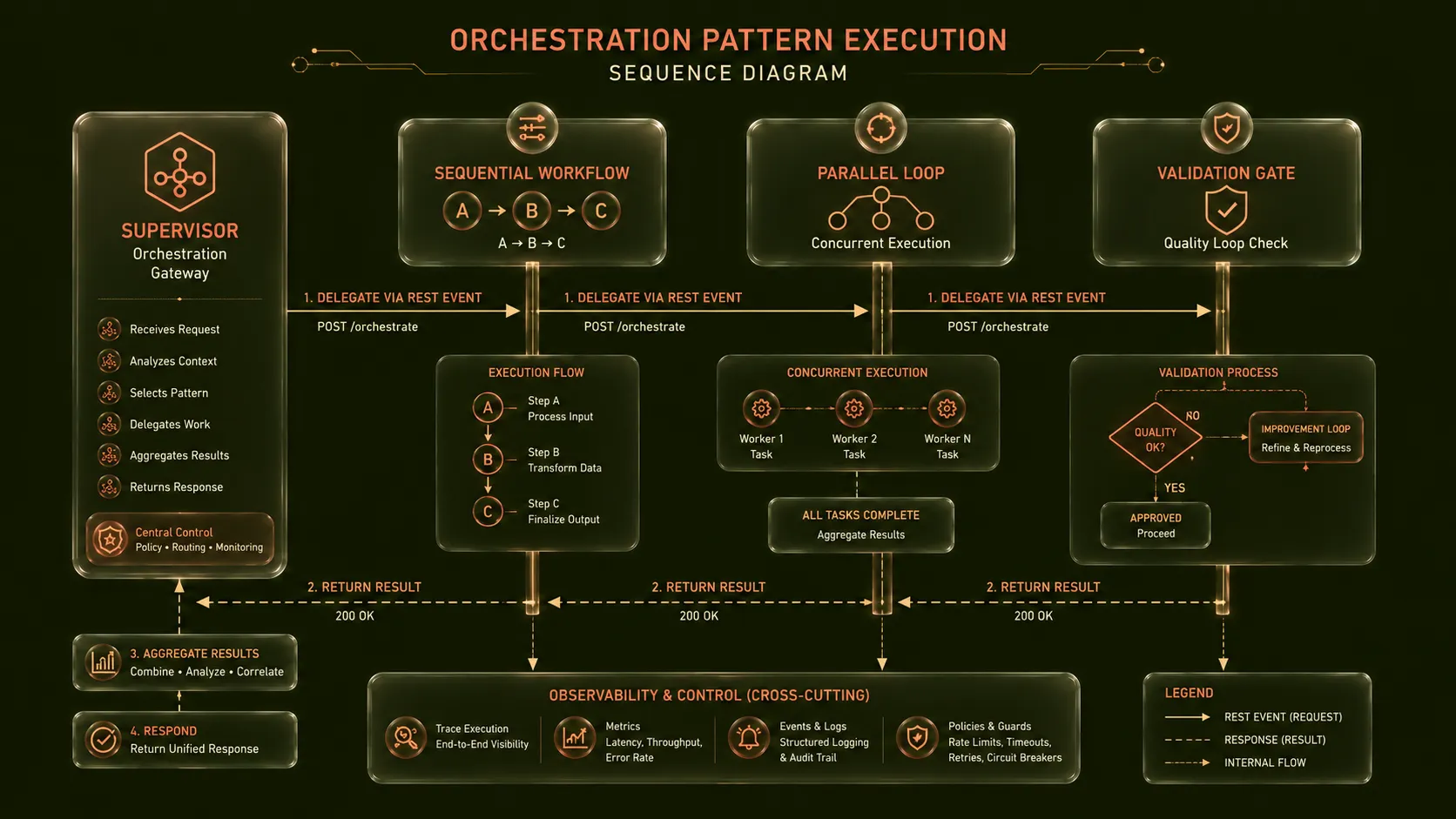
The 5 Patterns of Multi-Agent Orchestration: Sequential, Parallel, Hierarchical, Handoff, and Loop
Use Cases:
- ◆Document Processing: Extract entities -> Summarize text -> Classify sentiment -> Generate report.
- ◆Content Generation: Outline article -> Draft sections -> Review and edit -> Publish.
- ◆Data Transformation: Fetch raw data -> Clean data -> Enrich data (e.g., via Vector Database lookup) -> Store data.
Architectural Considerations:
- ◆Clear Interfaces: Each agent must have well-defined inputs and outputs to ensure smooth data transfer.
- ◆Robust Error Handling: A failure at any step can halt the entire pipeline. Implement comprehensive error handling and retry mechanisms.
- ◆Context Management: Ensure relevant context is passed efficiently between agents without exceeding LLM token limits. This often involves summarizing previous steps or using a shared Vector Database for persistent context.
from langchain.agents import AgentExecutor, create_react_agent
from langchain_core.prompts import ChatPromptTemplate
from langchain_community.llms import OpenAI # Or any other LLM provider
from langchain.tools import tool

# Define simple tools for demonstration
@tool
def analyze_sentiment(text: str) -> str:
    """Analyzes the sentiment of the input text (positive, negative, neutral)."""
    # In a real scenario, this would call a sophisticated NLP model or LLM
    if "great" in text.lower() or "happy" in text.lower():
        return "positive"
    elif "bad" in text.lower() or "unhappy" in text.lower():
        return "negative"
    return "neutral"

@tool
def summarize_text(text: str) -> str:
    """Summarizes the input text into a concise overview."""
    # In a real scenario, this would call an LLM for summarization
    return f"Summary of: {text[:50]}..."

# Initialize LLM
llm = OpenAI(temperature=0.7) # Consider using a specific model like 'gpt-3.5-turbo'

# Agent 1: Summarizer Agent
summarizer_prompt = ChatPromptTemplate.from_messages([
    ("system", "You are an expert summarizer. Summarize the user's input concisely."),
    ("human", "{input}")
])
summarizer_agent_executor = AgentExecutor(agent=create_react_agent(llm, [summarize_text], summarizer_prompt), tools=[summarize_text], verbose=True)

# Agent 2: Sentiment Analyzer Agent
sentiment_prompt = ChatPromptTemplate.from_messages([
    ("system", "You are a sentiment analysis expert. Determine the sentiment of the text (positive, negative, neutral)."),
    ("human", "{input}")
])
sentiment_agent_executor = AgentExecutor(agent=create_react_agent(llm, [analyze_sentiment], sentiment_prompt), tools=[analyze_sentiment], verbose=True)

def sequential_workflow(initial_input: str):
    print(f"\
--- Starting Sequential Workflow with: {initial_input[:70]}... ---")

    # Step 1: Summarize the initial input
    print("\
--- Summarizer Agent: Processing initial input ---")
    summary_result = summarizer_agent_executor.invoke({"input": initial_input})
    summary = summary_result['output']
    print(f"Summarizer Output: {summary}")

    # Step 2: Analyze the sentiment of the generated summary
    print("\
--- Sentiment Analyzer Agent: Processing summary ---")
    sentiment_result = sentiment_agent_executor.invoke({"input": summary})
    sentiment = sentiment_result['output']
    print(f"Sentiment Analyzer Output: {sentiment}")

    return {"summary": summary, "sentiment": sentiment}

# Example Usage
text_to_process = "The new product launch was a great success. Customers are very happy with the features, though some minor bugs were reported. Overall, a positive reception, but areas for improvement exist."
final_result = sequential_workflow(text_to_process)
print(f"\
Final Workflow Result: {final_result}")
Pattern 2: Parallel Orchestration — Concurrency for Speed and Breadth
When multiple parts of a problem can be solved simultaneously without direct dependencies, Parallel Orchestration allows agents to work concurrently, dramatically accelerating overall task completion. Instead of a linear flow, tasks fan out, are processed in parallel, and then their results are aggregated by a coordinating mechanism or agent.
This pattern is highly effective for tasks that involve querying multiple data sources, generating diverse ideas, or performing independent analyses. The main challenge lies in effectively merging the results from concurrent operations and handling potential conflicts or inconsistencies, often requiring a final synthesis step by an LLM.
Use Cases:
- ◆Information Retrieval: Query multiple knowledge bases, web APIs, or Vector Databases simultaneously for a comprehensive view.
- ◆Idea Generation: Brainstorm different solutions or creative concepts from various specialized agent perspectives.
- ◆Comparative Analysis: Analyze competitor products based on different criteria (e.g., features, pricing, user reviews) in parallel.
Architectural Considerations:
- ◆Result Aggregation: A coordinating agent or mechanism is needed to collect, deduplicate, and synthesize results from parallel agents.
- ◆Synchronization: Ensure all parallel tasks are completed before proceeding to the next stage of the workflow.
- ◆Resource Management: Efficiently manage computational resources and LLM API quotas for concurrent agent execution to avoid bottlenecks and cost overruns.
import asyncio
from langchain.agents import AgentExecutor, create_react_agent
from langchain_core.prompts import ChatPromptTemplate
from langchain_community.llms import OpenAI # Or any other LLM provider
from langchain.tools import tool

# Define tools (async for parallel execution)
@tool
async def fetch_news(topic: str) -> str:
    """Fetches recent news articles on a given topic."""
    print(f"Fetching news for: {topic}...")
    await asyncio.sleep(1) # Simulate API call delay
    return f"Recent news about {topic}: Article A (new tech), Article B (market trends), Article C (regulatory updates)"

@tool
async def fetch_social_media_trends(topic: str) -> str:
    """Fetches social media trends and discussions for a topic."""
    print(f"Fetching social media trends for: {topic}...")
    await asyncio.sleep(1) # Simulate API call delay
    return f"Social media trends for {topic}: High engagement on #AIethics, trending discussions on {topic} applications, influencer mentions."

# Initialize LLM
llm = OpenAI(temperature=0.7) # Consider using a specific model like 'gpt-3.5-turbo'

# Agent 1: News Aggregator (Conceptual LangChain agent)
news_prompt = ChatPromptTemplate.from_messages([
    ("system", "You are a news aggregator. Fetch and summarize key news for the given topic."),
    ("human", "{input}")
])
news_agent_executor = AgentExecutor(agent=create_react_agent(llm, [fetch_news], news_prompt), tools=[fetch_news], verbose=True)

# Agent 2: Social Media Trend Analyzer (Conceptual LangChain agent)
social_prompt = ChatPromptTemplate.from_messages([
    ("system", "You are a social media trend analyzer. Get and analyze trends for the topic."),
    ("human", "{input}")
])
social_agent_executor = AgentExecutor(agent=create_react_agent(llm, [fetch_social_media_trends], social_prompt), tools=[fetch_social_media_trends], verbose=True)

async def parallel_workflow(topic: str):
    print(f"\
--- Starting Parallel Workflow for topic: {topic} ---")

    # Run agents concurrently using ainvoke (asynchronous invoke)
    # Note: LangChain's ainvoke is designed for this.
    # For true concurrent execution of multiple AgentExecutors,
    # you'd typically manage their tasks directly with asyncio.gather.
    news_task = news_agent_executor.ainvoke({"input": topic})
    social_task = social_agent_executor.ainvoke({"input": topic})

    # Await both tasks to complete
    news_result, social_result = await asyncio.gather(news_task, social_task)

    news_output = news_result['output']
    social_output = social_result['output']

    print(f"\
News Aggregator Output: {news_output}")
    print(f"Social Media Analyzer Output: {social_output}")

    # Aggregate results (e.g., by another agent or simple string concatenation)
    combined_analysis = f"Combined Report for {topic}:\
\
News Insights:\
{news_output}\
\
Social Media Insights:\
{social_output}"
    print(f"\
--- Combined Analysis ---\
{combined_analysis}

**The 5 Patterns Of Multi-Agent Orchestration: Sequential, Parallel, Hierarchical, Handoff, And Loop** plays a vital role in modern IT and AI-driven digital transformation.