Introduction
JavaScript has become the foundation of modern web application development. From browser-based enterprise dashboards to cloud-hosted APIs, desktop applications, and mobile frameworks, JavaScript now powers software across nearly every computing environment. While its flexibility has contributed to widespread adoption, large enterprise applications frequently encounter maintainability challenges resulting from dynamic typing, evolving APIs, and increasingly complex architectures.
TypeScript addresses these challenges by introducing a statically analyzable type system that builds upon standard JavaScript without changing its runtime behavior. Over the past several releases, TypeScript has steadily expanded its type system while maintaining compatibility with the broader JavaScript ecosystem.
TypeScript 3.1 continues this progression through refinements focused on developer productivity rather than disruptive language redesign. The release improves mapped types for tuples and arrays, enhances support for assigning properties to functions, delivers compiler performance optimizations, and further strengthens tooling for large codebases.
From the perspective of November 2018, TypeScript 3.1 represents another important step toward making large-scale JavaScript development more maintainable, predictable, and efficient for enterprise engineering teams.
Industry Background
Enterprise software increasingly depends upon JavaScript and TypeScript.
Organizations commonly develop:
- ◆Single Page Applications.
- ◆Enterprise dashboards.
- ◆Cloud management platforms.
- ◆Node.js backend services.
- ◆Progressive Web Applications.
- ◆Internal business portals.
- ◆Component libraries.
These applications often contain:
- ◆Hundreds of modules.
- ◆Shared business logic.
- ◆Large engineering teams.
- ◆Continuous Integration pipelines.
- ◆Long-term maintenance requirements.
Static analysis and strong tooling have therefore become essential for maintaining software quality at enterprise scale.
The Business Problem
Large JavaScript applications frequently encounter several engineering challenges.
Organizations commonly experience:
- ◆Difficult refactoring.
- ◆Runtime type errors.
- ◆Long compilation times.
- ◆Complex generic types.
- ◆Large dependency graphs.
- ◆Reduced IDE productivity.
- ◆Increasing maintenance costs.
As projects continue growing, developer productivity depends not only on language expressiveness but also on compiler responsiveness and predictable type checking.
TypeScript 3.1 addresses these concerns through both language and tooling improvements.
Understanding the Technology
TypeScript is a statically typed superset of JavaScript.
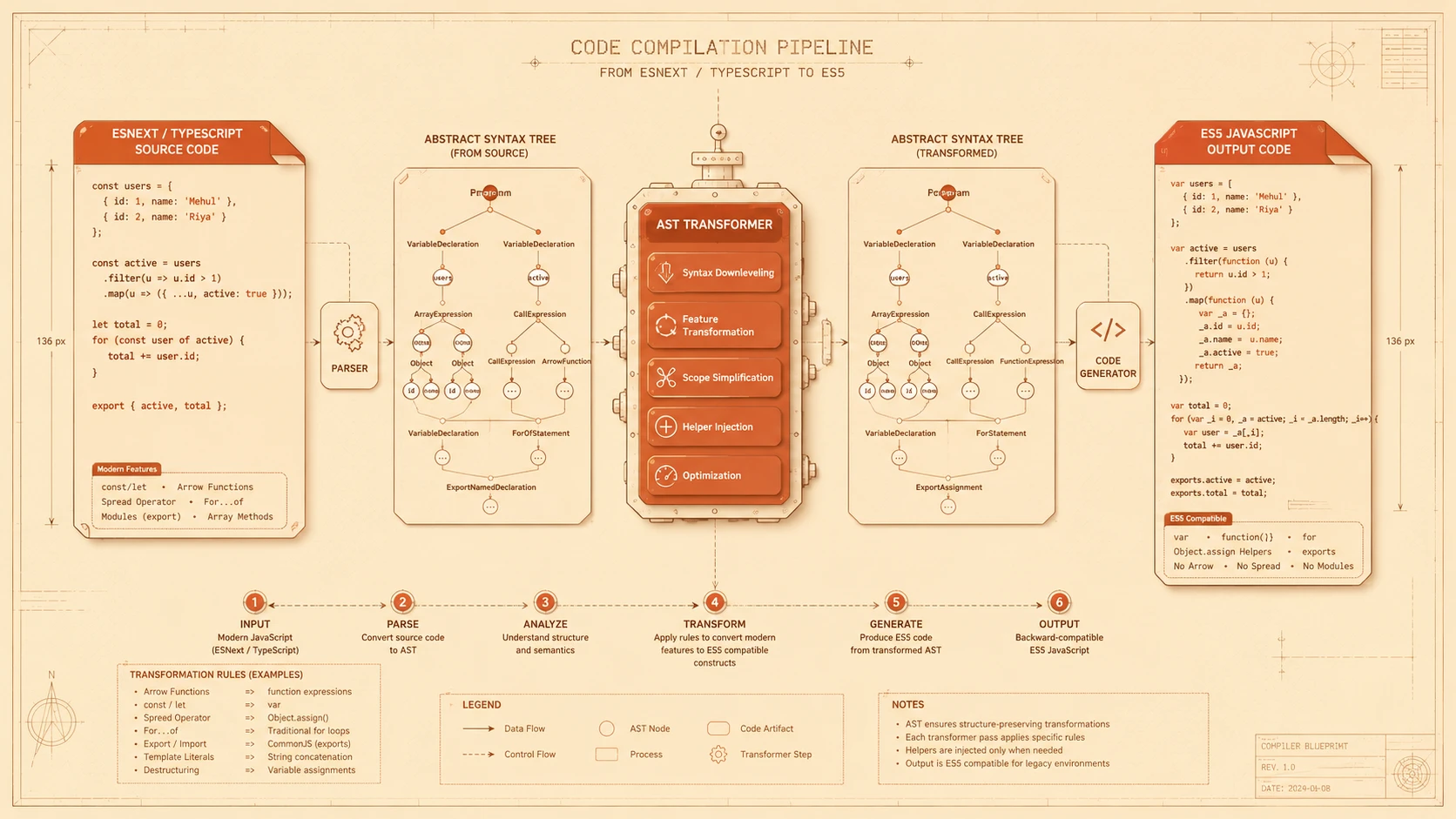
Applications are compiled into standard JavaScript while preserving compatibility with existing JavaScript runtimes.
TypeScript 3.1 introduces several important improvements.
Major enhancements include:
- ◆Improved mapped types.
- ◆Better tuple and array transformations.
- ◆Function property declarations.
- ◆Compiler performance improvements.
- ◆Enhanced language services.
- ◆Better editor responsiveness.
- ◆Continued ECMAScript compatibility.
These refinements improve both developer productivity and code maintainability.
Core Architecture
A simplified TypeScript development architecture appears below.
| Component | Responsibility |
|---|---|
| TypeScript Source Code | Application implementation |
| TypeScript Compiler | Parsing, type checking, transpilation |
| Type System | Compile-time validation |
| JavaScript Output | Runtime execution |
| Browser or Node.js | Application runtime |
| IDE Language Service | Code analysis and tooling |
The compiler validates types during development while producing standard JavaScript for deployment.
Key Features
Improved Mapped Types for Tuples and Arrays
One of the most significant improvements in TypeScript 3.1 is enhanced mapped type behavior for tuples and arrays.
Mapped types previously worked well with object types but were less intuitive when applied to tuple structures.
Version 3.1 improves this behavior by preserving tuple characteristics during transformations, allowing developers to create more expressive generic utility types without losing structural information.
This enhancement benefits frameworks and libraries that rely heavily on advanced generic programming.
Function Property Declarations
JavaScript commonly treats functions as objects capable of containing additional properties.
TypeScript 3.1 improves support for these programming patterns, making it easier to model widely used JavaScript APIs while maintaining compile-time type safety.
This refinement simplifies interoperability with existing JavaScript libraries.
Compiler Performance Improvements
Large enterprise applications often spend significant time during compilation.
TypeScript 3.1 introduces compiler optimizations that improve build responsiveness, particularly for projects containing extensive type definitions and dependency relationships.
Faster compilation contributes directly to developer productivity.
Improved Language Service
Editor tooling continues improving through enhancements to the TypeScript language service.
Developers benefit from:
- ◆Faster code completion.
- ◆Better navigation.
- ◆Improved error reporting.
- ◆More responsive editing.
These capabilities reduce development friction within large projects.
Better Generic Programming
The refinements to mapped types improve the expressiveness of generic utility libraries.
Developers can write reusable abstractions while preserving accurate type information across increasingly sophisticated codebases.
JavaScript Compatibility
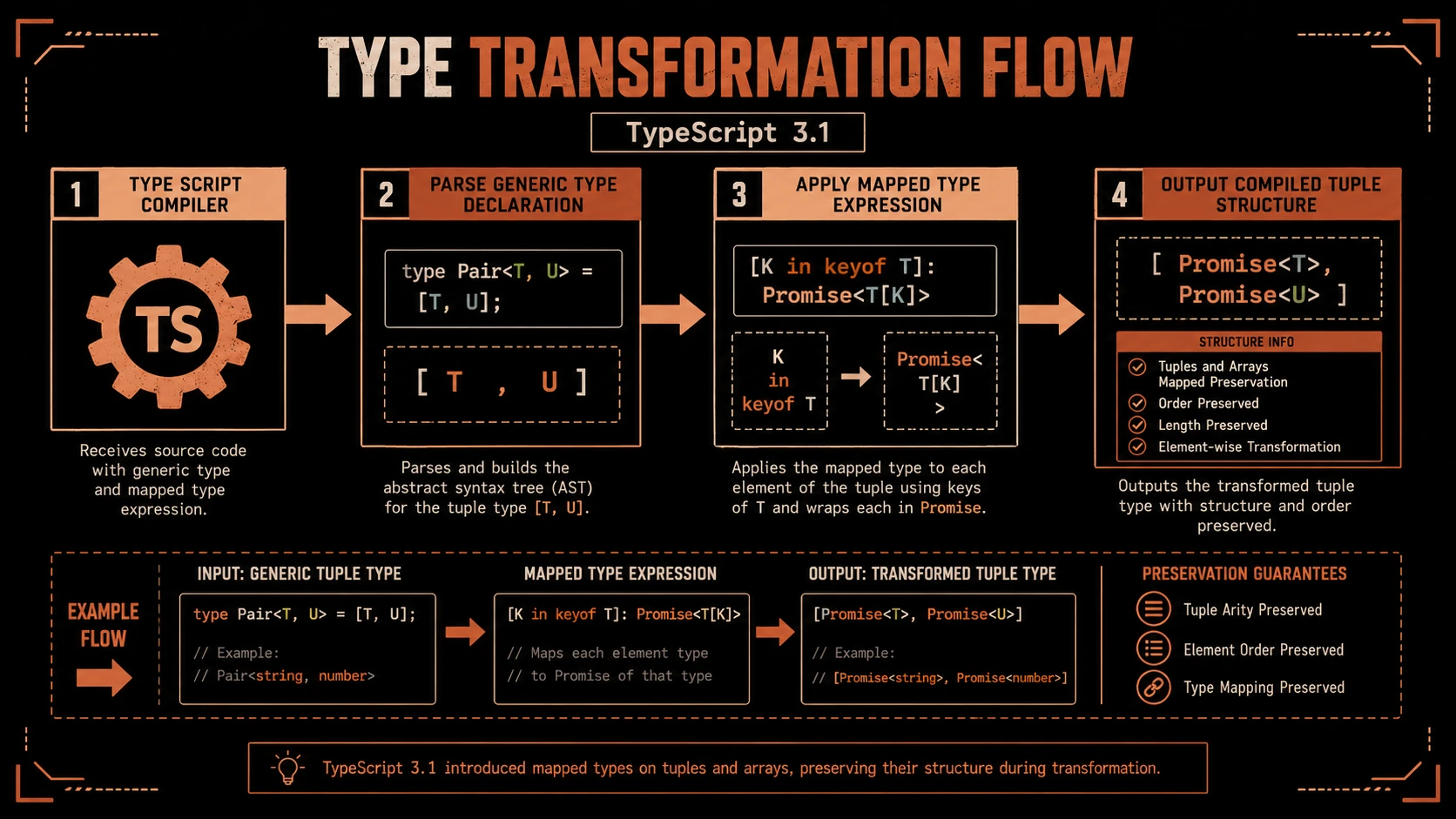
System architecture diagram and conceptual workflow layout for TypeScript 3.1: Mapped Types, Generic Parameter Tuples, and Compile Speeds.
TypeScript continues preserving complete compatibility with standard JavaScript.
Organizations can introduce static typing incrementally without abandoning existing JavaScript investments.
How It Works
A simplified compilation workflow appears below.
TypeScript Source
         |
TypeScript Compiler
         |
Type Checking
         |
Mapped Type Analysis
         |
JavaScript Output
         |
Browser or Node.js
Compile-time validation improves software quality while generated JavaScript executes normally across supported runtimes.
Enterprise Use Cases
Enterprise Web Applications
Large React, Angular, and Vue applications benefit from stronger type safety and improved maintainability.
Shared Component Libraries
Reusable UI libraries gain more expressive generic type definitions while preserving developer ergonomics.
Node.js Services
Backend applications benefit from compile-time validation and improved development tooling.
API Development
Strong typing simplifies maintenance of service contracts across distributed systems.
Continuous Integration
Compiler performance improvements reduce build times within automated development pipelines.
Performance Considerations
TypeScript 3.1 focuses primarily on development performance rather than runtime execution.
Organizations should evaluate:
- ◆Incremental compilation speed.
- ◆Full project build duration.
- ◆IDE responsiveness.
- ◆Type checking complexity.
- ◆Generic type evaluation.
- ◆Continuous Integration throughput.
Faster compiler execution improves engineering productivity without affecting generated JavaScript behavior.
Security Considerations
TypeScript contributes to software reliability but does not replace secure application design.
Organizations should continue implementing:
- ◆Authentication.
- ◆Authorization.
- ◆Input validation.
- ◆Dependency management.
- ◆Secure API communication.
- ◆Secure deployment practices.
Compile-time type checking complements broader secure software engineering practices.
Scalability
TypeScript 3.1 strengthens enterprise scalability by improving both language expressiveness and development workflows.
Advantages include:
- ◆Stronger generic abstractions.
- ◆Better maintainability.
- ◆Faster compilation.
- ◆Improved editor tooling.
- ◆Easier large-team collaboration.
These characteristics become increasingly valuable as applications continue expanding.
Best Practices
Organizations adopting TypeScript 3.1 should:
- ◆Standardize TypeScript versions across projects.
- ◆Use mapped types for reusable utility definitions.
- ◆Keep generic abstractions understandable.
- ◆Benchmark compiler performance after upgrades.
- ◆Integrate type checking into Continuous Integration pipelines.
- ◆Enable strict compiler options where practical.
- ◆Maintain updated type definitions for third-party libraries.
Consistent coding standards maximize the benefits of TypeScript's evolving type system.
Common Mistakes
| Mistake | Business Impact |
|---|---|
| Creating unnecessarily complex generic types | Reduced maintainability |
| Ignoring compiler diagnostics | Increased production defects |
| Delaying compiler upgrades | Missed tooling improvements |
Using any excessively | Reduced type safety |
| Measuring only runtime performance | Overlooking developer productivity gains |
| Skipping build performance benchmarking | Inaccurate engineering planning |
Effective TypeScript adoption balances expressive type systems with code readability and maintainability.
Technology Comparison
| Characteristic | TypeScript 3.0 | TypeScript 3.1 |
|---|---|---|
| Mapped Types | General object support | Improved tuple and array handling |
| Function Properties | Basic support | Improved JavaScript interoperability |
| Compiler Performance | Mature | Further optimized |
| Language Service | Strong tooling | Faster and more responsive |
| Enterprise Development | Large-scale support | Improved productivity for large projects |
TypeScript 3.1 refines existing capabilities rather than introducing disruptive language changes.
Adoption Strategy
Organizations should adopt TypeScript 3.1 through structured upgrades.
- 1.Upgrade the TypeScript compiler across development environments.
- 2.Validate third-party type definitions.
- 3.Benchmark build and Continuous Integration performance.
- 4.Review reusable generic utility types.
- 5.Standardize compiler configuration across engineering teams.
- 6.Expand adoption after validating production build pipelines.
This incremental strategy minimizes operational risk while allowing organizations to benefit from improved tooling and compiler performance.
Limitations
As of November 2018, organizations should recognize several considerations.
- ◆Advanced generic programming still requires experienced TypeScript developers.
- ◆Compiler improvements vary depending on project structure.
- ◆Existing JavaScript interoperability should be validated during upgrades.
- ◆Development teams should avoid unnecessary type complexity.
- ◆Enterprise projects should benchmark compilation performance before organization-wide migration.
These considerations should guide enterprise modernization planning.
Looking Ahead
From the perspective of November 2018, TypeScript 3.1 reinforces Microsoft's commitment to making JavaScript development increasingly suitable for large-scale enterprise software. Rather than pursuing disruptive language redesigns, this release focuses on practical engineering improvements through stronger mapped types, better support for common JavaScript programming patterns, faster compilation, and enhanced development tooling.
As enterprise applications continue expanding in size and complexity, improvements to compiler performance and type system expressiveness become just as valuable as new language features. Organizations building long-lived React, Angular, Vue, and Node.js applications should view TypeScript 3.1 as another important step toward a more productive, maintainable, and scalable JavaScript development ecosystem.