
Introduction
Vue.js has established itself as one of the most approachable JavaScript frameworks for building modern web applications. Its component model, reactive data system, and incremental adoption strategy have made it popular among startups and enterprise development teams alike.
As Vue applications continue growing in size, developers increasingly encounter architectural challenges involving reusable business logic, component complexity, testing, and long-term maintainability. Although Mixins, Higher-Order Components, and scoped slots provide mechanisms for sharing functionality, they often introduce naming conflicts, implicit dependencies, and code that becomes difficult to follow in large projects.
To address these challenges, Evan You introduced the Vue 3.0 Composition API RFC. Rather than replacing Vue's existing programming model, the RFC proposes an alternative approach that allows developers to organize code by business capability instead of lifecycle option.
Because this is an RFC, the design remains open for community discussion and refinement. Enterprise architects should therefore evaluate the proposal as an emerging direction rather than a finalized framework feature.
Industry Background
Modern enterprise front-end applications increasingly include:
- ◆Single Page Applications
- ◆Customer portals
- ◆Enterprise dashboards
- ◆E-commerce platforms
- ◆Administrative systems
- ◆Progressive Web Applications
- ◆Mobile-first interfaces
- ◆Component libraries
As projects expand, organizing reusable logic becomes increasingly important.
The Business Problem
Large Vue applications frequently experience:
- ◆Oversized components
- ◆Repeated business logic
- ◆Difficult testing
- ◆Lifecycle logic scattered across components
- ◆Mixins becoming difficult to maintain
- ◆Reduced code readability
Organizations require a cleaner approach for composing reusable application behavior.
Understanding the Composition API RFC
The Composition API proposes a new way of writing Vue components.
Instead of separating logic into data, methods, computed, and lifecycle hooks, related functionality can be grouped together within a composition function.
Primary objectives include:
- ◆Better code organization
- ◆Reusable business logic
- ◆Improved TypeScript compatibility
- ◆Easier testing
- ◆Greater scalability
- ◆Incremental adoption
The familiar Options API continues to be supported alongside this proposal.
Core Architecture
| Component | Responsibility |
|---|---|
| setup() | Entry point for composition logic |
| Reactive State | Holds application state |
| Computed Values | Derived data |
| Watchers | Respond to state changes |
| Lifecycle Hooks | Manage component lifecycle |
| Composition Functions | Encapsulate reusable logic |
This structure encourages grouping related behavior together rather than distributing it across multiple component options.
How the Composition API Works
- 1.Vue creates the component instance.
- 2.The
setup()function executes. - 3.Reactive state is initialized.
- 4.Composition functions expose reusable logic.
- 5.Computed values and watchers respond to state updates.
- 6.Lifecycle hooks coordinate component behavior.
- 7.Vue renders the updated user interface.
Key Features
Logic Grouping
Business functionality can be organized by feature instead of framework option, making complex components easier to understand.
Reusable Composition Functions
// Custom Composition Function (composable) using reactive state in Vue 3
import { ref, onMounted, onUnmounted } from 'vue';

export function useMousePosition() {
  const x = ref(0);
  const y = ref(0);

  function update(event) {
    x.value = event.pageX;
    y.value = event.pageY;
  }

  onMounted(() => window.addEventListener('mousemove', update));
  onUnmounted(() => window.removeEventListener('mousemove', update));

  return { x, y };
}
Reusable logic can be extracted into standalone functions without relying on Mixins.
Improved TypeScript Experience
The proposal is designed to work more naturally with TypeScript's type inference and tooling.
Explicit Dependencies
Composition functions make dependencies easier to understand than implicit Mixin behavior.
Incremental Adoption
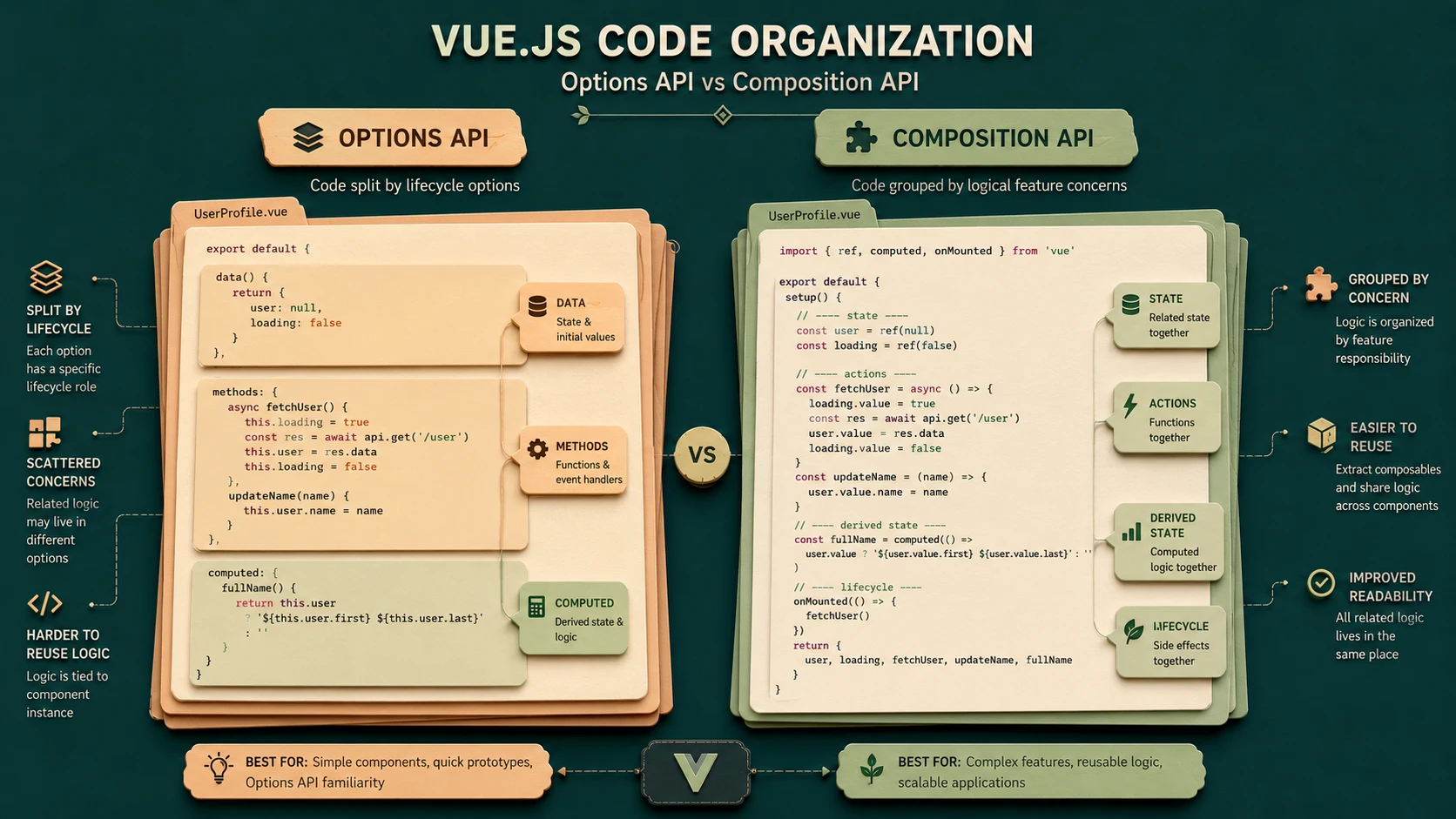
System architecture diagram and conceptual workflow layout for Vue.js 3.0 Composition API RFC.
Because the proposal complements the Options API, existing Vue applications are not required to migrate immediately.
Enterprise Use Cases
Large Dashboards
Reusable filtering, pagination, and authentication logic can be shared across multiple components.
Component Libraries
Common behaviors become easier to package into reusable composition functions.
Business Applications
Enterprise workflows benefit from improved separation of concerns.
Internal Platforms
Large engineering teams gain more consistent organization of business logic.
Progressive Web Applications
Reusable offline, synchronization, and networking logic can be shared across features.
Performance Considerations
The Composition API primarily improves developer experience and maintainability rather than raw runtime performance.
Teams should evaluate:
- ◆Component complexity
- ◆Build performance
- ◆Memory usage
- ◆Rendering behavior
- ◆Bundle size
- ◆TypeScript tooling
Performance characteristics should continue to be measured using representative production workloads.
Security Considerations
The Composition API does not alter Vue's security model.
Organizations should continue implementing:
- ◆Input validation
- ◆Authentication
- ◆Authorization
- ◆Secure API communication
- ◆HTTPS deployment
- ◆Dependency governance
Scalability
The proposal supports enterprise scalability through:
- ◆Feature-based code organization
- ◆Reusable business logic
- ◆Easier testing
- ◆Better maintainability
- ◆Cleaner component architecture
- ◆Improved collaboration across development teams
Best Practices
- ◆Keep composition functions focused on a single responsibility.
- ◆Separate business logic from presentation.
- ◆Continue writing reusable Vue components.
- ◆Avoid unnecessary abstraction.
- ◆Document shared composition utilities.
- ◆Evaluate TypeScript adoption alongside the Composition API.
- ◆Benchmark maintainability as projects grow.
- ◆Adopt incrementally while the RFC evolves.
Common Mistakes
| Mistake | Enterprise Impact |
|---|---|
| Replacing every component immediately | Unnecessary migration effort |
| Creating overly large composition functions | Reduced readability |
| Ignoring component boundaries | Lower maintainability |
| Treating the RFC as finalized | Upgrade risk |
| Excessive abstraction | Increased complexity |
| Skipping automated testing | Reduced software quality |
Technology Comparison
| Capability | Options API | Composition API RFC |
|---|---|---|
| Code Organization | By Component Option | By Feature |
| Logic Reuse | Mixins and Plugins | Composition Functions |
| TypeScript Support | Good | Improved |
| Component Scalability | Moderate | Improved |
| Learning Curve | Familiar | Higher |
| Enterprise Maintainability | Strong | Potentially Stronger |
Adoption Strategy
- 1.Evaluate the RFC in experimental projects.
- 2.Identify components suffering from logic duplication.
- 3.Prototype reusable composition functions.
- 4.Gather developer feedback.
- 5.Continue using the Options API where appropriate.
- 6.Monitor RFC updates.
- 7.Validate tooling compatibility.
- 8.Prepare migration guidance after the specification stabilizes.
Limitations
As of February 2019, the Composition API exists as a Request for Comments rather than a finalized framework feature. APIs may change based on community feedback before inclusion in Vue 3. Organizations should therefore treat the proposal as an opportunity for evaluation instead of an immediate production standard.
Looking Ahead
From the perspective of February 2019, the Vue 3.0 Composition API RFC represents one of the most significant architectural discussions in the Vue ecosystem. By proposing a more flexible approach to organizing component logic while preserving backward compatibility with the Options API, the RFC opens the possibility for better scalability, improved code reuse, and stronger support for large enterprise applications. The coming months of community discussion and experimentation will determine how these ideas shape the next major version of Vue.


