
Introduction
Enterprise data warehouses continue to grow at an unprecedented rate. Organizations are collecting information from transactional systems, web applications, customer relationship management platforms, enterprise resource planning solutions, and operational monitoring systems. As analytical workloads become larger, traditional row-oriented storage increasingly limits query performance, particularly for reporting and decision support applications.
SQL Server 2012 introduced nonclustered Columnstore Indexes, demonstrating the advantages of column-oriented storage for analytical processing. However, one important limitation remained: tables containing Columnstore Indexes became read-only, making them best suited for static data warehouse scenarios.
The SQL Server 2014 preview introduces Clustered Columnstore Indexes, representing a significant evolution of Microsoft's columnar storage strategy. Rather than treating the columnstore as an additional index layered on top of row storage, the clustered columnstore becomes the primary storage format for a table while introducing support for updateable workloads.
For enterprise architects designing data warehouses and business intelligence platforms, this enhancement represents one of the most important innovations planned for the next generation of SQL Server.
Industry Background
Analytical database systems have increasingly adopted column-oriented storage because reporting queries typically access only a subset of columns across millions of rows. Reading unnecessary columns increases disk activity, memory consumption, and query execution time.
Specialized analytical database platforms have demonstrated the effectiveness of columnar storage for business intelligence workloads. Microsoft entered this space with Columnstore Indexes in SQL Server 2012 and is now expanding the capability with a more integrated storage architecture in the SQL Server 2014 preview.
Organizations seeking faster reporting without fundamentally changing their database platform are closely evaluating these advancements.
The Business Problem
Large-scale analytical environments commonly encounter:
- ◆Long-running aggregation queries
- ◆Increasing storage requirements
- ◆Large fact tables containing billions of rows
- ◆Maintenance complexity
- ◆Limited reporting throughput
- ◆High I/O utilization
- ◆Operational challenges caused by read-only analytical indexes
Although SQL Server 2012 Columnstore Indexes significantly accelerated reporting queries, organizations often had to balance performance against operational flexibility because indexed tables could not be updated directly.
Understanding Clustered Columnstore Indexes
-- Creating a Clustered Columnstore Index in SQL Server 2014 to replace heap/b-tree
-- Drops existing indexes and compresses table columns into segments
CREATE CLUSTERED COLUMNSTORE INDEX CCI_FactInternetSales
ON FactInternetSales;
A Clustered Columnstore Index stores the table itself in a compressed column-oriented format.
Instead of maintaining a traditional clustered row-based index as the primary table storage, data is organized into compressed column segments optimized for analytical processing.
This architecture is designed to:
- ◆Reduce storage requirements
- ◆Improve scan performance
- ◆Increase compression efficiency
- ◆Accelerate aggregation queries
- ◆Support updateable analytical tables
The result is a storage model specifically targeted at enterprise data warehouse workloads.
Core Architecture
| Component | Responsibility |
|---|---|
| Clustered Columnstore | Primary table storage |
| Column Segments | Organize values by column |
| Compression Engine | Reduce storage and I/O |
| Query Optimizer | Select efficient execution plans |
| Storage Engine | Retrieve only referenced columns |
| Delta Store | Accommodate row modifications before columnar compression |
The introduction of the delta store allows incoming row operations to be handled efficiently before data is incorporated into the compressed columnar structure.
How It Works
A typical processing sequence includes:
- 1.Data is inserted into the table.
- 2.New rows are initially maintained within the delta store.
- 3.SQL Server later incorporates eligible rows into compressed column segments.
- 4.Analytical queries operate against the columnstore representation.
- 5.The optimizer selects execution plans that leverage compressed columnar storage.
This hybrid approach enables improved operational flexibility while preserving analytical performance.
Compression Advantages
Column-oriented storage enables higher compression because values within a single column frequently share similar characteristics.
Benefits include:
- ◆Reduced disk utilization
- ◆Lower memory consumption
- ◆Improved cache efficiency
- ◆Reduced storage bandwidth
- ◆Faster sequential scans
Compression contributes to overall performance by reducing the volume of data transferred between storage and memory.
Query Performance
Analytical workloads commonly involve:
- ◆SUM
- ◆COUNT
- ◆AVG
- ◆GROUP BY
- ◆Large joins
- ◆Fact table scans
Clustered Columnstore Indexes are designed to accelerate these operations by reading only the required columns and minimizing unnecessary I/O.
The SQL Server optimizer can evaluate execution plans that leverage the columnar storage format where appropriate.
Enterprise Use Cases
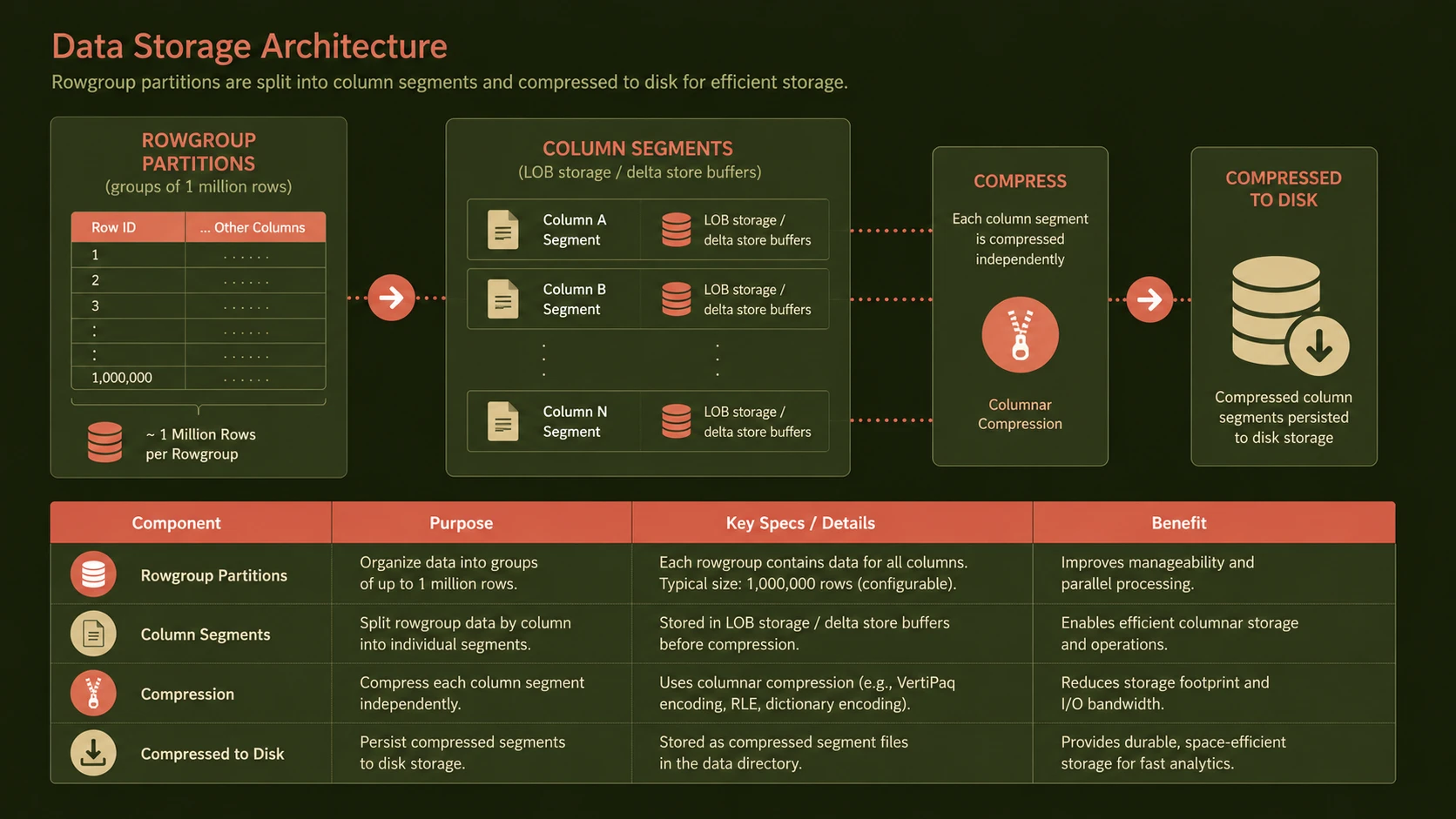
System architecture diagram and conceptual workflow layout for Clustered Columnstore Indexes in SQL Server 2014.
| Scenario | Benefit |
|---|---|
| Enterprise Data Warehouse | Faster reporting |
| Business Intelligence | Improved aggregation performance |
| Financial Analytics | Reduced query execution time |
| Sales Reporting | Efficient fact table scans |
| Historical Analytics | Better storage utilization |
| Executive Dashboards | Improved response times |
These scenarios typically involve large analytical datasets rather than high-frequency transactional processing.
Performance Considerations
Organizations evaluating the SQL Server 2014 preview should benchmark representative analytical workloads.
Important considerations include:
- ◆Fact table size
- ◆Compression ratios
- ◆Query execution plans
- ◆Memory utilization
- ◆Storage throughput
- ◆Batch loading characteristics
Performance improvements will vary depending on schema design and workload patterns.
Security Considerations
Clustered Columnstore Indexes do not introduce a separate security model.
Existing SQL Server security mechanisms continue to apply, including:
- ◆Windows Authentication
- ◆SQL Server Authentication
- ◆Database roles
- ◆Object permissions
- ◆Auditing
- ◆Encryption strategies
Organizations should continue applying least-privilege principles across analytical environments.
Scalability
Columnar storage is intended to improve scalability for analytical databases by reducing the amount of data processed during large reporting queries.
Advantages include:
- ◆Higher compression ratios
- ◆Lower storage requirements
- ◆Reduced disk I/O
- ◆Improved reporting throughput
- ◆Better utilization of memory resources
These improvements can help organizations support growing analytical workloads without relying exclusively on additional hardware.
Best Practices
Organizations evaluating Clustered Columnstore Indexes should:
- ◆Target large fact tables first.
- ◆Benchmark representative reporting queries.
- ◆Evaluate compression savings.
- ◆Review execution plans after deployment.
- ◆Separate OLTP and analytical workload evaluations.
- ◆Test batch loading processes.
- ◆Monitor maintenance operations.
- ◆Validate application compatibility with preview software.
Common Mistakes
Common evaluation mistakes include:
- ◆Assuming every table benefits from columnar storage.
- ◆Applying analytical storage techniques to OLTP workloads without testing.
- ◆Ignoring workload characteristics.
- ◆Measuring only synthetic benchmarks.
- ◆Neglecting storage planning.
- ◆Deploying preview software directly into production environments.
Technology adoption should always be guided by measured business requirements.
Technology Comparison
| Capability | SQL Server 2012 Columnstore | SQL Server 2014 Preview Clustered Columnstore |
|---|---|---|
| Primary Storage Format | Rowstore with nonclustered columnstore | Columnstore |
| Analytical Compression | Yes | Enhanced |
| Large Scan Performance | Excellent | Expected to Improve |
| Updateable Tables | Read-only limitation | Update support through new architecture |
| Data Warehouse Focus | Yes | Yes |
The new architecture builds upon the earlier implementation while addressing one of its most significant operational limitations.
Adoption Strategy
Because SQL Server 2014 is currently available as a preview in August 2013, organizations should evaluate the feature through controlled pilot projects rather than immediate production deployment.
A practical evaluation strategy includes:
- 1.Identify representative analytical databases.
- 2.Benchmark SQL Server 2012 implementations.
- 3.Test Clustered Columnstore Indexes using preview environments.
- 4.Measure storage compression and query performance.
- 5.Validate ETL and reporting workflows.
- 6.Develop migration plans based on measured results.
This approach reduces deployment risk while allowing engineering teams to understand operational implications before the final product becomes available.
Limitations
As of August 2013, Clustered Columnstore Indexes remain part of the SQL Server 2014 preview, and organizations should recognize that implementation details and supported capabilities may evolve before the final release.
Additional considerations include:
- ◆Preview software is not intended for production workloads.
- ◆Existing applications should undergo compatibility testing.
- ◆Workload analysis remains essential before migration.
- ◆Operational procedures should be validated through pilot deployments.
Looking Ahead
The SQL Server 2014 preview demonstrates Microsoft's continued investment in analytical database performance. By evolving from read-only nonclustered columnstore technology toward updateable clustered columnar storage, Microsoft is addressing one of the most significant limitations experienced by early adopters of SQL Server 2012 Columnstore Indexes.
As of August 2013, enterprise architects responsible for business intelligence platforms and large-scale data warehouses should closely evaluate Clustered Columnstore Indexes during preview testing. If the technology delivers on its design objectives in the final release, it has the potential to simplify analytical database architecture while improving both performance and operational flexibility for modern enterprise reporting systems.


