Introduction
Enterprise data architectures have undergone a significant transformation over the past decade. Traditional organizations typically separated operational systems from analytical platforms through Extract, Transform, and Load (ETL) processes that executed on fixed schedules. While this model enabled reporting and business intelligence, it also introduced delays, duplicated data, increased infrastructure complexity, and required substantial operational maintenance.
As businesses increasingly depend on real-time analytics, AI-assisted decision making, customer personalization, fraud detection, and operational monitoring, organizations can no longer rely solely on overnight batch processing. Modern applications require data to move securely and efficiently between cloud platforms, on-premises infrastructure, SaaS applications, and analytical services.
Two architectural trends have emerged to address these demands. Hybrid Cloud APIs provide standardized interfaces that connect distributed enterprise systems, while Zero-ETL architectures reduce or eliminate traditional data movement by enabling direct, near real-time access between operational and analytical platforms.
Rather than viewing operational systems and analytics platforms as isolated environments, organizations increasingly build interconnected ecosystems that minimize data duplication while improving data freshness.
From the perspective of August 2023, Hybrid Cloud APIs and Zero-ETL Pipelines represent a significant evolution in enterprise data platform architecture.
Industry Background
Organizations continue accelerating cloud modernization initiatives.
Common enterprise environments include:
- ◆Public cloud platforms.
- ◆Private cloud infrastructure.
- ◆On-premises systems.
- ◆SaaS applications.
- ◆Data warehouses.
- ◆Data lakes.
- ◆Streaming platforms.
Modern business priorities increasingly emphasize:
- ◆Real-time analytics.
- ◆Operational intelligence.
- ◆Cloud interoperability.
- ◆API-first integration.
- ◆AI readiness.
- ◆Data governance.
Data architecture is becoming a strategic capability rather than a back-office function.
The Business Problem
Traditional ETL-based architectures frequently introduce operational challenges.
Organizations commonly experience:
- ◆Data duplication.
- ◆Long synchronization delays.
- ◆Complex transformation pipelines.
- ◆High operational costs.
- ◆Multiple data copies.
- ◆Integration bottlenecks.
- ◆Difficult pipeline maintenance.
As enterprise systems continue expanding across multiple cloud providers, maintaining numerous ETL workflows becomes increasingly difficult.
Hybrid Cloud APIs and Zero-ETL architectures address these challenges through standardized connectivity and minimized data movement.
Understanding the Technology
Hybrid Cloud APIs expose secure interfaces allowing distributed enterprise applications to exchange information across cloud and on-premises environments.
Zero-ETL architectures reduce traditional batch movement by enabling operational systems to share data directly with analytical platforms through managed integrations, streaming technologies, replication mechanisms, or service-native capabilities.
Key architectural capabilities include:
- ◆API-first integration.
- ◆Event-driven synchronization.
- ◆Real-time analytics.
- ◆Managed data replication.
- ◆Cloud interoperability.
- ◆Centralized governance.
- ◆Reduced operational complexity.
Rather than replacing every existing ETL workflow, Zero-ETL focuses on scenarios where minimizing unnecessary data movement provides operational advantages.
Core Architecture
A simplified Hybrid Cloud and Zero-ETL architecture appears below.
| Component | Responsibility |
|---|---|
| Operational Applications | Business transactions |
| Hybrid Cloud APIs | Secure service communication |
| Event Streaming Platform | Real-time event distribution |
| Managed Data Services | Synchronization and replication |
| Analytical Platform | Business intelligence and analytics |
| AI and Machine Learning Services | Predictive analysis |
| Governance Layer | Security, auditing, and compliance |
Operational systems exchange information through APIs while analytical platforms consume continuously synchronized data with reduced reliance on traditional batch ETL.
Key Features
Hybrid Cloud API Integration
The defining capability of Hybrid Cloud APIs is standardized communication across distributed environments.
Organizations increasingly expose business capabilities through secure APIs rather than proprietary integration mechanisms.
Benefits include:
- ◆Platform independence.
- ◆Standardized communication.
- ◆Service reuse.
- ◆Simplified integration.
- ◆Faster modernization.
API-first architecture allows cloud and on-premises systems to participate within a unified enterprise ecosystem.
Zero-ETL Data Pipelines
-- SQL query creating a Zero-ETL federated search bridge to external warehouse
CREATE CONNECTION aws_s3_crm_conn
TYPE AMAZON_S3
OPTIONS (
  endpoint = 's3.us-east-1.amazonaws.com',
  credentials = '{"aws_access_key_id": "KEY", "aws_secret_access_key": "SECRET"}'
);

-- Access data directly in real-time without ETL processing
SELECT * FROM external_table('aws_s3_crm_conn', 'bucket-name', 'crm_data.csv');
Traditional ETL architectures require scheduled extraction, transformation, and loading between multiple systems.
Zero-ETL aims to reduce these batch-oriented workflows by enabling managed synchronization or direct analytical access with minimal operational intervention.
Advantages include:
- ◆Lower latency.
- ◆Fewer duplicate datasets.
- ◆Simplified pipeline management.
- ◆Reduced infrastructure overhead.
Organizations gain fresher analytical data while reducing operational complexity.
Event-Driven Architecture
Modern enterprise integration increasingly relies on event-driven communication.
Instead of polling databases continuously, systems publish business events such as:
- ◆Customer registration.
- ◆Order creation.
- ◆Inventory updates.
- ◆Payment processing.
- ◆Device telemetry.
Subscribers process these events independently, improving scalability and reducing coupling.
API-Centric Data Access
Rather than exposing direct database access, organizations increasingly provide business capabilities through secure APIs.
This improves:
- ◆Governance.
- ◆Security.
- ◆Version management.
- ◆Platform portability.
API management becomes a strategic enterprise capability.
Cloud-Native Analytics
Modern analytical platforms increasingly integrate directly with operational data sources through managed cloud services.
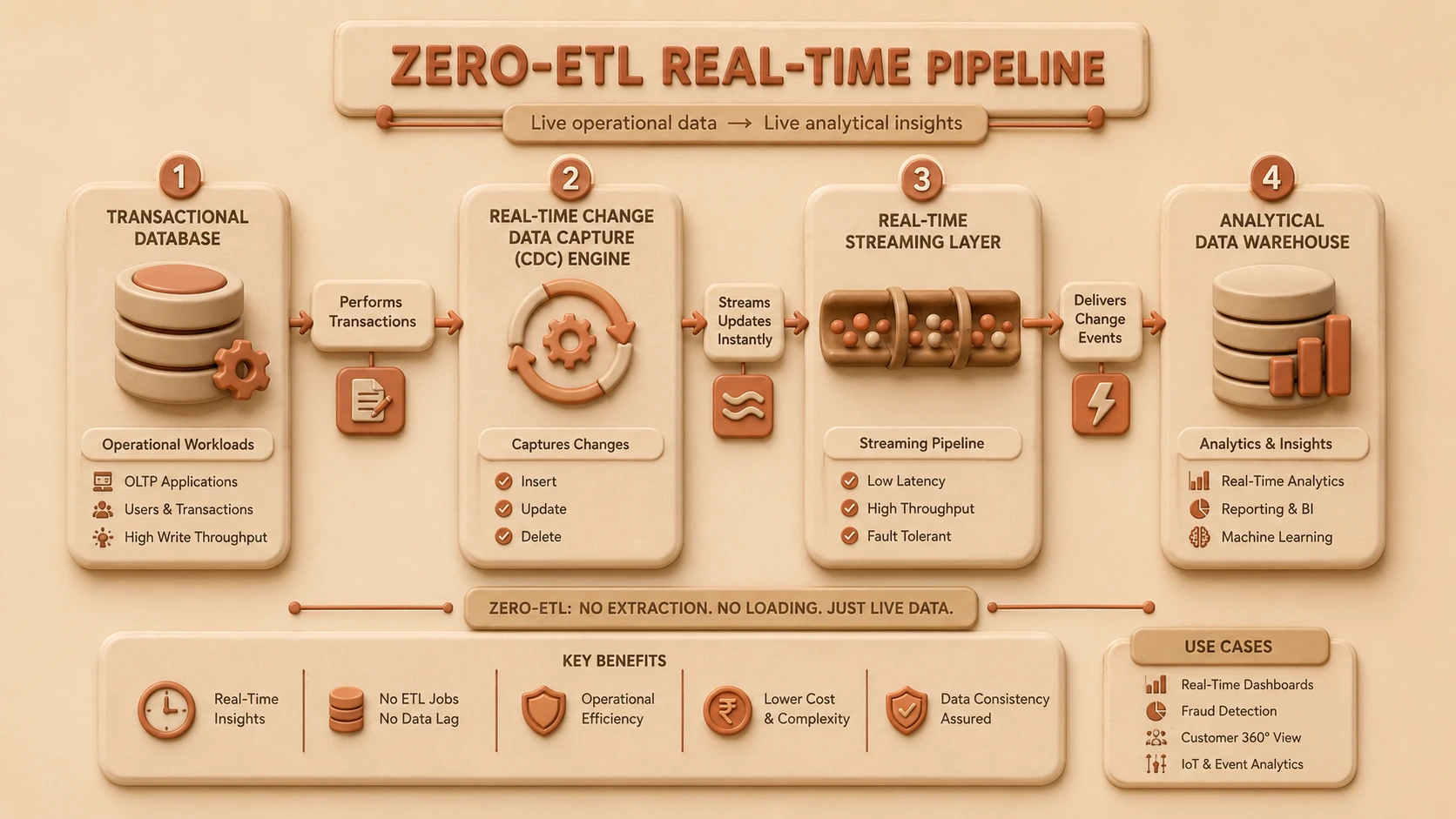
System architecture diagram and conceptual workflow layout for Hybrid Cloud APIs and Zero-ETL Pipelines.
This reduces the engineering effort traditionally required for large-scale ETL infrastructure while improving reporting freshness.
Enterprise Governance
As data becomes more distributed, governance becomes increasingly important.
Organizations establish centralized policies covering:
- ◆Identity management.
- ◆Data classification.
- ◆Access controls.
- ◆Encryption.
- ◆Audit logging.
- ◆Compliance.
Governance ensures greater connectivity does not compromise enterprise security.
How It Works
A simplified workflow appears below.
Operational Applications
          |
Hybrid Cloud APIs
          |
Event Streaming
          |
Managed Synchronization
          |
Analytics Platform
          |
Dashboards
AI Models
Business Intelligence
Operational systems publish data through APIs and events while analytical platforms consume continuously synchronized information.
Enterprise Use Cases
Financial Services
Transaction platforms provide near real-time analytical visibility for fraud detection and operational monitoring.
Retail and E-Commerce
Customer activity, inventory updates, and order processing become available rapidly for reporting and personalization.
Healthcare
Clinical systems synchronize operational information with analytical platforms while maintaining governance requirements.
Manufacturing
Production systems stream equipment events into analytics platforms for operational intelligence.
Enterprise SaaS
Cloud-native applications expose APIs that enable reporting, monitoring, and customer analytics without complex batch synchronization.
Performance Considerations
Organizations adopting Hybrid Cloud APIs and Zero-ETL architectures should evaluate:
- ◆API latency.
- ◆Event processing throughput.
- ◆Synchronization delays.
- ◆Network utilization.
- ◆Data freshness.
- ◆Platform scalability.
Performance optimization should balance operational workloads with analytical processing requirements.
Security Considerations
Enterprise data integration requires comprehensive governance.
Organizations should implement:
- ◆API authentication.
- ◆OAuth or equivalent authorization mechanisms.
- ◆Encryption in transit.
- ◆Encryption at rest.
- ◆Data classification.
- ◆Audit logging.
- ◆Continuous monitoring.
Security architecture should remain consistent across cloud providers and on-premises infrastructure.
Scalability
Hybrid Cloud APIs and Zero-ETL Pipelines improve enterprise scalability through:
- ◆Reduced data duplication.
- ◆API reuse.
- ◆Event-driven integration.
- ◆Cloud-native services.
- ◆Simplified operational maintenance.
- ◆Faster analytical access.
These characteristics enable organizations to modernize large-scale data platforms while supporting rapidly growing workloads.
Best Practices
Organizations adopting these architectures should:
- ◆Design APIs using consistent enterprise standards.
- ◆Minimize unnecessary data replication.
- ◆Use event-driven integration where appropriate.
- ◆Establish centralized API governance.
- ◆Continuously monitor data synchronization quality.
- ◆Secure every integration endpoint.
- ◆Build observability into integration platforms from the beginning.
Successful adoption depends on treating APIs and data integration as strategic enterprise infrastructure.
Common Mistakes
| Mistake | Business Impact |
|---|---|
| Attempting to eliminate every ETL workload regardless of business requirements | Unnecessary architectural complexity |
| Exposing databases directly instead of secure APIs | Increased security risk |
| Ignoring governance across multiple cloud providers | Compliance challenges |
| Creating duplicate API implementations | Higher maintenance costs |
| Neglecting event monitoring and observability | Difficult operational troubleshooting |
| Treating Zero-ETL as a universal replacement for all data engineering | Unrealistic implementation expectations |
Organizations should adopt Zero-ETL selectively where it delivers measurable operational and analytical value.
Technology Comparison
| Characteristic | Traditional ETL Architecture | Hybrid Cloud APIs & Zero-ETL |
|---|---|---|
| Data Movement | Scheduled batch transfers | Minimized, near real-time synchronization |
| Integration Model | Pipeline-centric | API and event-driven |
| Data Freshness | Minutes to hours | Near real-time for supported workloads |
| Operational Complexity | High | Reduced through managed integrations |
| Cloud Interoperability | Platform dependent | Designed for hybrid environments |
| Enterprise Agility | Moderate | Improved responsiveness |
Hybrid Cloud APIs and Zero-ETL architectures modernize enterprise integration by reducing unnecessary data movement while strengthening interoperability.
Adoption Strategy
Organizations should modernize incrementally.
- 1.Inventory existing ETL workflows and integration points.
- 2.Identify workloads requiring near real-time analytics.
- 3.Standardize enterprise API design.
- 4.Introduce event-driven communication for suitable business domains.
- 5.Evaluate managed Zero-ETL capabilities where available.
- 6.Expand adoption after validating security, governance, and operational performance.
This phased approach minimizes migration risk while enabling measurable improvements in data availability and operational efficiency.
Limitations
As of August 2023, organizations should recognize several considerations.
- ◆Zero-ETL does not eliminate every transformation requirement; many analytical and regulatory workloads still require data preparation.
- ◆Legacy systems may require modernization before participating in API-first architectures.
- ◆Distributed cloud environments increase the importance of governance and observability.
- ◆Performance characteristics should be validated using representative production workloads.
- ◆Long-term success depends on standardized APIs, disciplined platform engineering, and enterprise-wide data governance.
These considerations should guide enterprise data modernization initiatives.
Looking Ahead
From the perspective of August 2023, Hybrid Cloud APIs and Zero-ETL Pipelines represent a major shift in enterprise data architecture. Rather than building increasingly complex batch-oriented integration infrastructures, organizations are embracing API-first connectivity, event-driven communication, and managed synchronization capabilities that reduce operational complexity while improving data freshness.
As AI, real-time analytics, and cloud-native platforms continue driving enterprise innovation, architectural emphasis will increasingly shift toward interoperable services, governed data access, and intelligent integration rather than large-scale data duplication. Organizations investing in Hybrid Cloud APIs, event-driven architectures, and Zero-ETL strategies will be well positioned to build scalable, responsive, and future-ready enterprise data platforms.