
Why Agentic AI Needs High-Throughput Microservices
As Agentic AI systems become more sophisticated, a single monolithic application is no longer sufficient to support autonomous planning, memory management, tool execution, retrieval, and workflow orchestration. Modern AI platforms consist of dozens of independently deployable services that must communicate efficiently while processing thousands of requests every second.
.NET 10 provides the performance, scalability, and cloud-native capabilities required to build these distributed systems. With improvements in ASP.NET Core, runtime optimizations, asynchronous processing, and container-first deployment, developers can build resilient microservices capable of supporting enterprise-scale AI workloads.
Architecture Principle: Every AI capability should exist as an independent service that can scale, evolve, and deploy without impacting the rest of the platform.
---
Why Microservices for Agentic Systems?
An Agentic AI platform is composed of multiple autonomous capabilities rather than a single AI endpoint.
Typical services include:
- ◆Agent Orchestrator
- ◆Planning Service
- ◆Memory Service
- ◆Prompt Management
- ◆Tool Execution
- ◆Knowledge Retrieval
- ◆Authentication
- ◆Policy Engine
- ◆Event Processing
- ◆Observability
Each service performs one responsibility and communicates through lightweight APIs or asynchronous messaging.
---
Modern .NET 10 Architecture
A production-ready .NET 10 deployment typically follows this architecture:
Client Applications
        │
        ▼
API Gateway
        │
Load Balancer
        │
──────────────────────────────────────────────
│ Agent Service │ Memory │ Planning │ Tools │
│ Auth │ RAG │ Workflow │ Monitoring │
──────────────────────────────────────────────
        │
Event Bus / Message Queue
        │
Distributed Storage
        │
Enterprise Systems
This architecture allows every service to evolve independently while maintaining system-wide resilience.
---
High-Performance Features in .NET 10
.NET 10 introduces several capabilities that improve high-throughput applications.
Key improvements include:
- ◆Runtime performance optimizations
- ◆Faster Minimal APIs
- ◆Improved Native AOT support
- ◆Better garbage collection efficiency
- ◆Reduced memory allocations
- ◆Enhanced async performance
- ◆Optimized HTTP pipelines
- ◆Container-aware runtime improvements
These features make .NET 10 particularly suitable for latency-sensitive AI infrastructure.
---
Event-Driven Communication
Synchronous service-to-service communication creates bottlenecks as AI workloads grow.
Modern microservice platforms rely heavily on asynchronous messaging using:
- ◆Event Bus
- ◆Message Queues
- ◆Publish/Subscribe
- ◆Event Streaming
- ◆Background Workers
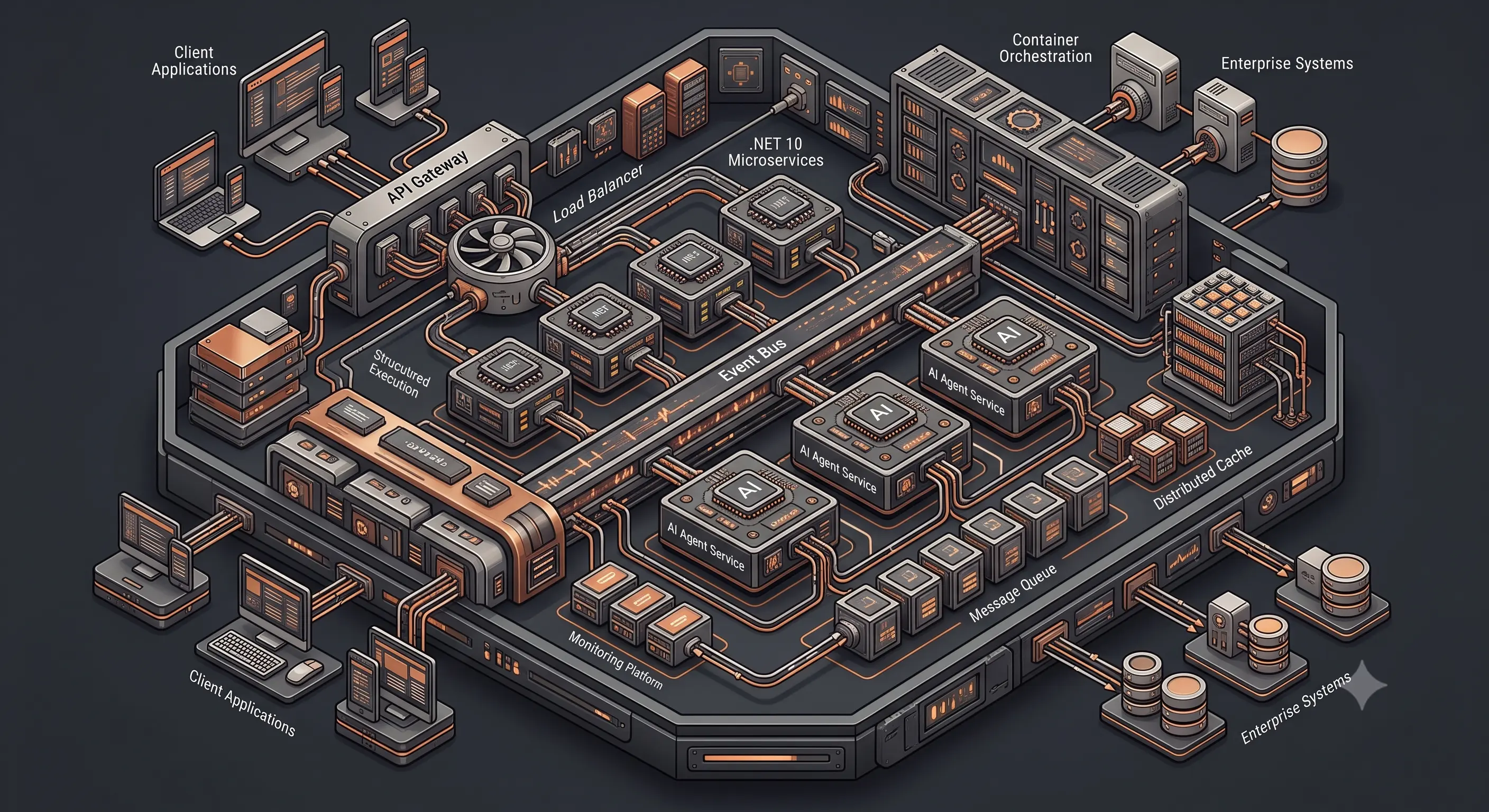
This approach increases throughput while improving fault tolerance and scalability.
---
Scaling Independent AI Services
One of the biggest advantages of microservices is independent scaling.
For example:
- ◆Memory Service may require more RAM.
- ◆Agent Orchestrator may require more CPU.
- ◆Vector Search Service may need GPU acceleration.
- ◆Workflow Engine may process thousands of background jobs.
- ◆Authentication Service may scale during peak login traffic.
Independent scaling optimizes infrastructure utilization and reduces operational costs.
---
Observability Across Distributed Systems
As the number of services increases, monitoring becomes essential.
Production platforms typically collect:
- ◆Request latency
- ◆Service health
- ◆Distributed traces
- ◆Event processing time
- ◆Queue depth
- ◆CPU utilization
- ◆Memory usage
- ◆Error rates
Centralized observability enables faster debugging and proactive infrastructure optimization.
---
Security Considerations
Every microservice should implement enterprise-grade security controls.
Recommended practices include:
- ◆Mutual TLS
- ◆JWT authentication
- ◆Service-to-service authorization
- ◆API Gateway enforcement
- ◆Secret management
- ◆Rate limiting
- ◆Audit logging
- ◆Zero Trust networking
Security must be applied consistently across the entire distributed platform.
---
Best Practices
| Area | Best Practice |
|---|---|
| Framework | ASP.NET Core .NET 10 |
| Communication | Event-Driven Messaging |
| APIs | Minimal APIs |
| Deployment | Kubernetes |
| Discovery | Service Mesh |
| Performance | Native AOT |
| Monitoring | OpenTelemetry |
| Security | Zero Trust Architecture |
---
The Future of AI Microservices
Enterprise AI platforms are evolving toward highly distributed architectures where specialized services collaborate to execute complex business workflows. .NET 10 provides the performance foundation required to build these next-generation systems through efficient networking, cloud-native deployment, and high-throughput execution.
By combining microservices, event-driven communication, observability, and independent scaling, organizations can build resilient Agentic AI platforms capable of handling millions of requests while remaining maintainable, secure, and future-ready.