Why Ethical DevOps Matters
Modern software is no longer evaluated solely on performance, scalability, or deployment speed. Organizations are increasingly expected to build applications that protect user privacy, secure sensitive information, comply with global regulations, and use artificial intelligence responsibly.
Traditional DevOps accelerated software delivery by automating development and operations. However, automation without governance can introduce security vulnerabilities, privacy risks, supply chain attacks, and compliance failures.
Ethical DevOps extends DevOps by embedding trust, privacy, security, compliance, and responsible engineering practices into every stage of the software delivery lifecycle.
Architecture Principle: Trust should be engineered into the delivery pipeline—not audited after deployment.
---
What Is Ethical DevOps?
Ethical DevOps is an engineering philosophy that integrates security, privacy, compliance, governance, and ethical AI into continuous software delivery.
Rather than treating security or compliance as independent review stages, every pipeline execution validates software against organizational trust policies before production deployment.
Core capabilities include:
- ◆DevSecOps
- ◆Privacy by Design
- ◆Policy as Code
- ◆Compliance Automation
- ◆AI Governance
- ◆Secure Supply Chain
- ◆Identity Management
- ◆Continuous Risk Assessment
These capabilities transform software delivery into a continuously validated engineering process.
---
Evolution of Software Delivery
Enterprise software delivery has evolved significantly over time.
- 1.Manual Releases
- 2.Continuous Integration
- 3.Continuous Delivery
- 4.DevOps
- 5.DevSecOps
- 6.Ethical DevOps
The latest generation extends automation beyond deployment to include governance, transparency, and organizational accountability.
---
Enterprise Reference Architecture
Developer Commit
        │
Source Repository
        │
AI Code Review
        │
Static Security Analysis
        │
Privacy Validation
        │
Dependency & SBOM Scan
        │
Policy Engine
        │
Compliance Automation
        │
CI/CD Deployment
        │
Runtime Security
        │
Continuous Observability
Every stage validates software quality, security, privacy, and governance before progressing.
---
Privacy by Design
Privacy should be considered during software development rather than after deployment.
Modern pipelines automatically verify:
- ◆Personal data handling
- ◆Data minimization
- ◆Encryption policies
- ◆Consent management
- ◆Data retention rules
- ◆Access controls
- ◆Cross-border data policies
- ◆Sensitive information exposure
Embedding these checks early reduces compliance risk and protects customer trust.
---
Secure Software Supply Chain
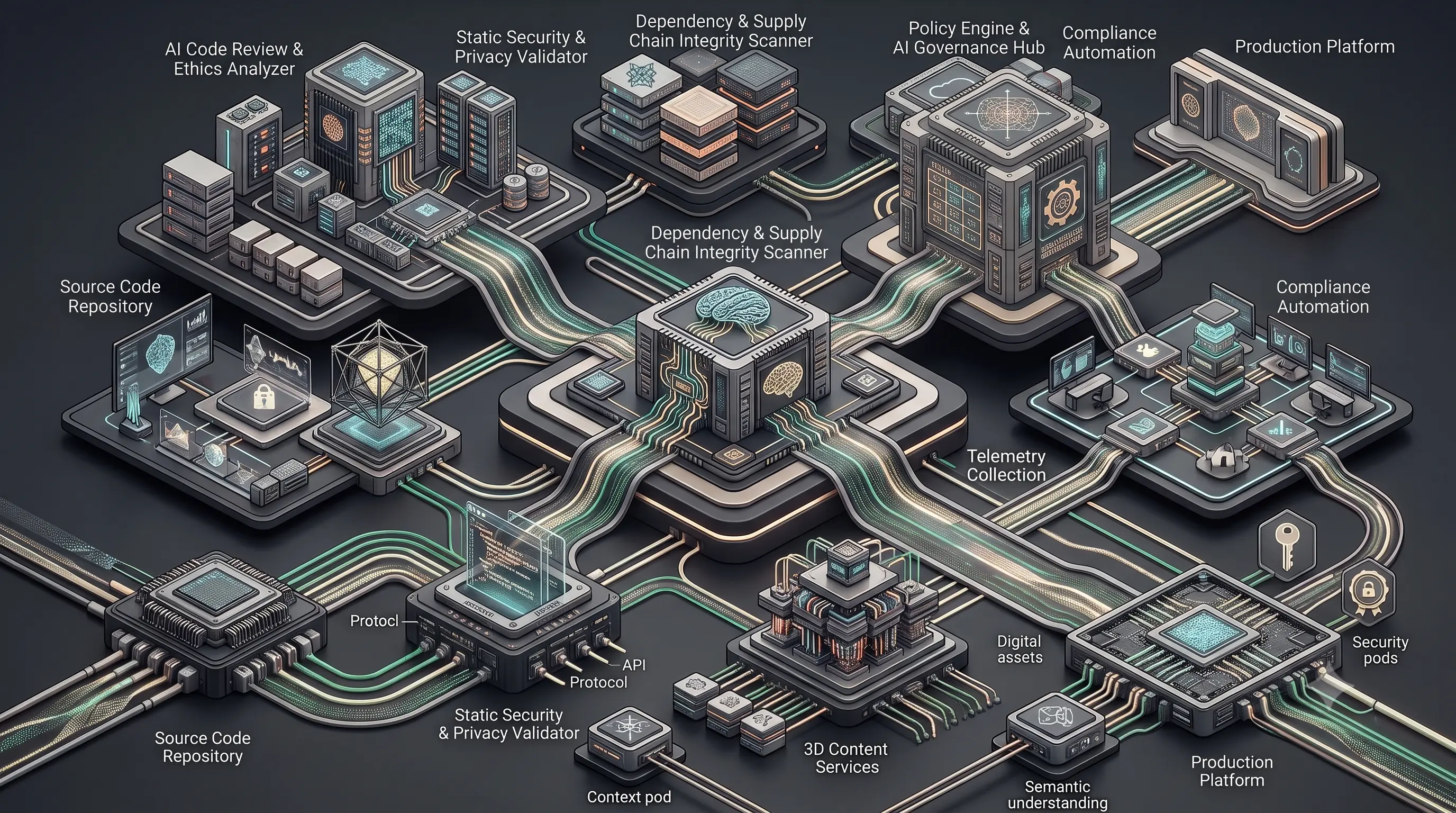
Software increasingly depends on open-source libraries, containers, and third-party services.
Ethical DevOps secures the supply chain through:
- ◆SBOM generation
- ◆Dependency scanning
- ◆Container image verification
- ◆Digital signing
- ◆Provenance tracking
- ◆Vulnerability analysis
- ◆Artifact integrity validation
- ◆Trusted package repositories
Every deployment artifact is verified before reaching production.
---
AI Governance in DevOps
As AI becomes part of software delivery, governance must extend to machine learning and LLM-powered applications.
Typical governance controls include:
- ◆Prompt validation
- ◆Model approval workflows
- ◆Bias evaluation
- ◆Hallucination testing
- ◆Dataset lineage
- ◆Explainability checks
- ◆Policy enforcement
- ◆Human approval gates
This ensures AI systems remain trustworthy throughout their lifecycle.
---
Continuous Compliance
Instead of preparing for periodic audits, Ethical DevOps automates compliance continuously.
Examples include:
- ◆GDPR validation
- ◆ISO 27001 controls
- ◆SOC 2 verification
- ◆HIPAA compliance
- ◆PCI DSS policies
- ◆Infrastructure validation
- ◆Access reviews
- ◆Audit evidence generation
Automation reduces manual effort while improving regulatory readiness.
---
Observability and Trust Metrics
A trustworthy pipeline measures more than deployment success.
Important operational metrics include:
- ◆Vulnerability trends
- ◆Policy violations
- ◆Compliance coverage
- ◆Privacy incidents
- ◆Deployment integrity
- ◆Supply chain health
- ◆AI governance scores
- ◆Security remediation time
These metrics help engineering teams continuously improve software trustworthiness.
---
Best Practices
| Area | Best Practice |
|---|---|
| Security | DevSecOps by Default |
| Privacy | Privacy by Design |
| Governance | Policy as Code |
| Supply Chain | SBOM & Signed Artifacts |
| Compliance | Continuous Compliance Automation |
| AI | Responsible AI Governance |
| Observability | Trust & Risk Monitoring |
| Delivery | Secure CI/CD Pipelines |
---
The Future of Trusted Software Engineering
Software delivery is evolving beyond speed and automation toward systems that are secure, transparent, privacy-aware, and ethically governed by design. Future engineering platforms will automatically validate every code change, infrastructure update, AI model, and deployment against organizational trust policies before software reaches production.
Organizations adopting Ethical DevOps will build resilient delivery pipelines that protect users, simplify compliance, strengthen software supply chains, and foster long-term customer confidence—making trust a core engineering capability rather than an afterthought.