Introduction
Modern web applications increasingly serve users distributed across continents, devices, and network environments. Customers expect applications to respond almost instantly regardless of location, while businesses continue deploying increasingly sophisticated workloads involving personalization, AI-assisted experiences, real-time analytics, API orchestration, and media processing.
Traditionally, enterprise applications have relied on centralized cloud regions for executing business logic. Although hyperscale cloud providers offer exceptional scalability, network latency remains constrained by physical distance. Every request must traverse multiple network hops before reaching an application server, increasing response times for globally distributed users.
Edge computing addresses this challenge by moving application execution closer to end users through geographically distributed execution environments. At the same time, WebAssembly (WASM) has evolved into a portable, secure, and high-performance runtime capable of executing code written in multiple programming languages beyond JavaScript.
The convergence of WebAssembly and edge computing represents an important architectural trend. Rather than viewing WebAssembly solely as a browser technology, organizations are increasingly evaluating it as a universal execution format for lightweight, sandboxed workloads deployed across edge infrastructure.
As of July 2023, this combination is becoming an important consideration for organizations building globally distributed digital platforms requiring low latency, portability, and efficient resource utilization.
Industry Background
Several technology trends continue driving adoption:
- ◆Edge computing platforms
- ◆WebAssembly ecosystem maturity
- ◆Cloud-native architectures
- ◆Serverless computing
- ◆Content Delivery Networks (CDNs)
- ◆API-first platforms
- ◆Multi-region deployments
- ◆Event-driven systems
Organizations increasingly seek architectures capable of delivering consistent user experiences regardless of geographic location.
The Business Problem
Traditional centralized application architectures commonly experience:
- ◆High network latency
- ◆Regional bottlenecks
- ◆Increased bandwidth costs
- ◆Delayed API responses
- ◆Scalability challenges during global traffic spikes
- ◆Slow personalization for distributed users
Businesses require execution models that reduce latency without sacrificing security or operational consistency.
Understanding WebAssembly
WebAssembly is a standardized binary instruction format designed for efficient execution in secure runtime environments.
Unlike JavaScript, which is interpreted or Just-In-Time (JIT) compiled by JavaScript engines, WebAssembly modules are compiled ahead of execution into a compact binary representation.
Key characteristics include:
- ◆Portable binary format
- ◆Near-native execution performance
- ◆Language interoperability
- ◆Sandboxed execution
- ◆Compact deployment artifacts
- ◆Deterministic runtime behavior
Originally designed for browsers, WebAssembly is increasingly being adopted across server-side and edge computing environments.
Understanding Edge Computing
Edge computing distributes application execution across geographically dispersed infrastructure located closer to users.
Instead of routing every request to centralized cloud regions, workloads execute at nearby edge locations whenever appropriate.
Typical edge workloads include:
- ◆Authentication
- ◆API routing
- ◆Image optimization
- ◆Request validation
- ◆Content personalization
- ◆Caching
- ◆Security inspection
Executing these operations closer to users reduces network travel time and improves responsiveness.
Core Architecture
| Component | Responsibility |
|---|---|
| Client Browser | Initiates user requests |
| Edge Runtime | Executes low-latency application logic |
| WebAssembly Module | Performs portable, sandboxed computation |
| Edge Cache | Stores frequently accessed content |
| Origin Services | Hosts primary business systems |
| Cloud Infrastructure | Provides centralized processing and storage |
| Monitoring Platform | Observes distributed execution |
This architecture allows latency-sensitive operations to execute at the edge while preserving centralized systems for core business processing.
Why WASM Fits Edge Computing
// Rust code compiled to WebAssembly running at Cloudflare/Edge runtime
use wasm_bindgen::prelude::*;

#[wasm_bindgen]
pub fn parse_edge_request(body: &str) -> String {
    let parsed_ip = format!("Client Request Body: {}", body);
    parsed_ip
}
Edge environments require execution models that emphasize:
- ◆Fast startup
- ◆Low memory usage
- ◆Strong isolation
- ◆Predictable execution
- ◆Portability
WebAssembly aligns well with these requirements because modules are lightweight, sandboxed, and language-independent.
Potential enterprise benefits include:
- ◆Faster request processing
- ◆Reduced infrastructure overhead
- ◆Cross-platform portability
- ◆Improved deployment consistency
Typical Request Flow
A common edge processing workflow includes:
- 1.Client request reaches the nearest edge location.
- 2.Edge runtime evaluates routing and security policies.
- 3.WebAssembly module processes request logic.
- 4.Cached responses are returned when available.
- 5.Origin infrastructure is contacted only when necessary.
- 6.Response is delivered to the client.
Reducing unnecessary round trips can significantly improve user-perceived performance.
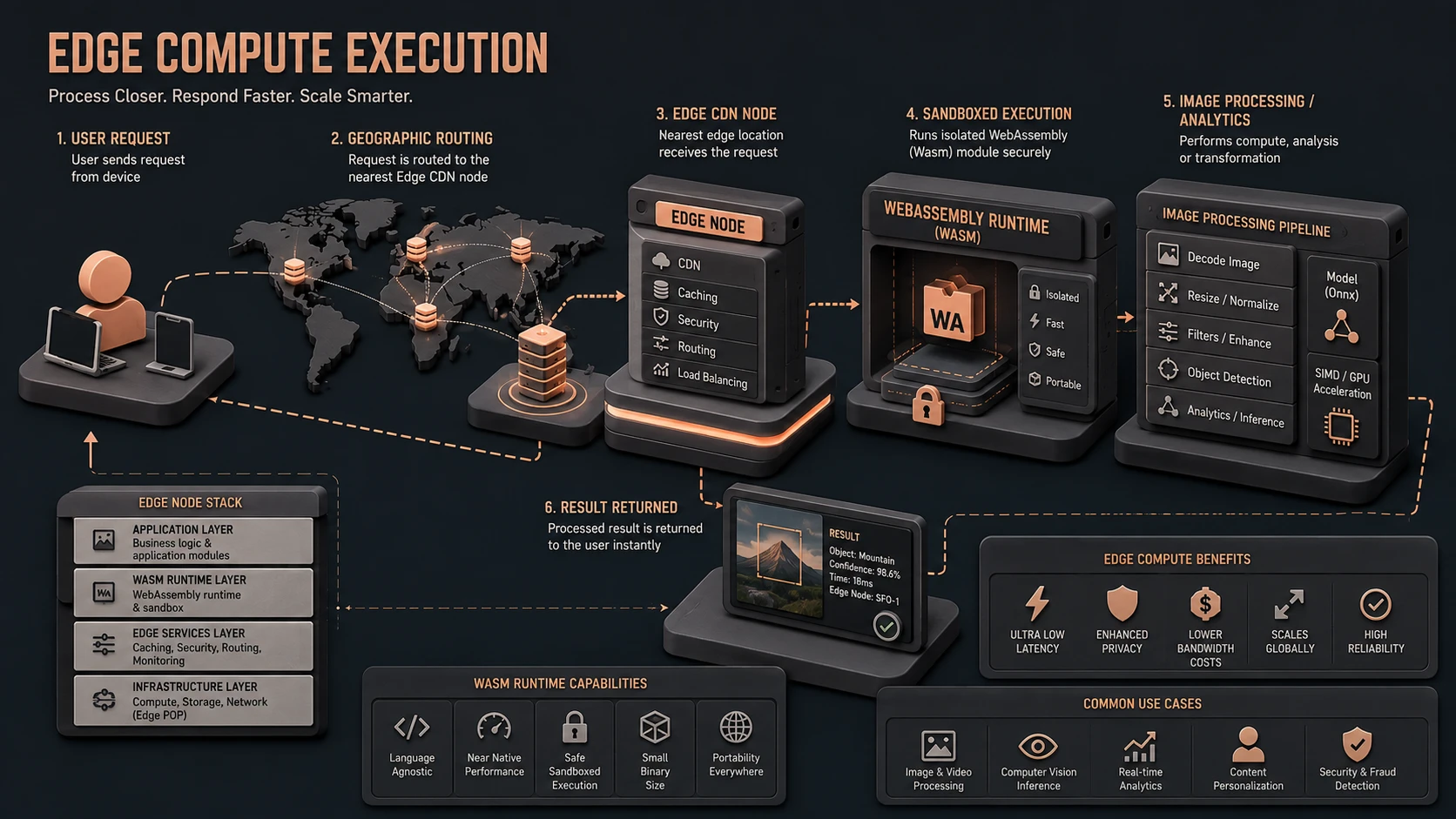
System architecture diagram and conceptual workflow layout for High-Performance Web with WASM and Edge Compute.
Enterprise Use Cases
| Scenario | Benefit |
|---|---|
| E-commerce Platforms | Faster regional personalization |
| Global SaaS Applications | Lower response latency |
| API Gateways | Edge authentication and request filtering |
| Financial Services | Regional request validation |
| Media Platforms | Image optimization and content delivery |
| IoT Platforms | Distributed event processing |
Organizations serving global audiences can particularly benefit from moving latency-sensitive operations closer to users.
Performance Considerations
When evaluating WASM-based edge architectures, engineering teams should measure:
- ◆End-to-end latency
- ◆Startup time
- ◆Request throughput
- ◆Memory utilization
- ◆Cache hit ratio
- ◆Geographic response consistency
Performance validation should be based on production-like traffic patterns across multiple regions.
Security Considerations
WebAssembly contributes to security through sandboxed execution, but secure architecture still depends on broader operational controls.
Organizations should continue implementing:
- ◆Identity and access management
- ◆API authentication
- ◆TLS encryption
- ◆Secrets management
- ◆Secure deployment pipelines
- ◆Runtime monitoring
- ◆Least privilege principles
Edge deployments should also ensure consistent policy enforcement across distributed locations.
Scalability
Combining WASM with edge computing supports enterprise scalability through:
- ◆Distributed request handling
- ◆Horizontal scaling across edge regions
- ◆Efficient resource utilization
- ◆Reduced origin traffic
- ◆Improved resilience during traffic spikes
These capabilities help organizations deliver consistent experiences to globally distributed users.
Best Practices
Organizations adopting WASM-powered edge architectures should:
- ◆Execute only latency-sensitive workloads at the edge.
- ◆Keep business-critical state within centralized systems when appropriate.
- ◆Design stateless edge services whenever possible.
- ◆Optimize WebAssembly module size.
- ◆Implement comprehensive observability across distributed environments.
- ◆Benchmark regional performance regularly.
- ◆Maintain consistent deployment automation.
- ◆Evaluate workload placement based on measurable latency improvements.
Incremental adoption allows organizations to validate architectural benefits before expanding deployment.
Common Mistakes
Organizations should avoid:
- ◆Moving every workload to the edge without business justification.
- ◆Ignoring distributed observability requirements.
- ◆Assuming WebAssembly automatically improves every workload.
- ◆Storing sensitive state unnecessarily at edge locations.
- ◆Underestimating synchronization complexity between edge and origin systems.
- ◆Optimizing solely for latency while neglecting maintainability and governance.
Successful edge strategies balance performance improvements with operational simplicity.
Technology Comparison
| Capability | Centralized Cloud Execution | WASM with Edge Compute |
|---|---|---|
| Request Latency | Dependent on region distance | Reduced through local execution |
| Startup Time | Runtime dependent | Typically very fast for lightweight modules |
| Geographic Distribution | Regional | Globally distributed edge locations |
| Isolation | Container or VM based | Sandboxed WebAssembly runtime |
| Resource Footprint | Higher for full application services | Lightweight execution model |
| Ideal Workloads | Stateful business services | Stateless, latency-sensitive processing |
Rather than replacing centralized cloud infrastructure, WASM-powered edge computing complements existing enterprise architectures.
Adoption Strategy
Organizations should approach adoption through phased implementation.
A practical roadmap includes:
- 1.Identify latency-sensitive workloads.
- 2.Measure current global performance.
- 3.Build pilot WebAssembly modules.
- 4.Deploy selected functionality at edge locations.
- 5.Monitor latency, reliability, and operational costs.
- 6.Expand successful workloads gradually.
- 7.Continuously optimize workload placement across edge and cloud infrastructure.
This incremental strategy minimizes operational risk while allowing engineering teams to gain experience with distributed execution models.
Limitations
As of July 2023, organizations should recognize several considerations.
Current observations include:
- ◆Not every workload benefits from edge execution.
- ◆Stateful applications often continue to rely on centralized data services.
- ◆Operational tooling for distributed edge environments continues to mature.
- ◆Application architecture should determine workload placement rather than technology trends alone.
Successful adoption requires balancing latency improvements with governance, maintainability, and operational complexity.
Looking Ahead
As of July 2023, the convergence of WebAssembly and edge computing is expanding the possibilities for enterprise web architecture. Lightweight sandboxed execution, improved portability, and globally distributed edge infrastructure enable organizations to deliver faster and more responsive digital experiences while maintaining centralized business systems.
For enterprise architects, platform engineers, and cloud engineering teams, the strategic opportunity lies in identifying workloads where edge execution creates measurable business value. Organizations that combine thoughtful workload placement, strong observability, secure deployment practices, and incremental modernization will be well positioned to leverage the growing WebAssembly ecosystem as edge computing continues to evolve.