Introduction
When WebAssembly (Wasm) became a web standard in 2017, its primary objective was straightforward: enable near-native execution speeds for compute-intensive applications inside web browsers. Early adoption focused on games, media processing, scientific visualization, and applications originally written in languages such as C and C++.
Seven years later, the ecosystem has expanded significantly. Modern WebAssembly is no longer viewed simply as a browser optimization layer. Instead, it is increasingly recognized as a portable execution format capable of running securely across browsers, servers, edge platforms, developer tools, embedded systems, and cloud-native environments.
Several initiatives have accelerated this evolution. The WebAssembly Component Model is improving interoperability between languages. The WebAssembly System Interface (WASI) extends execution beyond browsers. Garbage Collection (GC) support improves compatibility with managed languages. Tooling has matured, making WebAssembly accessible to Rust, Go, C#, Kotlin, TinyGo, AssemblyScript, and numerous other ecosystems.
Together, these developments position WebAssembly as an increasingly important runtime technology for modern enterprise software.
From the perspective of July 2024, WebAssembly is transitioning from a browser feature into a universal application platform.
Industry Background
Modern enterprise applications increasingly span:
- ◆Web browsers.
- ◆Edge computing platforms.
- ◆Cloud-native services.
- ◆Embedded devices.
- ◆AI inference platforms.
- ◆IoT environments.
- ◆Developer tooling.
Organizations increasingly prioritize:
- ◆Performance.
- ◆Portability.
- ◆Security.
- ◆Cross-platform deployment.
- ◆Language interoperability.
- ◆Runtime consistency.
WebAssembly aligns closely with these architectural objectives.
The Business Problem
Traditional software deployment frequently introduces operational challenges.
Organizations commonly experience:
- ◆Platform-specific builds.
- ◆Runtime inconsistencies.
- ◆Browser performance limitations.
- ◆Language lock-in.
- ◆Deployment complexity.
- ◆Security concerns.
- ◆Difficult application portability.
Maintaining separate implementations across browsers, servers, and edge platforms increases engineering effort.
WebAssembly provides a standardized execution format that addresses many of these challenges.
Understanding the Technology
WebAssembly is a binary instruction format designed for portable, sandboxed, high-performance execution.
Unlike JavaScript, WebAssembly executes precompiled binary modules that can be generated from multiple programming languages.
Modern WebAssembly capabilities include:
- ◆High-performance execution.
- ◆Secure sandboxing.
- ◆Cross-language interoperability.
- ◆WASI support.
- ◆Component Model.
- ◆Garbage Collection integration.
- ◆Portable deployment.
Rather than replacing JavaScript, WebAssembly increasingly complements it by executing performance-sensitive workloads.
Core Architecture
A simplified WebAssembly architecture appears below.
| Component | Responsibility |
|---|---|
| Application Code | Business logic |
| Language Compiler | Generates WebAssembly modules |
| WebAssembly Module | Portable binary execution unit |
| JavaScript Runtime | Browser integration |
| WASI Runtime | Server and edge execution |
| Host APIs | Filesystem, networking, resources |
| Client or Cloud Platform | Application execution |
Applications can execute inside browsers or standalone WASI runtimes while sharing the same compiled modules.
Key Features
High-Performance Execution
The defining advantage of WebAssembly remains execution performance.
Compiled binary modules reduce interpretation overhead and enable efficient execution for workloads including:
- ◆Image processing.
- ◆Video editing.
- ◆Scientific computing.
- ◆CAD applications.
- ◆Data visualization.
- ◆AI inference.
Performance-sensitive applications increasingly combine JavaScript for interface logic with WebAssembly for computational tasks.
WebAssembly Component Model
One of the most significant ecosystem developments is the Component Model.
Rather than treating modules as isolated binaries, the Component Model introduces standardized interfaces that simplify communication between independently developed WebAssembly components.
Benefits include:
- ◆Language interoperability.
- ◆Component reuse.
- ◆Standardized interfaces.
- ◆Better modularity.
This significantly improves large-scale application development.
WebAssembly System Interface (WASI)
Originally designed for browsers, WebAssembly is increasingly executing outside the browser.
WASI provides standardized interfaces for:
- ◆File access.
- ◆Environment variables.
- ◆Standard input and output.
- ◆Resource management.
This enables portable execution across cloud, edge, and server environments without depending on browser APIs.
Garbage Collection Support
Recent advances introduce Garbage Collection capabilities that improve interoperability with managed languages.
This expands WebAssembly's appeal for languages that rely on automatic memory management while reducing the complexity of language runtime implementations.
Multi-Language Development
Modern WebAssembly development supports numerous languages, including:
- ◆Rust.
- ◆C.
- ◆C++.
- ◆Go.
- ◆C#.
- ◆Kotlin.
- ◆AssemblyScript.
Organizations gain greater flexibility without committing to a single programming ecosystem.
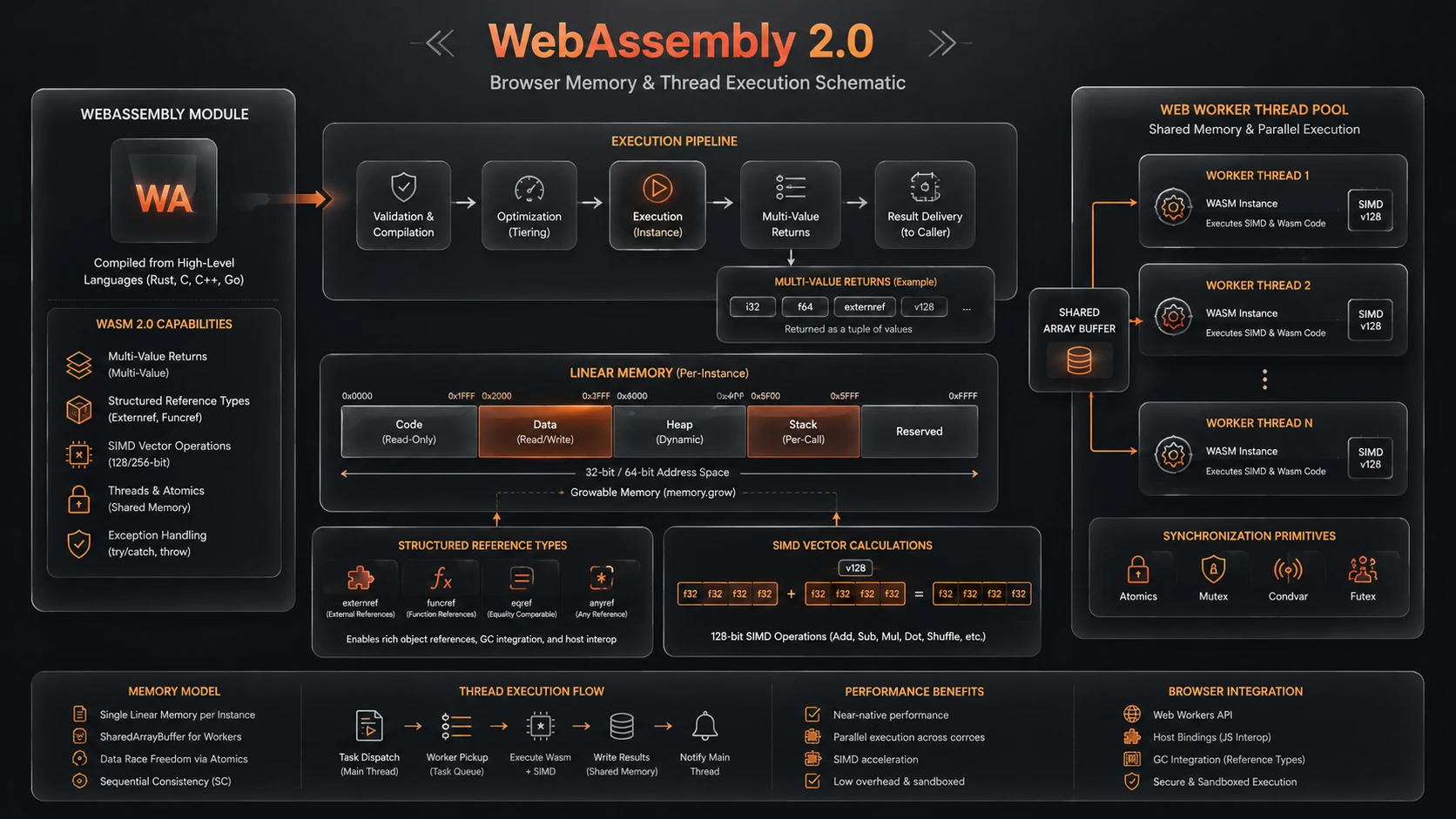
System architecture diagram and conceptual workflow layout for WebAssembly 2.0 & Beyond.
Secure Sandboxed Execution
Security remains one of WebAssembly's strongest architectural characteristics.
Applications execute inside isolated environments with controlled access to host resources.
This sandboxed model reduces the attack surface while supporting portable execution across diverse environments.
How It Works
A simplified execution workflow appears below.
Source Code
       |
Language Compiler
       |
WebAssembly Module
       |
Browser Runtime or WASI Runtime
       |
Host APIs
       |
Application Execution
The same compiled module can execute across multiple environments while interacting with host capabilities through standardized interfaces.
Enterprise Use Cases
Browser-Based Productivity Applications
Complex editing tools, visualization platforms, and engineering software benefit from improved computational performance.
AI Inference
Lightweight machine learning inference workloads execute efficiently within browsers and edge environments.
Edge Computing
Portable WebAssembly modules simplify deployment across geographically distributed edge infrastructure.
Cloud-Native Platforms
Server-side WebAssembly runtimes provide secure execution for plugin systems, extensibility, and isolated workloads.
Cross-Platform Software
Organizations reduce platform-specific implementations by compiling business logic into reusable WebAssembly modules.
Performance Considerations
Organizations implementing WebAssembly should evaluate:
- ◆Module initialization time.
- ◆Execution throughput.
- ◆Memory utilization.
- ◆JavaScript interoperability.
- ◆Binary size.
- ◆Runtime startup latency.
Performance improvements should be validated using representative production workloads rather than synthetic benchmarks alone.
Security Considerations
Although WebAssembly provides strong sandboxing, organizations should continue implementing:
- ◆Identity management.
- ◆Secure host interfaces.
- ◆Input validation.
- ◆Least privilege execution.
- ◆Runtime monitoring.
- ◆Dependency management.
Sandboxing complements rather than replaces broader application security practices.
Scalability
WebAssembly improves enterprise scalability through:
- ◆Portable execution.
- ◆Runtime consistency.
- ◆Multi-language support.
- ◆Efficient resource utilization.
- ◆Secure isolation.
- ◆Reusable application components.
These capabilities enable organizations to deploy workloads consistently across browsers, cloud infrastructure, and edge environments.
Best Practices
Organizations adopting WebAssembly should:
- ◆Use WebAssembly for computationally intensive workloads rather than every application component.
- ◆Design clear interfaces between JavaScript and WebAssembly modules.
- ◆Adopt the Component Model where modularity provides measurable benefits.
- ◆Evaluate WASI for portable server-side execution.
- ◆Benchmark real-world workloads before migration.
- ◆Monitor runtime performance continuously.
- ◆Maintain secure host capability boundaries.
Successful adoption depends on selecting workloads that benefit from WebAssembly's execution model.
Common Mistakes
| Mistake | Business Impact |
|---|---|
| Attempting to replace JavaScript entirely with WebAssembly | Increased development complexity |
| Ignoring module startup overhead | Reduced application responsiveness |
| Overusing host interface calls | Lower runtime efficiency |
| Treating WASI as a complete operating system replacement | Unrealistic architectural expectations |
| Failing to benchmark production workloads | Incorrect technology selection |
| Neglecting runtime security configuration | Increased operational risk |
Organizations should adopt WebAssembly where measurable performance, portability, or isolation advantages justify its use.
Technology Comparison
| Characteristic | Traditional Browser Applications | Modern WebAssembly Ecosystem |
|---|---|---|
| Primary Runtime | JavaScript Engine | JavaScript plus WebAssembly |
| Performance | Interpreted and JIT optimized | Compiled binary execution |
| Language Support | JavaScript and TypeScript | Multiple compiled languages |
| Deployment | Browser focused | Browser, cloud, edge, and embedded |
| Portability | Platform dependent | Runtime portable |
| Security | Browser sandbox | Sandboxed browser and WASI execution |
WebAssembly complements existing web technologies by extending browser and server runtimes with efficient portable execution.
Adoption Strategy
Organizations should modernize incrementally.
- 1.Identify performance-critical workloads.
- 2.Evaluate candidate modules for WebAssembly compilation.
- 3.Integrate JavaScript and WebAssembly using well-defined interfaces.
- 4.Assess WASI for server-side portability.
- 5.Monitor runtime performance and resource utilization.
- 6.Expand adoption where measurable business value is demonstrated.
This phased approach enables organizations to realize performance improvements while minimizing architectural risk.
Limitations
As of July 2024, organizations should recognize several considerations.
- ◆WebAssembly complements rather than replaces JavaScript for most web applications.
- ◆Some browser APIs remain accessible only through JavaScript integration.
- ◆WASI continues to evolve, and available capabilities vary across runtime implementations.
- ◆Application startup costs should be evaluated for latency-sensitive workloads.
- ◆Long-term success depends on selecting appropriate use cases, maintaining strong security practices, and adopting standardized interfaces such as the Component Model where beneficial.
These considerations should guide enterprise adoption.
Looking Ahead
From the perspective of July 2024, WebAssembly has evolved from a browser performance technology into an increasingly versatile execution platform spanning browsers, cloud infrastructure, edge computing, and embedded environments. Advances in the Component Model, WASI, garbage collection integration, and multi-language tooling have significantly expanded its role within modern software architecture.
Rather than competing with existing application platforms, WebAssembly complements them by providing a portable, secure, and high-performance execution layer capable of supporting diverse programming languages and deployment environments. As runtime ecosystems continue to mature, organizations investing in WebAssembly are well positioned to build applications that combine performance, portability, interoperability, and long-term architectural flexibility across the modern computing landscape.