Introduction
JavaScript has undergone a remarkable transformation over the past several years. Once viewed primarily as a browser scripting language, it now powers cloud-native platforms, enterprise APIs, serverless applications, developer tooling, desktop software, and mobile application frameworks. Node.js has played a central role in this transformation by providing a scalable server-side runtime built around Google's V8 JavaScript engine and an asynchronous event-driven architecture.
Despite JavaScript's continued evolution, one long-standing inconsistency has remained between browser and server-side development: the module system. Browsers have standardized on ECMAScript Modules (ESM), while Node.js applications have historically depended on the CommonJS module format using require() and module.exports.
Node.js has been gradually introducing support for ECMAScript Modules through experimental releases. Node.js 13.0 represents a major milestone by allowing native ES Module support without requiring the --experimental-modules runtime flag. While the implementation continues evolving, this release demonstrates Node.js' commitment to aligning with the ECMAScript standard and modern JavaScript tooling.
As of October 2019, organizations should evaluate native ES Modules as an important modernization capability while continuing to assess compatibility across existing production ecosystems.
Industry Background
Modern JavaScript development increasingly depends upon:
- ◆ECMAScript standardization
- ◆Cross-platform development
- ◆Cloud-native deployment
- ◆Build automation
- ◆Package management
- ◆Module bundlers
- ◆Server-side rendering
- ◆Component-based architectures
Development teams increasingly seek consistency between browser and server-side JavaScript environments, reducing the cognitive overhead associated with maintaining multiple module systems.
The Business Problem
Enterprise Node.js applications commonly encounter:
- ◆Mixed CommonJS and ES Module codebases
- ◆Inconsistent import syntax
- ◆Build pipeline complexity
- ◆Package interoperability challenges
- ◆Long-term maintenance concerns
- ◆Multiple transpilation workflows
Organizations require a standardized module system capable of improving portability and simplifying application architecture.
Understanding Node.js 13
Node.js 13 continues modernizing the runtime through:
- ◆Native ECMAScript Modules
- ◆Removal of the experimental module runtime flag
- ◆Continued V8 improvements
- ◆Runtime optimization
- ◆Package resolution enhancements
Rather than replacing CommonJS, the runtime expands its capabilities by supporting both module systems.
Core Architecture
| Component | Responsibility |
|---|---|
| V8 JavaScript Engine | Executes JavaScript |
| ECMAScript Module Loader | Resolves ES Modules |
| CommonJS Loader | Loads traditional modules |
| Package Resolution | Resolves package dependencies |
| Event Loop | Coordinates asynchronous execution |
| Node.js Runtime | Provides server-side platform services |
Together these components provide a flexible runtime capable of supporting both legacy and modern JavaScript applications.
Native ECMAScript Modules
The most significant enhancement in Node.js 13 is native support for ECMAScript Modules without requiring the experimental command-line flag.
ECMAScript Modules introduce a standardized import and export model that aligns Node.js with modern browser JavaScript.
Typical capabilities include:
- ◆Static imports
- ◆Named exports
- ◆Default exports
- ◆Improved dependency analysis
- ◆Standardized syntax
This alignment simplifies cross-platform JavaScript development while improving interoperability with modern tooling.
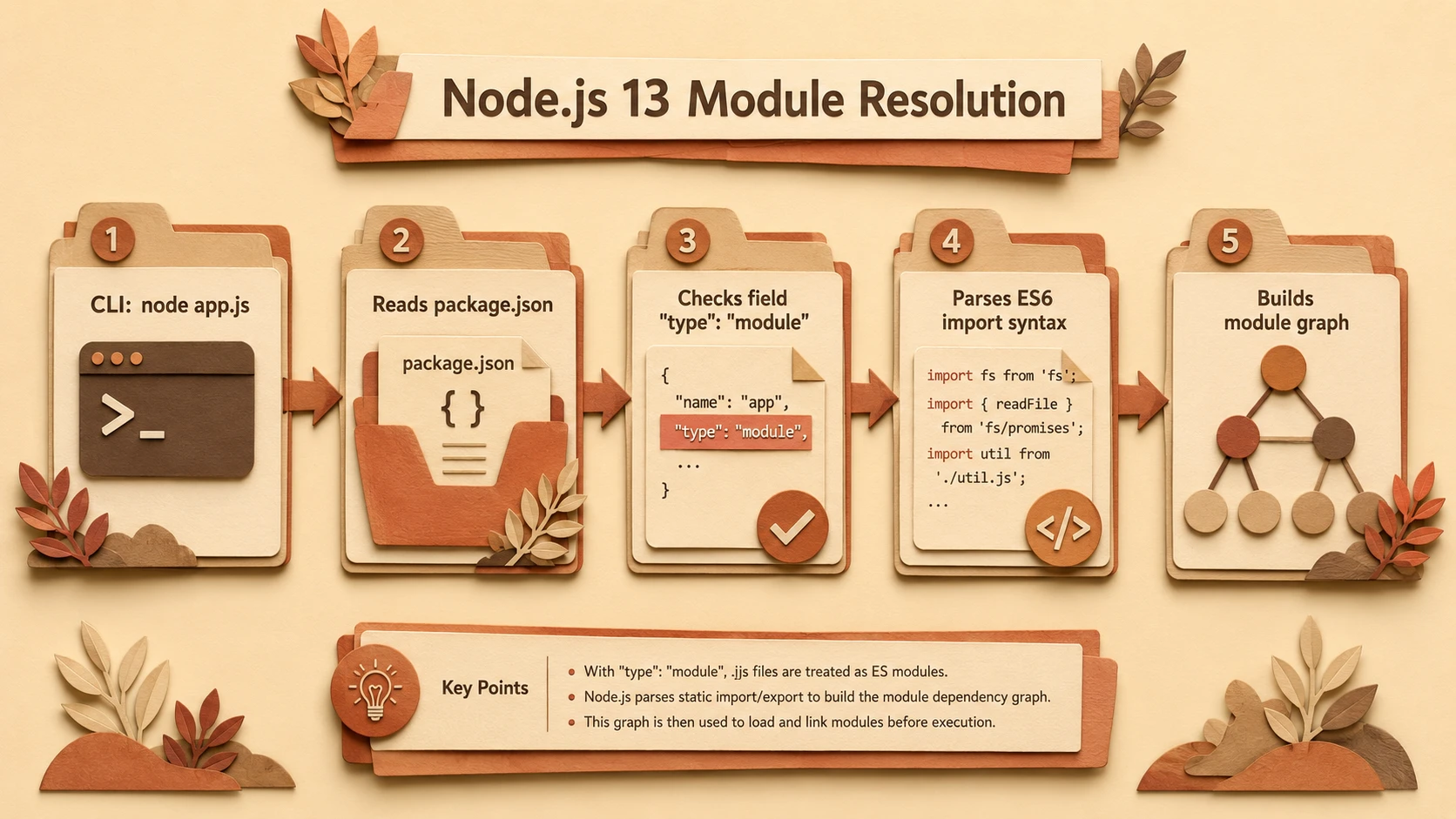
Module Resolution
Node.js 13 continues refining how modules are identified and loaded.
The runtime distinguishes module behavior using established configuration mechanisms such as package metadata and file extensions.
A typical module loading workflow includes:
- 1.The runtime identifies the module type.
- 2.Module dependencies are resolved.
- 3.Imports are validated.
- 4.The dependency graph is constructed.
- 5.Modules are executed.
- 6.Exported values become available to dependent modules.
This deterministic process improves consistency while supporting static dependency analysis.
Relationship with CommonJS
One of the most important considerations for enterprise development is that CommonJS remains fully supported.
Organizations can continue using:
- ◆
require() - ◆
module.exports - ◆Existing package ecosystems
The introduction of native ECMAScript Modules expands the platform rather than replacing existing application architectures.
Migration can therefore occur incrementally.
Enterprise Architecture Benefits
Standardized modules provide several architectural advantages.
Potential improvements include:
- ◆Better dependency organization
- ◆Improved readability
- ◆Consistent browser and server syntax
- ◆Easier static analysis
- ◆Cleaner package boundaries
Applications shared across frontend and backend environments may particularly benefit from consistent module semantics.
Tooling Integration
Event loop routing for non-blocking asynchronous I/O execution threads.
Modern JavaScript development commonly integrates:
- ◆Webpack
- ◆Rollup
- ◆Babel
- ◆TypeScript
- ◆Continuous Integration pipelines
Native ECMAScript Module support reduces reliance on transpilation solely for module syntax, although organizations may continue using build tooling for broader compatibility and optimization.
Enterprise Use Cases
| Scenario | Benefit |
|---|---|
| REST APIs | Modern module organization |
| Microservices | Cleaner dependency management |
| Shared Libraries | Standardized exports |
| Cloud Services | Improved maintainability |
| Full-Stack JavaScript | Consistent module syntax |
| Enterprise Platforms | Simplified architecture |
Organizations maintaining large JavaScript ecosystems benefit from aligning server-side development with the ECMAScript standard.
Performance Considerations
Module syntax itself is not intended as a performance optimization.
Development teams should continue evaluating:
- ◆Application startup
- ◆Dependency resolution
- ◆Module loading behavior
- ◆Build performance
- ◆Memory utilization
- ◆Runtime throughput
Performance improvements should continue to be validated through representative production benchmarking.
Security Considerations
Node.js 13 does not fundamentally alter the platform's security model.
Organizations should continue implementing:
- ◆Dependency auditing
- ◆Package integrity verification
- ◆Input validation
- ◆Authentication
- ◆Authorization
- ◆Secure deployment practices
Migration to ECMAScript Modules should occur alongside established software supply chain governance.
Scalability
Node.js 13 supports scalable enterprise development by:
- ◆Standardizing module organization
- ◆Improving code maintainability
- ◆Simplifying dependency management
- ◆Supporting modern JavaScript ecosystems
These improvements become increasingly valuable as enterprise applications continue expanding across multiple services and repositories.
Best Practices
Organizations evaluating Node.js 13 should:
- ◆Introduce ECMAScript Modules in new development where appropriate.
- ◆Maintain compatibility testing for existing CommonJS applications.
- ◆Standardize project structure before migration.
- ◆Review third-party package compatibility.
- ◆Update development documentation.
- ◆Validate build automation.
- ◆Maintain comprehensive regression testing.
- ◆Establish organization-wide module conventions.
Incremental migration minimizes operational risk while improving long-term maintainability.
Common Mistakes
Development teams should avoid:
- ◆Assuming CommonJS is immediately obsolete.
- ◆Converting mature applications without architectural justification.
- ◆Mixing module styles inconsistently throughout projects.
- ◆Ignoring package compatibility.
- ◆Upgrading production systems without regression testing.
- ◆Treating syntax modernization as a substitute for architectural improvement.
Successful migration depends upon disciplined engineering practices and careful dependency management.
Technology Comparison
| Capability | CommonJS | ECMAScript Modules |
|---|---|---|
| Import Syntax | require() | import |
| Export Syntax | module.exports | export |
| Standardized by ECMAScript | No | Yes |
| Browser Compatibility | No | Yes |
| Static Dependency Analysis | Limited | Improved |
| Native Support in Node.js 13 | Yes | Yes |
Both module systems remain supported, allowing organizations to modernize according to business priorities rather than technical necessity.
Adoption Strategy
Organizations should approach migration through controlled phases.
A recommended strategy includes:
- 1.Inventory existing CommonJS applications.
- 2.Identify shared libraries suitable for modernization.
- 3.Validate third-party package compatibility.
- 4.Introduce ECMAScript Modules in new projects.
- 5.Benchmark build and deployment workflows.
- 6.Update coding standards.
- 7.Expand adoption after operational validation.
Incremental migration minimizes compatibility risk while allowing development teams to gain experience with the standardized module system.
Limitations
As of October 2019, organizations should recognize several considerations.
Current observations include:
- ◆The ECMAScript Module ecosystem continues maturing.
- ◆Existing CommonJS applications remain fully supported.
- ◆Third-party package compatibility should be evaluated before migration.
- ◆Modernization efforts should prioritize maintainability over syntax changes alone.
Organizations should therefore view native ECMAScript Modules as an important platform capability while continuing to follow measured enterprise upgrade practices.
Looking Ahead
Node.js 13 marks a significant step toward aligning server-side JavaScript with the broader ECMAScript ecosystem by enabling native module support without requiring the experimental runtime flag. By embracing standardized imports and exports while maintaining compatibility with CommonJS, the platform provides organizations with a practical path toward modern JavaScript development.
As of October 2019, enterprise architects should begin evaluating ECMAScript Modules for new services and shared libraries while planning incremental migration strategies for existing applications. Organizations that combine careful dependency management, comprehensive compatibility testing, and standardized engineering practices will be well positioned to benefit from the continued evolution of the Node.js ecosystem.