Introduction
Modern enterprise web applications have evolved into highly interactive software platforms supporting real-time dashboards, collaborative workspaces, customer portals, financial systems, and cloud administration consoles. These applications routinely manage thousands of UI components while responding to asynchronous events, user interactions, and continuous network activity.
React has established itself as one of the leading JavaScript libraries for building component-driven interfaces. Earlier releases demonstrated the benefits of declarative programming and Virtual DOM reconciliation, but increasingly complex applications also highlighted limitations in the original rendering engine, particularly regarding scheduling flexibility and error recovery.
React 16.0 marks one of the most important releases in the library's history. Beneath the familiar programming model lies Fiber, a completely redesigned reconciliation engine that enables more intelligent scheduling and establishes a stronger architectural foundation for future enhancements. Alongside Fiber, React 16 introduces Error Boundaries, Portals, improved server-side rendering, support for returning arrays and strings from render methods, and numerous performance optimizations.
From the perspective of September 2017, React 16.0 is not merely another framework update but the beginning of a new architectural generation for enterprise front-end development.
Industry Background
Enterprise software increasingly relies on sophisticated Single Page Applications.
Organizations commonly develop:
- ◆Customer Relationship Management systems.
- ◆Enterprise Resource Planning portals.
- ◆Business intelligence dashboards.
- ◆Financial trading platforms.
- ◆Cloud infrastructure consoles.
- ◆Healthcare management systems.
- ◆Software-as-a-Service applications.
As these applications grow, development teams require frameworks that provide:
- ◆Predictable rendering.
- ◆Component isolation.
- ◆Better fault tolerance.
- ◆Scalable application architecture.
- ◆Efficient updates.
- ◆Long-term maintainability.
React 16.0 addresses these requirements through improvements to both runtime behavior and developer experience.
The Business Problem
Large React applications frequently encounter several engineering challenges.
Organizations commonly experience:
- ◆Large rendering workloads.
- ◆Limited error isolation.
- ◆Complex modal implementations.
- ◆Deep component hierarchies.
- ◆Application instability after rendering failures.
- ◆Difficult debugging.
- ◆Growing maintenance complexity.
Production applications require mechanisms that improve resilience while maintaining responsive user interfaces.
React 16.0 introduces architectural improvements designed specifically for these enterprise concerns.
Understanding the Technology
React 16.0 preserves the familiar component programming model while introducing a redesigned rendering architecture.
Major capabilities include:
- ◆Fiber reconciliation engine.
- ◆Improved scheduling.
- ◆Error Boundaries.
- ◆Portals.
- ◆Better server-side rendering.
- ◆Improved rendering flexibility.
- ◆Enhanced developer experience.
Most application code continues using familiar React components, while the underlying rendering engine has been substantially modernized.
Core Architecture
A simplified React 16 architecture appears below.
| Component | Responsibility |
|---|---|
| React Components | Define application UI |
| Fiber Scheduler | Organizes rendering work |
| Reconciliation Engine | Calculates UI updates |
| Virtual DOM | Intermediate UI representation |
| Renderer | Updates browser DOM |
| Browser | Displays application |
Fiber enables React to manage rendering work more intelligently while preserving the existing component model.
Key Features
Fiber Scheduler
The defining architectural improvement in React 16 is Fiber.
Fiber replaces the original reconciliation implementation with a more flexible scheduling system capable of organizing rendering work into smaller units.
This architecture provides the foundation for improved responsiveness and future rendering enhancements.
Although many of Fiber's capabilities remain internal, the redesign prepares React for increasingly sophisticated scheduling strategies.
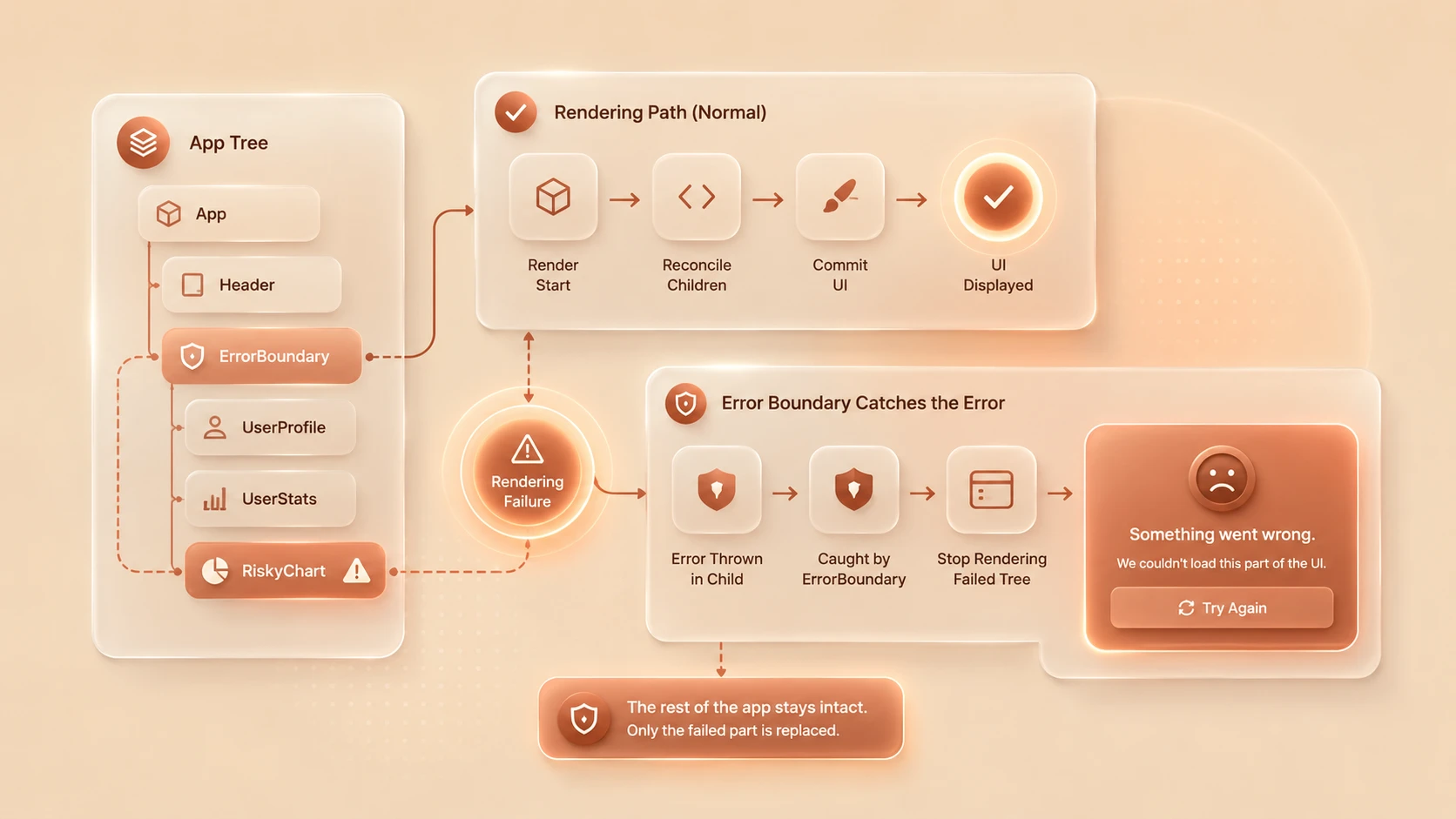
Error Boundaries
Prior to React 16, rendering errors frequently caused entire component trees to fail.
Error Boundaries allow developers to isolate rendering failures within specific portions of the interface.
Applications can display fallback user interfaces rather than terminating unexpectedly.
This significantly improves resilience for enterprise software.
Portals
Portals allow components to render content outside their normal parent hierarchy while preserving React's event model.
This simplifies implementation of:
- ◆Modal dialogs.
- ◆Notifications.
- ◆Tooltips.
- ◆Overlay components.
Developers can build complex interface structures without compromising application organization.
Improved Server-Side Rendering
React 16 introduces improvements to server-side rendering performance and output generation.
These enhancements benefit applications emphasizing initial page delivery and server-generated markup.
Flexible Render Output
Components are no longer restricted to returning a single root element.
Developers gain additional flexibility through support for rendering arrays and strings where appropriate.
Smaller Runtime
Internal optimizations contribute to a reduced framework footprint while preserving existing functionality.
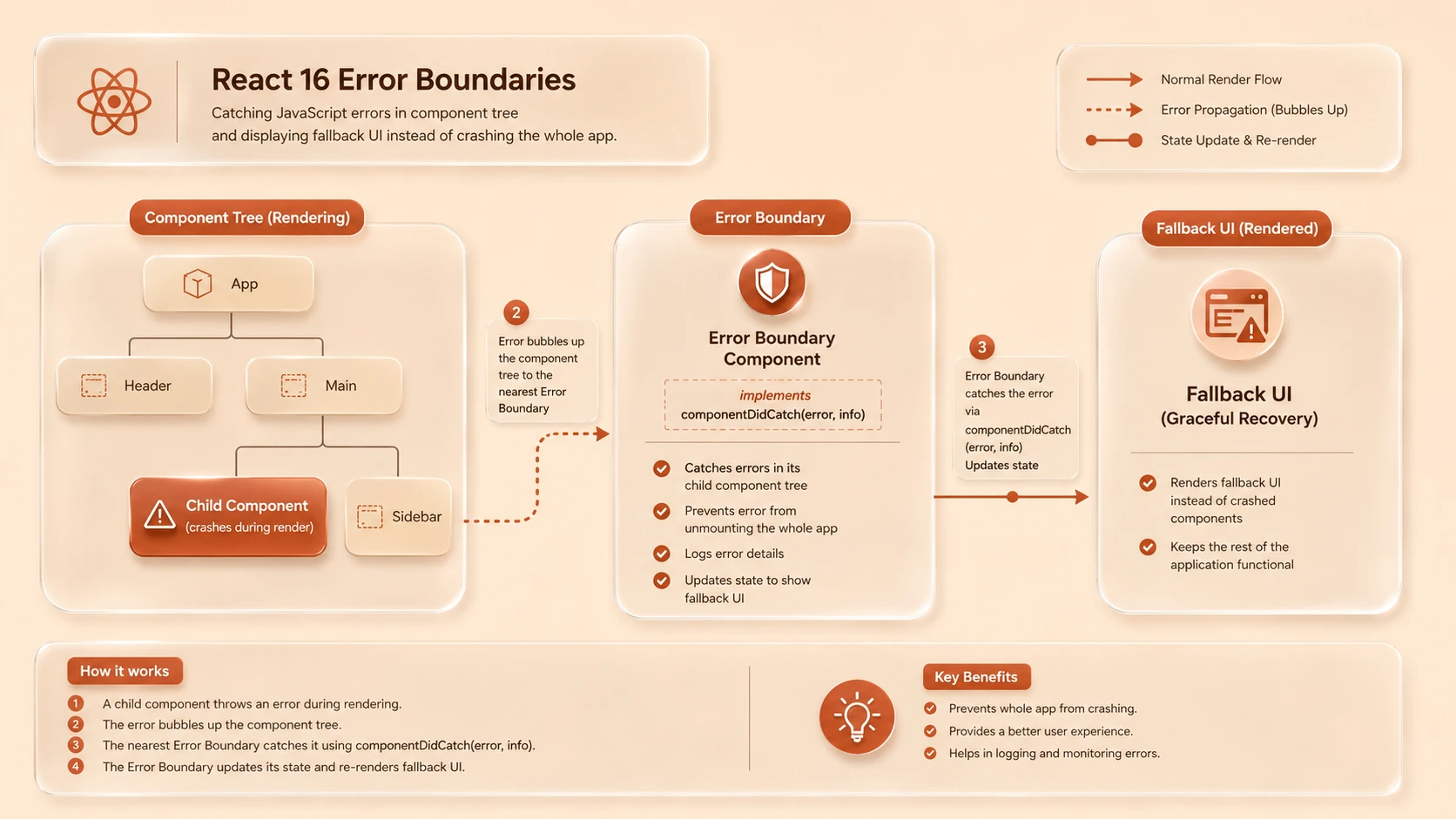
System architecture diagram and conceptual workflow layout for React 16.0: The Fiber Scheduler, Portals, and Error Boundaries.
How It Works
A simplified rendering workflow appears below.
Application State
        |
Component Update
        |
Fiber Scheduler
        |
Reconciliation
        |
Virtual DOM
        |
Browser DOM
        |
Updated Interface
Rendering work flows through the Fiber scheduler before updates are committed to the browser.
Enterprise Use Cases
Business Dashboards
Large administrative interfaces benefit from improved rendering architecture and resilient component error handling.
Software-as-a-Service Platforms
Customer-facing applications gain better fault isolation through Error Boundaries.
Financial Systems
Mission-critical interfaces benefit from graceful recovery when rendering failures occur.
Cloud Administration Portals
Complex modal windows and overlays become easier to implement using Portals.
Enterprise Design Systems
Reusable component libraries benefit from improved rendering flexibility and cleaner application architecture.
Performance Considerations
React 16 introduces several internal improvements.
Organizations should evaluate:
- ◆Rendering latency.
- ◆Component complexity.
- ◆Server-side rendering performance.
- ◆Bundle size.
- ◆Browser responsiveness.
- ◆Memory utilization.
Application architecture remains the primary factor influencing overall performance.
Security Considerations
React 16 focuses on rendering architecture rather than application security.
Organizations should continue implementing:
- ◆Authentication.
- ◆Authorization.
- ◆HTTPS.
- ◆Cross-Site Scripting mitigation.
- ◆Secure API communication.
- ◆Dependency management.
Framework improvements should complement established secure software development practices.
Scalability
React 16 strengthens enterprise scalability through architectural improvements.
Advantages include:
- ◆Better rendering foundation.
- ◆Improved fault isolation.
- ◆Flexible component composition.
- ◆More maintainable interfaces.
- ◆Better support for large applications.
These characteristics become increasingly valuable as enterprise applications continue expanding.
Best Practices
Organizations adopting React 16 should:
- ◆Introduce Error Boundaries around critical interface regions.
- ◆Use Portals for overlays and modal dialogs.
- ◆Continue designing reusable components.
- ◆Profile rendering performance regularly.
- ◆Benchmark server-side rendering.
- ◆Maintain predictable application state.
- ◆Validate third-party library compatibility.
Well-designed component architecture remains essential for long-term maintainability.
Common Mistakes
| Mistake | Business Impact |
|---|---|
| Assuming Fiber changes the public React programming model | Architectural confusion |
| Using Error Boundaries as a substitute for proper testing | Reduced software quality |
| Overusing Portals unnecessarily | Increased interface complexity |
| Ignoring performance profiling | Missed optimization opportunities |
| Delaying third-party compatibility testing | Migration risk |
| Treating React 16 as only a performance update | Underestimating architectural improvements |
Organizations should evaluate React 16 as both a runtime modernization and a foundation for future framework evolution.
Technology Comparison
| Characteristic | React 15 | React 16 |
|---|---|---|
| Rendering Engine | Original reconciler | Fiber architecture |
| Error Recovery | Entire tree may fail | Error Boundaries |
| Portal Rendering | External libraries or workarounds | Native Portals |
| Render Output | Single root element | Arrays and strings supported |
| Server-Side Rendering | Mature | Improved implementation |
| Architecture | Synchronous reconciliation | Fiber-based scheduling foundation |
React 16 modernizes the rendering engine while maintaining a familiar developer experience.
Adoption Strategy
Organizations should adopt React 16 through incremental modernization.
- 1.Evaluate existing React applications.
- 2.Verify third-party library compatibility.
- 3.Upgrade development environments.
- 4.Introduce Error Boundaries around critical application modules.
- 5.Replace custom overlay implementations with Portals where appropriate.
- 6.Benchmark rendering and server-side performance before production deployment.
This phased approach minimizes migration risk while allowing engineering teams to benefit from React 16's architectural improvements.
Limitations
As of September 2017, organizations should recognize several considerations.
- ◆Some third-party libraries may require compatibility updates.
- ◆Fiber's long-term scheduling capabilities continue evolving.
- ◆Existing optimization techniques remain important.
- ◆Migration testing should be comprehensive.
- ◆Development teams should understand the new error handling model.
These considerations should be incorporated into enterprise upgrade planning.
Looking Ahead
From the perspective of September 2017, React 16.0 represents the most significant architectural advancement since React's original release. By introducing the Fiber scheduler into production, improving application resilience through Error Boundaries, simplifying complex UI composition with Portals, and refining server-side rendering, Facebook has created a stronger foundation for the next generation of enterprise web applications.
While developers can continue using the familiar React component model, the underlying architecture is now considerably more flexible and better suited to increasingly interactive applications. Organizations building large-scale Single Page Applications should view React 16 not simply as another framework release, but as a strategic investment in a more scalable, maintainable, and resilient front-end platform.