Introduction
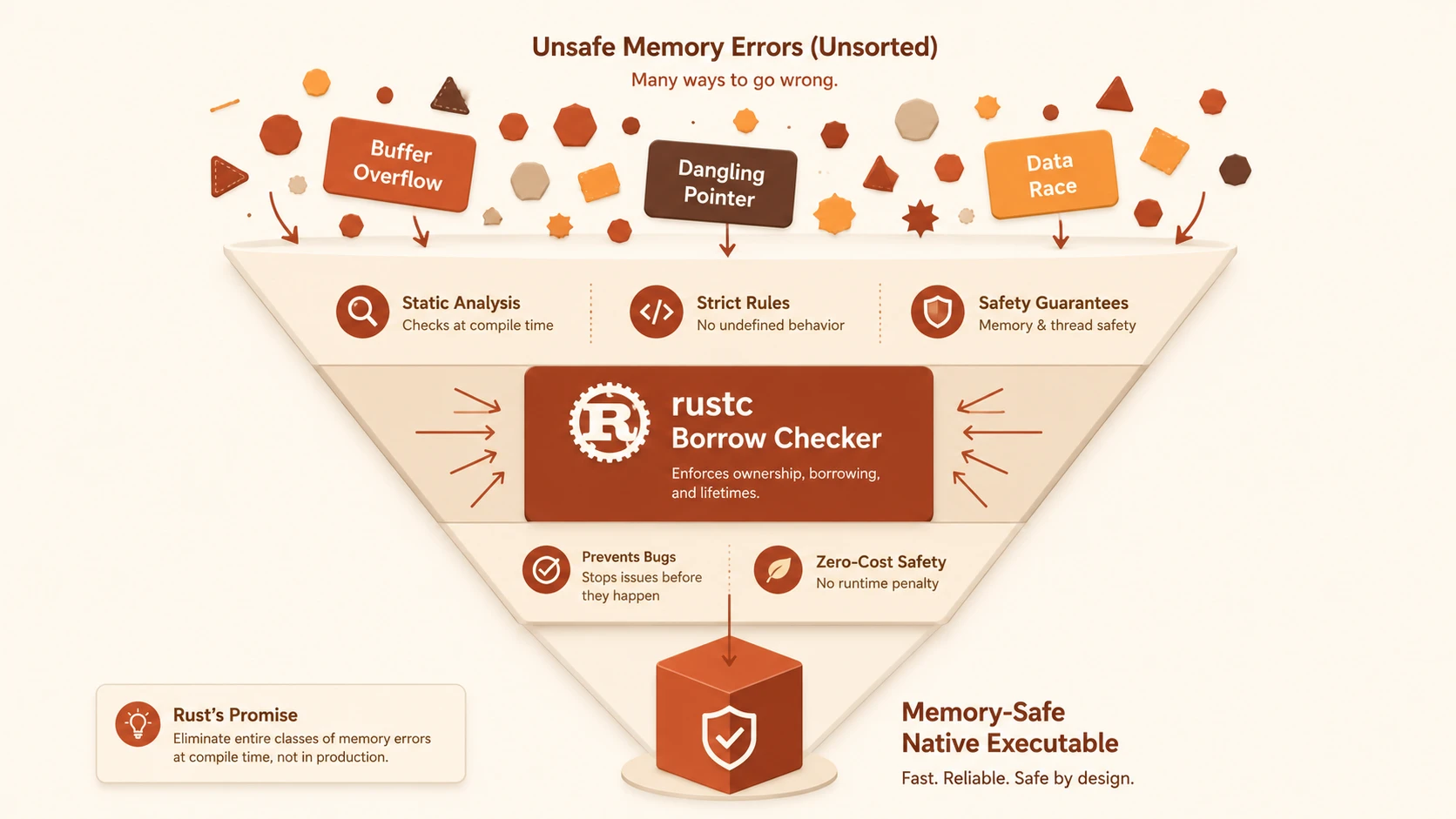
Since reaching its 1.0 release, Rust has steadily gained attention among systems programmers for combining high performance with strong compile-time safety guarantees. Its ownership model, borrow checker, and zero-cost abstractions allow developers to write efficient native applications while significantly reducing classes of memory-related errors that have historically affected systems software.
As Rust adoption has expanded beyond language enthusiasts into infrastructure engineering, networking, cloud platforms, command-line utilities, and embedded systems, developer productivity has become just as important as language correctness. Organizations evaluating Rust require a stable language that can evolve without fragmenting the ecosystem or introducing unnecessary compatibility concerns.
The Rust 2018 Edition represents an important milestone toward that objective. Rather than introducing an entirely new language, the edition mechanism provides a structured way to deliver language improvements, tooling refinements, and compiler enhancements while preserving compatibility across the broader Rust ecosystem.
Among the most notable improvements are refinements to the module system, simplified path handling, Non-Lexical Lifetimes (NLL), improved tooling integration, and continued enhancements to Cargo.
From the perspective of May 2018, the Rust 2018 Edition demonstrates the language's growing maturity and its readiness for larger enterprise software projects.
Industry Background
Modern infrastructure software increasingly emphasizes:
- ◆Memory safety.
- ◆High performance.
- ◆Cross-platform portability.
- ◆Reliable concurrency.
- ◆Infrastructure automation.
- ◆Cloud-native services.
- ◆Long-term maintainability.
Organizations developing operating system components, networking software, command-line tools, distributed services, and security-sensitive applications increasingly seek languages capable of balancing runtime efficiency with compile-time correctness.
Rust continues attracting attention because it addresses many of these requirements without relying on garbage collection.
The Business Problem
Large native software projects frequently encounter several engineering challenges.
Organizations commonly experience:
- ◆Memory safety vulnerabilities.
- ◆Complex ownership rules.
- ◆Difficult module organization.
- ◆Compiler learning curves.
- ◆Package management challenges.
- ◆Long-term maintainability concerns.
- ◆Migration complexity.
Although Rust's ownership model provides significant safety guarantees, earlier language versions occasionally required developers to structure code in ways that felt unnecessarily restrictive.
The Rust 2018 Edition addresses several of these developer experience concerns while preserving Rust's safety principles.
Understanding the Technology
The Rust 2018 Edition introduces a collection of language, compiler, and tooling improvements.
Major enhancements include:
- ◆Edition-based language evolution.
- ◆Module system simplification.
- ◆Path clarity improvements.
- ◆Non-Lexical Lifetimes.
- ◆Cargo workflow enhancements.
- ◆Better compiler diagnostics.
- ◆Improved tooling integration.
Unlike traditional language versioning, Rust Editions allow existing projects to continue compiling while enabling new projects to adopt improved conventions.
Core Architecture
A simplified Rust development architecture appears below.
| Component | Responsibility |
|---|---|
| Rust Source Code | Application implementation |
| Cargo | Build and dependency management |
| Rust Compiler | Parsing, borrow checking, optimization |
| Edition Rules | Language behavior and compatibility |
| Native Binary | Platform executable |
| Operating System | Application execution |
The edition mechanism influences language behavior while allowing the compiler to preserve compatibility between supported editions.
Key Features
Rust Editions
The Rust 2018 Edition introduces a structured evolution model.
Rather than creating incompatible language branches, editions provide a mechanism for improving language ergonomics while preserving interoperability across the Rust ecosystem.
Libraries compiled under different editions continue to interact through the same compiler infrastructure.
Module Path Improvements
Earlier Rust versions occasionally required verbose or unintuitive module paths.
The 2018 Edition simplifies module organization by making path handling more consistent and predictable.
Developers spend less effort understanding module visibility and more time focusing on application architecture.
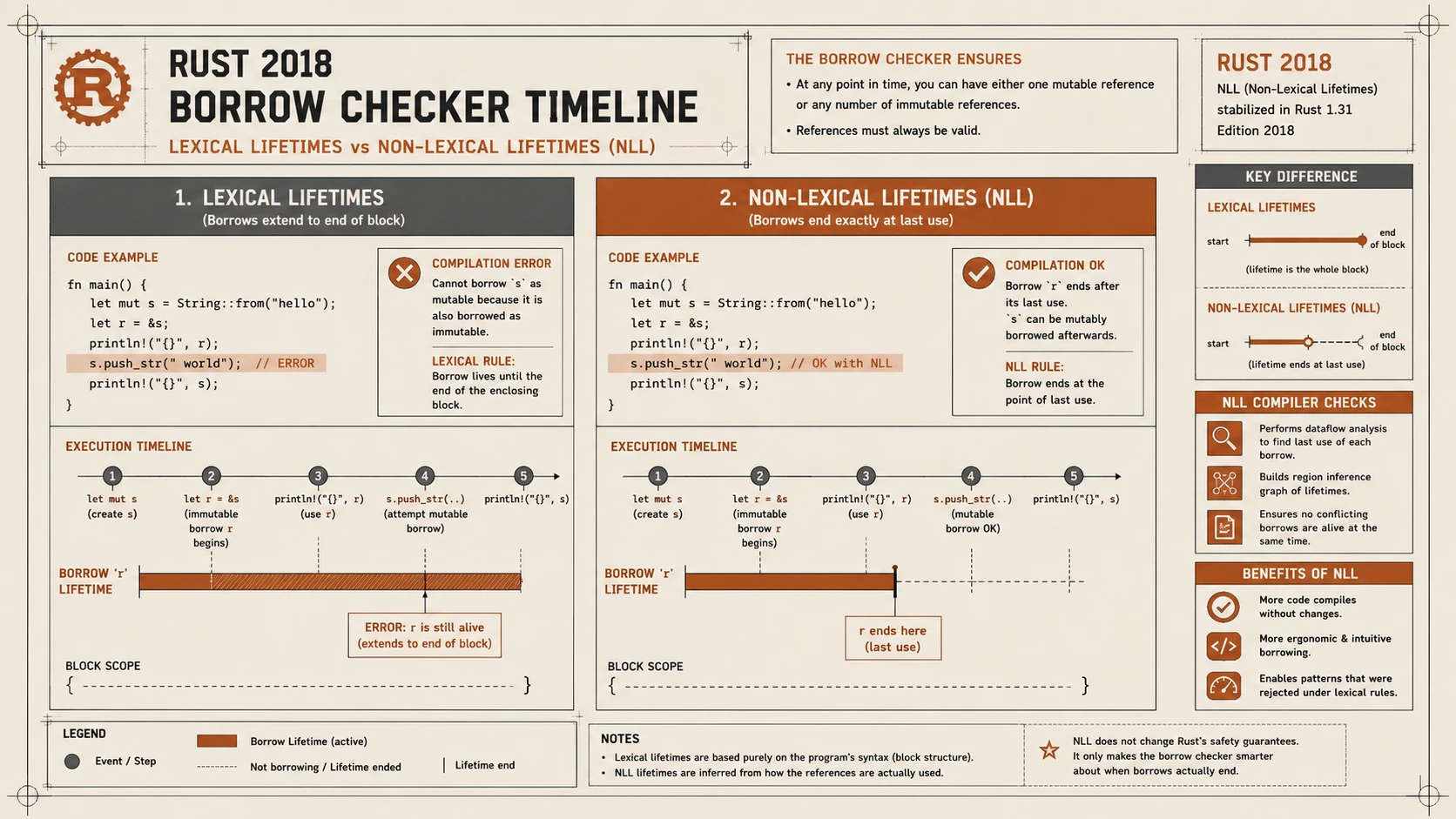
Non-Lexical Lifetimes (NLL)
One of the most significant compiler improvements is the introduction of Non-Lexical Lifetimes.
Traditional borrow checking often extended lifetimes until the end of a lexical scope, even when references were no longer used.
NLL enables the compiler to determine lifetimes more precisely based on actual program usage rather than purely lexical boundaries.
This allows many valid programs to compile without weakening Rust's ownership guarantees.
Improved Compiler Diagnostics
Rust continues emphasizing high-quality compiler feedback.
Clearer diagnostics help developers understand ownership issues, borrowing constraints, and type mismatches more efficiently.
Cargo Enhancements
Cargo remains the standard build and package management tool for Rust.
The 2018 Edition continues strengthening development workflows through improved tooling integration.
Productivity Improvements
Many language refinements target developer productivity rather than raw runtime performance.
Reducing unnecessary complexity improves maintainability while preserving Rust's safety guarantees.
How It Works
System architecture diagram and conceptual workflow layout for Rust 2018 Edition.
A simplified compilation workflow appears below.
Rust Source Code
        |
Cargo
        |
Rust Compiler
        |
Borrow Checker
        |
Edition Rules
        |
Native Binary
Edition rules influence language interpretation while the compiler continues enforcing ownership, borrowing, and type safety.
Enterprise Use Cases
Infrastructure Software
System utilities benefit from Rust's memory safety and efficient native execution.
Cloud Services
High-performance backend services can leverage Rust's predictable resource management.
Networking Software
Protocol implementations benefit from safe concurrency and efficient memory usage.
Security Applications
Compile-time memory safety reduces classes of vulnerabilities commonly associated with systems programming.
Command-Line Tools
Cross-platform utilities benefit from Cargo's package management and Rust's portable compiler.
Performance Considerations
The Rust 2018 Edition primarily improves developer productivity rather than changing runtime execution characteristics.
Organizations should evaluate:
- ◆Compilation performance.
- ◆Build workflows.
- ◆Memory utilization.
- ◆Compiler diagnostics.
- ◆Binary size.
- ◆Developer productivity.
Runtime performance continues depending largely on application architecture and compiler optimizations.
Security Considerations
Rust continues emphasizing secure systems programming.
Organizations should continue implementing:
- ◆Secure software architecture.
- ◆Dependency management.
- ◆Authentication.
- ◆Authorization.
- ◆Input validation.
- ◆Security testing.
Rust's ownership model complements broader secure software engineering practices by reducing memory safety risks.
Scalability
The Rust 2018 Edition strengthens scalability from a software engineering perspective.
Advantages include:
- ◆Cleaner module organization.
- ◆Improved compiler ergonomics.
- ◆Better tooling.
- ◆More maintainable code.
- ◆Safer concurrent programming.
These characteristics support long-lived enterprise software projects.
Best Practices
Organizations adopting the Rust 2018 Edition should:
- ◆Standardize new projects on the 2018 Edition.
- ◆Continue using Cargo for dependency management.
- ◆Organize applications into well-defined modules.
- ◆Take advantage of improved compiler diagnostics.
- ◆Benchmark representative production workloads.
- ◆Expand automated testing.
- ◆Train development teams on updated module conventions.
Incremental modernization minimizes migration risk while improving long-term maintainability.
Common Mistakes
| Mistake | Business Impact |
|---|---|
| Treating editions as incompatible language forks | Architectural misunderstanding |
| Ignoring module organization improvements | Reduced maintainability |
| Assuming NLL removes ownership rules | Incorrect expectations |
| Delaying dependency updates | Missed tooling improvements |
| Migrating large projects without testing | Operational risk |
| Overlooking compiler guidance | Slower developer productivity |
Organizations should view the Rust 2018 Edition as an evolution of the language rather than a complete redesign.
Technology Comparison
| Characteristic | Rust 2015 Edition | Rust 2018 Edition |
|---|---|---|
| Module Paths | Earlier module conventions | Simplified path organization |
| Borrow Checking | Lexical lifetime model | Non-Lexical Lifetimes |
| Compiler Diagnostics | Mature | Improved guidance |
| Cargo Integration | Stable | Enhanced workflow |
| Language Evolution | Traditional releases | Edition-based improvements |
The Rust 2018 Edition focuses on improving developer experience while preserving Rust's core safety model.
Adoption Strategy
Organizations should approach the Rust 2018 Edition through structured modernization.
- 1.Upgrade Rust toolchains.
- 2.Evaluate existing projects.
- 3.Standardize new development on the 2018 Edition.
- 4.Modernize module organization where appropriate.
- 5.Validate production workloads.
- 6.Expand adoption following successful migration.
This incremental strategy allows organizations to benefit from language improvements while minimizing operational disruption.
Limitations
As of May 2018, organizations should recognize several considerations.
- ◆Existing projects may require migration planning.
- ◆Development teams should become familiar with revised module conventions.
- ◆Compiler improvements do not eliminate the need to understand ownership.
- ◆Third-party libraries should be evaluated during upgrades.
- ◆Enterprise development practices continue evolving alongside the Rust ecosystem.
These considerations should guide long-term adoption planning.
Looking Ahead
From the perspective of May 2018, the Rust 2018 Edition represents an important milestone in the language's maturation. By introducing edition-based evolution, simplifying module paths, improving compiler ergonomics through Non-Lexical Lifetimes, and strengthening developer tooling, the Rust project has demonstrated a commitment to improving productivity without compromising its core principles of safety and performance.
For organizations evaluating Rust as a long-term systems programming platform, the 2018 Edition offers a more approachable development experience while preserving the language's defining strengths in memory safety, concurrency, and predictable native performance. These improvements position Rust as an increasingly compelling choice for modern infrastructure, cloud, networking, and enterprise systems software.