Modern enterprises increasingly depend on distributed systems rather than large monolithic applications. Business processes span multiple departments, applications, and platforms, requiring software architects to design systems that communicate reliably regardless of language or operating system.
Windows Communication Foundation (WCF) has become Microsoft's strategic framework for building service-oriented applications. With the release of .NET Framework 4.0, WCF continues to mature by simplifying configuration, improving diagnostics, introducing better workflow integration, and making enterprise service development more approachable for development teams.
For organizations already investing in Microsoft technologies, WCF provides a unified communication framework capable of supporting SOAP web services, TCP communication, message queues, peer networking, and REST-style services from a common programming model.
This article examines how enterprise teams can successfully adopt WCF in .NET 4.0 while following sound Service-Oriented Architecture (SOA) principles.
Why Enterprises Are Moving Toward SOA
Many enterprise systems developed during the previous decade were tightly coupled. Individual applications often contained business rules, presentation logic, and data access layers within a single deployment, making maintenance increasingly difficult.
Organizations now seek architectures that provide:
- ◆Reusable business services
- ◆Platform interoperability
- ◆Independent application evolution
- ◆Simplified integration projects
- ◆Centralized security policies
- ◆Better scalability
- ◆Easier partner integration
Rather than exposing entire applications, SOA encourages exposing business capabilities as well-defined services.
Examples include:
- ◆Customer Management Service
- ◆Order Processing Service
- ◆Inventory Service
- ◆Payment Service
- ◆Employee Directory Service
Each service focuses on a specific business responsibility while remaining accessible to multiple client applications.
WCF as Microsoft's Unified Communication Framework
Prior to WCF, Microsoft developers selected different technologies depending on communication requirements.
| Scenario | Earlier Technology |
|---|---|
| SOAP Web Services | ASP.NET Web Services (ASMX) |
| Distributed Objects | .NET Remoting |
| Enterprise Messaging | MSMQ APIs |
| COM+ Integration | Enterprise Services |
| TCP Communication | Custom Solutions |
Maintaining several communication technologies increased complexity across enterprise projects.
WCF unifies these scenarios into a single programming model where developers define:
- ◆Service contracts
- ◆Data contracts
- ◆Endpoints
- ◆Bindings
- ◆Behaviors
The transport mechanism becomes largely configurable rather than requiring major application rewrites.
Core WCF Architecture
Every WCF service revolves around three fundamental concepts.
Service Contract
// Defining a WCF Service Contract with Operation Contracts
[ServiceContract(Namespace = "http://shivamitcs.com/services/2010/04")]
public interface IOrderProcessor
{
    [OperationContract]
    [FaultContract(typeof(OrderProcessingFault))]
    ProcessOrderResponse ProcessOrder(ProcessOrderRequest request);
}

[DataContract]
public class ProcessOrderRequest
{
    [DataMember(IsRequired = true)]
    public string OrderId { get; set; }
}
The service contract defines what operations are available.
csharp [ServiceContract] public interface ICustomerService { [OperationContract] Customer GetCustomer(int id); }
The contract represents the public interface that consumers interact with.
Data Contract
Data contracts define how business objects are serialized.
csharp [DataContract] public class Customer { [DataMember] public int CustomerId;
[DataMember] public string Name; }
Clear data contracts improve interoperability between different platforms.
Endpoints
Every WCF endpoint consists of three components:
- ◆Address
- ◆Binding
- ◆Contract
Many architects summarize this using the phrase:
ABC = Address + Binding + Contract
This separation provides flexibility while minimizing implementation changes.
Choosing the Appropriate Binding
Selecting the correct binding remains one of the most important architectural decisions.
| Binding | Recommended Scenario | Advantages |
|---|---|---|
| BasicHttpBinding | Legacy ASMX interoperability | Broad compatibility |
| WSHttpBinding | Enterprise SOAP services | Security and WS-* support |
| NetTcpBinding | Internal enterprise communication | High performance |
| NetNamedPipeBinding | Same-machine applications | Very fast IPC |
| NetMsmqBinding | Reliable asynchronous messaging | Offline processing |
| WebHttpBinding | REST-style services | Lightweight HTTP communication |
Architects should avoid selecting bindings solely based on performance. Security requirements, interoperability, reliability, and infrastructure support must also influence the decision.
What's New in WCF with .NET Framework 4.0
Developers upgrading to .NET Framework 4.0 will notice several improvements that simplify enterprise development.
Simplified Configuration
Configuration files are less verbose than previous releases.
Many default settings reduce the amount of XML developers must maintain.
Benefits include:
- ◆Faster onboarding
- ◆Easier maintenance
- ◆Reduced configuration errors
Improved Diagnostics
Diagnosing distributed systems has traditionally been difficult.
.NET 4.0 improves diagnostics through:
- ◆Better tracing
- ◆Improved message logging
- ◆Enhanced configuration validation
- ◆Richer debugging experience
These improvements reduce troubleshooting time during development and production support.
Better Workflow Integration
Windows Workflow Foundation and WCF now integrate more naturally.
Organizations automating approval processes, document routing, and long-running business operations can more easily expose workflows as services.
Routing Service
WCF Routing enables intelligent message routing between clients and services.
Possible enterprise scenarios include:
- ◆Version migration
- ◆Load distribution
- ◆Service aggregation
- ◆Centralized endpoint management
Routing provides additional architectural flexibility without requiring client applications to understand the physical deployment topology.
Typical Enterprise Service Architecture
A layered WCF application often follows this architecture.
text Client Applications
WCF Services
Business Logic Layer
Repository Layer
Databases / Legacy Systems
This separation encourages maintainability while supporting independent testing of business logic.
Security Considerations
Enterprise services frequently exchange sensitive business information.
Security should therefore be considered during initial architecture rather than being added later.
WCF supports multiple security approaches.
Transport Security
Transport security relies on protocols such as HTTPS.
Advantages include:
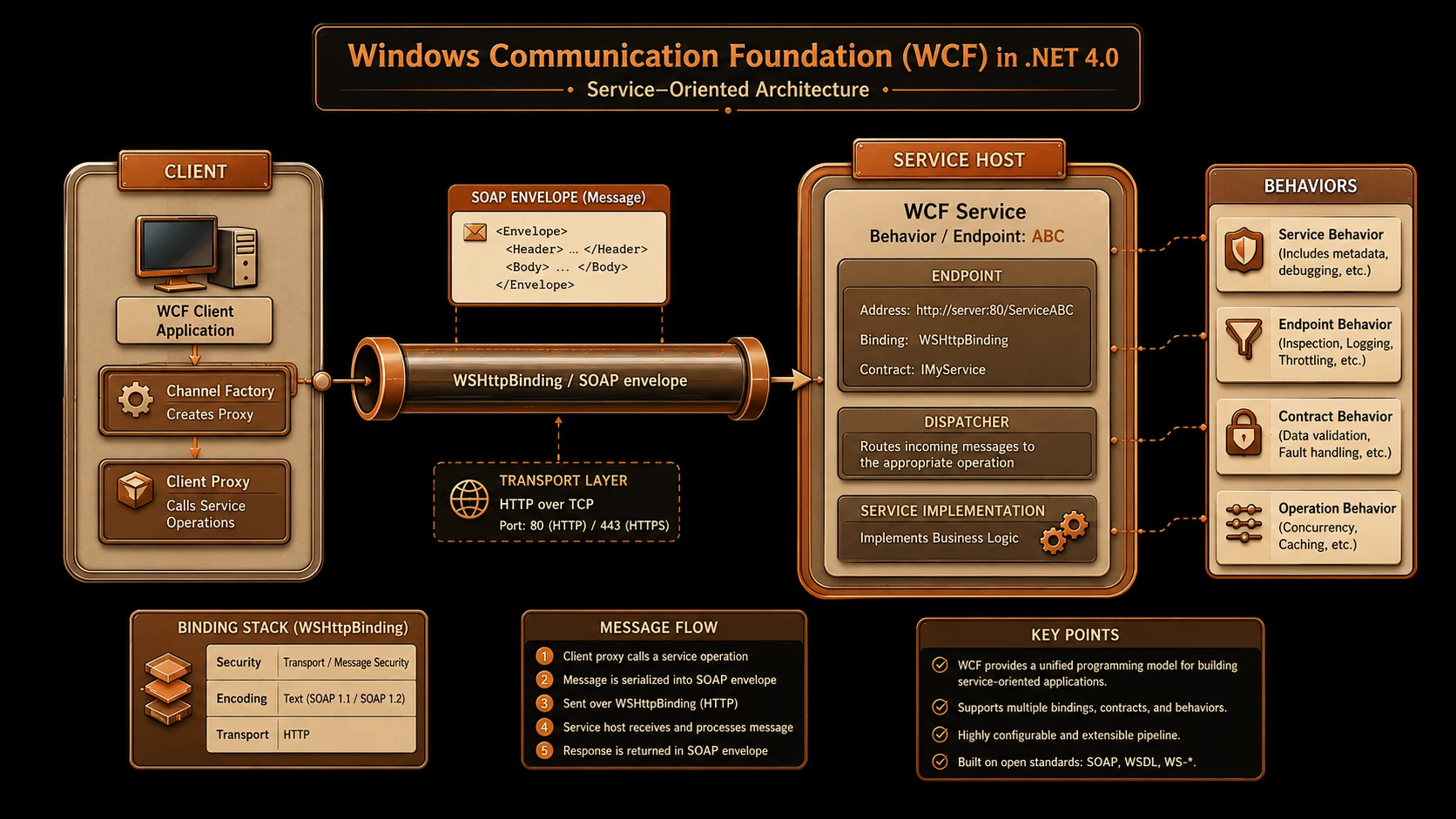
Service-Oriented Architecture (SOA) channel bindings and message security configurations.
- ◆Simpler deployment
- ◆Strong encryption
- ◆Suitable for Internet-facing applications
Message Security
Message security protects the SOAP message itself.
Advantages include:
- ◆End-to-end protection
- ◆Multi-hop communication support
- ◆Flexible authentication models
Although message security introduces additional processing overhead, it provides capabilities valuable for many enterprise integrations.
Authentication Options
WCF supports several authentication mechanisms including:
- ◆Windows Authentication
- ◆Username and Password
- ◆X.509 Certificates
- ◆Custom authentication providers
Internal enterprise environments commonly leverage Windows authentication because it integrates naturally with Active Directory.
Reliable Messaging
Enterprise applications often cannot tolerate message loss.
Examples include:
- ◆Financial transactions
- ◆Purchase orders
- ◆Insurance processing
- ◆Manufacturing systems
Reliable messaging ensures messages reach their destination despite temporary network interruptions.
Combined with MSMQ, WCF enables asynchronous communication patterns suitable for disconnected environments.
Designing Effective Service Contracts
Well-designed service contracts remain stable even as internal implementations evolve.
Best practices include:
- ◆Keep operations business-oriented
- ◆Avoid exposing database structures
- ◆Use coarse-grained operations
- ◆Design for version tolerance
- ◆Keep contracts independent from UI concerns
Instead of exposing numerous small methods, services should represent meaningful business operations.
For example:
Good:
- ◆SubmitOrder()
- ◆ApproveInvoice()
- ◆RegisterCustomer()
Less desirable:
- ◆UpdateField1()
- ◆UpdateColumn2()
- ◆SaveRow()
Business-oriented contracts better reflect enterprise workflows.
Interoperability Considerations
Many organizations operate heterogeneous environments.
A single enterprise may include:
- ◆Java applications
- ◆IBM middleware
- ◆PHP web applications
- ◆Legacy systems
- ◆Microsoft solutions
When interoperability is a priority, architects should:
- ◆Follow WS-* standards
- ◆Avoid unnecessary proprietary extensions
- ◆Validate service contracts with external consumers
- ◆Carefully select compatible bindings
BasicHttpBinding often provides the broadest compatibility when communicating with non-Microsoft platforms.
Hosting Options
WCF supports multiple hosting environments.
| Hosting Option | Typical Scenario |
|---|---|
| IIS | Internet-facing web services |
| Windows Service | Long-running enterprise services |
| Self Hosting | Lightweight internal applications |
| WAS | Flexible protocol hosting |
Choosing the appropriate hosting environment depends on operational requirements, availability expectations, and infrastructure standards.
Performance Best Practices
Enterprise scalability depends on careful service design.
Recommended practices include:
- ◆Minimize network round trips
- ◆Reduce message size
- ◆Use appropriate bindings
- ◆Enable connection pooling where applicable
- ◆Avoid excessive serialization
- ◆Cache reference data when practical
- ◆Monitor service performance under realistic workloads
Developers should benchmark representative workloads before production deployment.
Common Design Mistakes
Many early WCF projects encounter similar challenges.
Treating Services Like Remote Objects
Simply exposing existing classes as services often produces chatty interfaces with poor network performance.
Ignoring Versioning
Contracts should evolve carefully. Breaking existing consumers creates unnecessary deployment challenges.
Overly Fine-Grained Operations
Numerous small service calls increase latency and reduce scalability.
Poor Exception Handling
Internal exceptions should not be exposed directly to clients.
Instead, use structured fault contracts that communicate meaningful business errors.
Excessive Configuration Complexity
Large configuration files become difficult to maintain.
Development teams should organize configuration consistently across environments.
Enterprise Use Cases
Organizations evaluating WCF should consider several practical scenarios.
Banking
- ◆Account services
- ◆Loan processing
- ◆Customer verification
- ◆Internal branch communication
Healthcare
- ◆Patient management
- ◆Appointment scheduling
- ◆Insurance integration
- ◆Laboratory information exchange
Manufacturing
- ◆Inventory synchronization
- ◆Production scheduling
- ◆Supplier communication
- ◆Warehouse management
Government
- ◆Citizen services
- ◆Document processing
- ◆Department integration
- ◆Secure information exchange
These scenarios illustrate how reusable service layers can support multiple client applications while centralizing business logic.
Governance and Service Lifecycle
Successful SOA initiatives require more than technology.
Organizations should establish governance practices that include:
- ◆Service ownership
- ◆Naming standards
- ◆Version management
- ◆Security reviews
- ◆Documentation requirements
- ◆Deployment procedures
- ◆Operational monitoring
Without governance, service portfolios can quickly become inconsistent and difficult to manage.
Adoption Recommendations
Organizations considering WCF adoption should proceed incrementally rather than attempting a complete system rewrite.
Recommended approach:
- 1.Identify reusable business capabilities.
- 2.Design stable service contracts.
- 3.Standardize bindings and security policies.
- 4.Establish governance early.
- 5.Pilot services with one or two business domains.
- 6.Monitor performance and operational metrics.
- 7.Expand the service portfolio based on proven success.
This gradual approach reduces project risk while allowing teams to build expertise with WCF.
Looking Ahead
Service-oriented architecture continues to gain attention as enterprises seek greater flexibility and integration across increasingly diverse application portfolios. WCF in .NET Framework 4.0 offers a comprehensive platform for implementing service-oriented solutions using a consistent programming model while supporting multiple communication protocols and deployment options.
As organizations modernize existing applications and introduce new distributed systems, architects should focus on designing clear service boundaries, selecting appropriate communication patterns, enforcing governance, and prioritizing interoperability from the beginning. Teams that invest in thoughtful service design, disciplined contract management, and operational best practices will be well positioned to build enterprise platforms capable of adapting to evolving business requirements while maintaining reliability and maintainability.