Commander Architecture
Viewing all posts categorized under Commander Architecture.


What Is Multi-Agent Orchestration? The Complete 2026 Technical Guide
Multi-agent orchestration is the architectural discipline of coordinating multiple specialized AI agents to work together toward shared business objectives. Rather than relying on a single general-purpose agent, enterprise organizations increasingly deploy teams of autonomous agents responsible for planning, reasoning, collaboration, execution, and governance across business systems. This guide explores orchestration architectures, communication models, planning strategies, coordination patterns, security, observability, scalability, enterprise adoption, and implementation best practices.

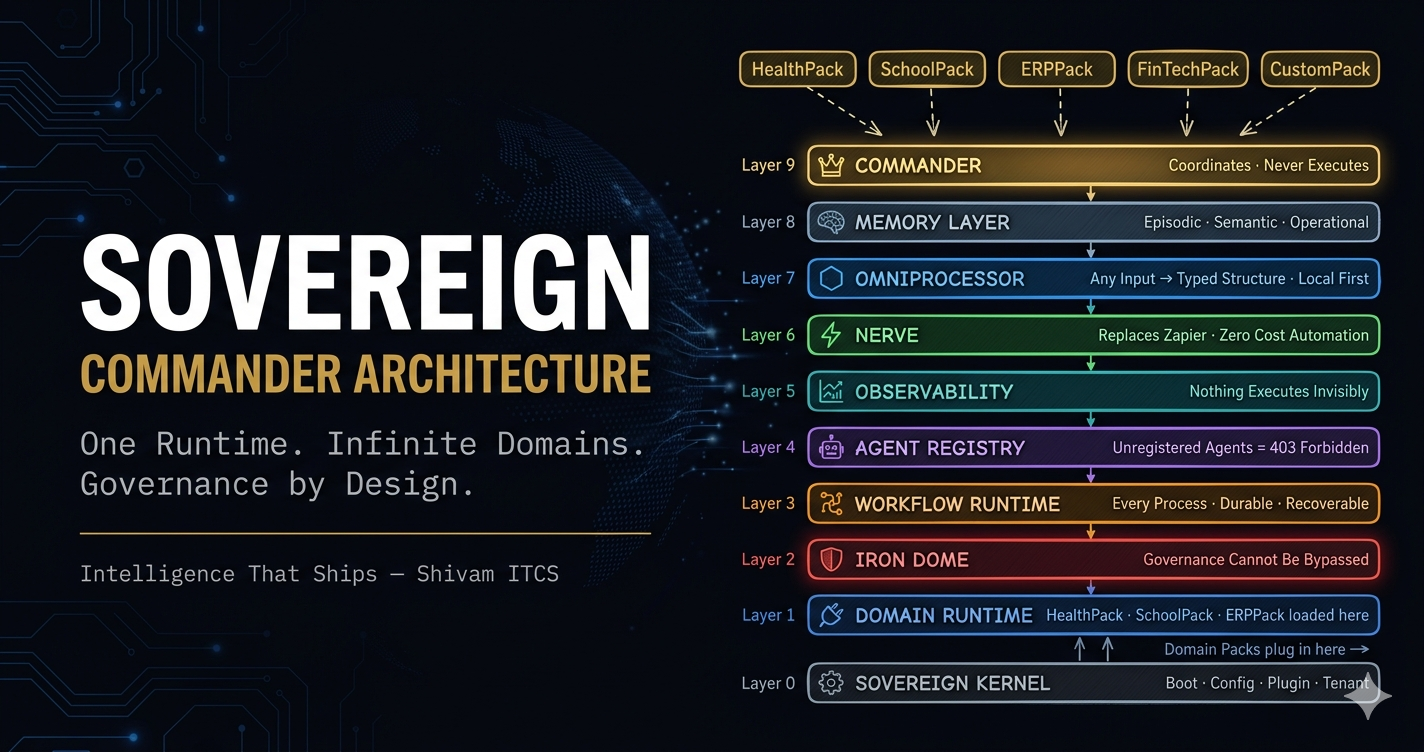
Commander Architecture: How We Cut AI Costs by 70% in Production
A detailed technical breakdown of how Claude Opus as Supreme Commander + local Qwen agents via Ollama creates a multi-agent system that delivers 40–70% AI infrastructure cost reduction — with real numbers.

Agentic Swarms: Orchestrating Collaborative Task Resolution Across Multiple Hermes Models
Agentic swarms represent the next evolution of enterprise AI by enabling multiple Hermes models to collaborate on complex workflows. Learn how swarm orchestration, task decomposition, shared memory, and distributed reasoning create scalable, resilient AI systems.

Hybrid Intelligence: Humans + Agents in the Loop
Learn how enterprises design Human-in-the-Loop AI systems where autonomous agents collaborate with people through shared decision-making, governance, continuous learning, and intelligent workflow orchestration.

Trustworthy AI & Governance: Building Ethical AI Systems in the Stack
By late 2024, enterprise AI has moved beyond experimentation into business-critical operations. As organizations deploy Large Language Models, AI copilots, autonomous agents, and predictive systems across core business functions, governance has become as important as model performance. This article explores how Trustworthy AI, governance frameworks, observability, security, and ethical engineering are becoming foundational components of the modern enterprise technology stack.

Docker and Kubernetes Native Integration: The End of Orchestration Wars
Docker's announcement of native Kubernetes support within Docker Enterprise Edition marks a major turning point for enterprise container platforms. Rather than forcing organizations to choose between Docker Swarm and Kubernetes, Docker is embracing Kubernetes as a first-class orchestrator alongside Swarm. This shift has significant implications for enterprise infrastructure, DevOps teams, and cloud-native application strategies. This article examines the announcement from the perspective of October 2017.