Introduction
For decades, software engineering has been evaluated primarily through performance, reliability, scalability, maintainability, and cost efficiency. As cloud computing matured, organizations focused on building highly available distributed systems capable of supporting millions of users across global infrastructure.
However, the rapid growth of cloud computing, artificial intelligence, large-scale data processing, and always-on digital services has significantly increased energy consumption across the technology sector. Modern applications rely on enormous data centers, GPU clusters, distributed databases, continuous integration pipelines, and globally distributed content delivery networks. While these technologies have accelerated innovation, they also consume substantial computational resources.
As environmental sustainability becomes an increasingly important business objective, enterprise architects are expanding traditional architectural principles to include carbon efficiency, responsible infrastructure utilization, workload optimization, and sustainable engineering practices.
This movement has become widely known as Green Software Engineering. Rather than treating sustainability as solely an infrastructure concern, organizations increasingly recognize that software architecture decisions directly influence energy consumption throughout an application's lifecycle.
From the perspective of June 2024, Green Software and Sustainable Architecture represent an emerging discipline that complements performance engineering, cloud optimization, and responsible technology leadership.
Industry Background
Organizations continue accelerating digital transformation while simultaneously pursuing Environmental, Social, and Governance (ESG) objectives.
Enterprise technology portfolios increasingly include:
- ◆Cloud-native applications.
- ◆Artificial Intelligence platforms.
- ◆Data lakes.
- ◆Distributed microservices.
- ◆IoT ecosystems.
- ◆High-performance analytics.
- ◆Global SaaS platforms.
Modern technology leadership increasingly prioritizes:
- ◆Infrastructure efficiency.
- ◆Responsible cloud usage.
- ◆Cost optimization.
- ◆Resource utilization.
- ◆Carbon awareness.
- ◆Sustainable engineering.
Software architecture is becoming an important contributor to broader sustainability initiatives.
The Business Problem
Modern digital platforms frequently consume more infrastructure resources than necessary.
Organizations commonly encounter:
- ◆Overprovisioned cloud resources.
- ◆Idle virtual machines.
- ◆Inefficient database queries.
- ◆Excessive data movement.
- ◆Redundant workloads.
- ◆Unoptimized AI inference.
- ◆Infrastructure waste.
These inefficiencies increase operational costs while consuming additional energy and infrastructure capacity.
Green Software Engineering seeks to reduce unnecessary resource consumption without compromising business objectives.
Understanding the Technology
Green Software Engineering applies sustainability principles throughout software architecture, development, deployment, and operations.
Rather than focusing exclusively on hardware efficiency, software systems are designed to minimize unnecessary computation, storage, networking, and infrastructure utilization.
Core architectural capabilities include:
- ◆Carbon-aware computing.
- ◆Efficient cloud resource management.
- ◆Sustainable application design.
- ◆Energy-efficient algorithms.
- ◆Infrastructure optimization.
- ◆Performance engineering.
- ◆Continuous sustainability monitoring.
These principles encourage organizations to optimize software for both business performance and environmental responsibility.
Core Architecture
A simplified sustainable software architecture appears below.
| Component | Responsibility |
|---|---|
| Client Applications | Efficient user interactions |
| API Layer | Optimized service communication |
| Application Services | Resource-efficient business logic |
| Data Layer | Optimized storage and queries |
| Cloud Infrastructure | Elastic compute resources |
| Monitoring Platform | Performance and sustainability metrics |
| Governance Platform | Cost, utilization, and compliance |
Every architectural layer contributes to overall resource efficiency and operational sustainability.
Key Features
Carbon-Aware Architecture
The defining principle of Green Software Engineering is designing systems that minimize unnecessary environmental impact.
Organizations increasingly evaluate architectural decisions according to:
- ◆Compute efficiency.
- ◆Infrastructure utilization.
- ◆Storage optimization.
- ◆Data transfer.
- ◆Workload scheduling.
- ◆Energy consumption.
Architectural optimization benefits both sustainability objectives and operational costs.
Efficient Cloud Resource Utilization
Cloud-native platforms provide nearly unlimited scalability, but improperly managed infrastructure often leads to resource waste.
Modern engineering teams increasingly implement:
- ◆Automatic scaling.
- ◆Resource right-sizing.
- ◆Container density optimization.
- ◆Scheduled infrastructure shutdown.
- ◆Efficient workload placement.
These practices improve utilization while reducing unnecessary cloud consumption.
Sustainable Application Design
Software design choices significantly influence infrastructure requirements.
Architects increasingly optimize:
- ◆Database access.
- ◆API communication.
- ◆Cache utilization.
- ◆Data serialization.
- ◆Background processing.
- ◆Network traffic.
Efficient applications require fewer computational resources throughout their operational lifecycle.
Responsible AI Workloads
Generative AI and machine learning systems can require significant computational resources.
Organizations increasingly evaluate:
- ◆Model selection.
- ◆Inference efficiency.
- ◆Hardware utilization.
- ◆Prompt optimization.
- ◆Model caching.
- ◆Batch processing.
Responsible AI engineering balances capability with efficient infrastructure utilization.
Observability Beyond Performance
Traditional monitoring focused on latency, throughput, and availability.
Modern observability increasingly includes:
- ◆Resource utilization.
- ◆Infrastructure efficiency.
- ◆Cloud spending.
- ◆Compute consumption.
- ◆Storage growth.
- ◆Sustainability indicators.
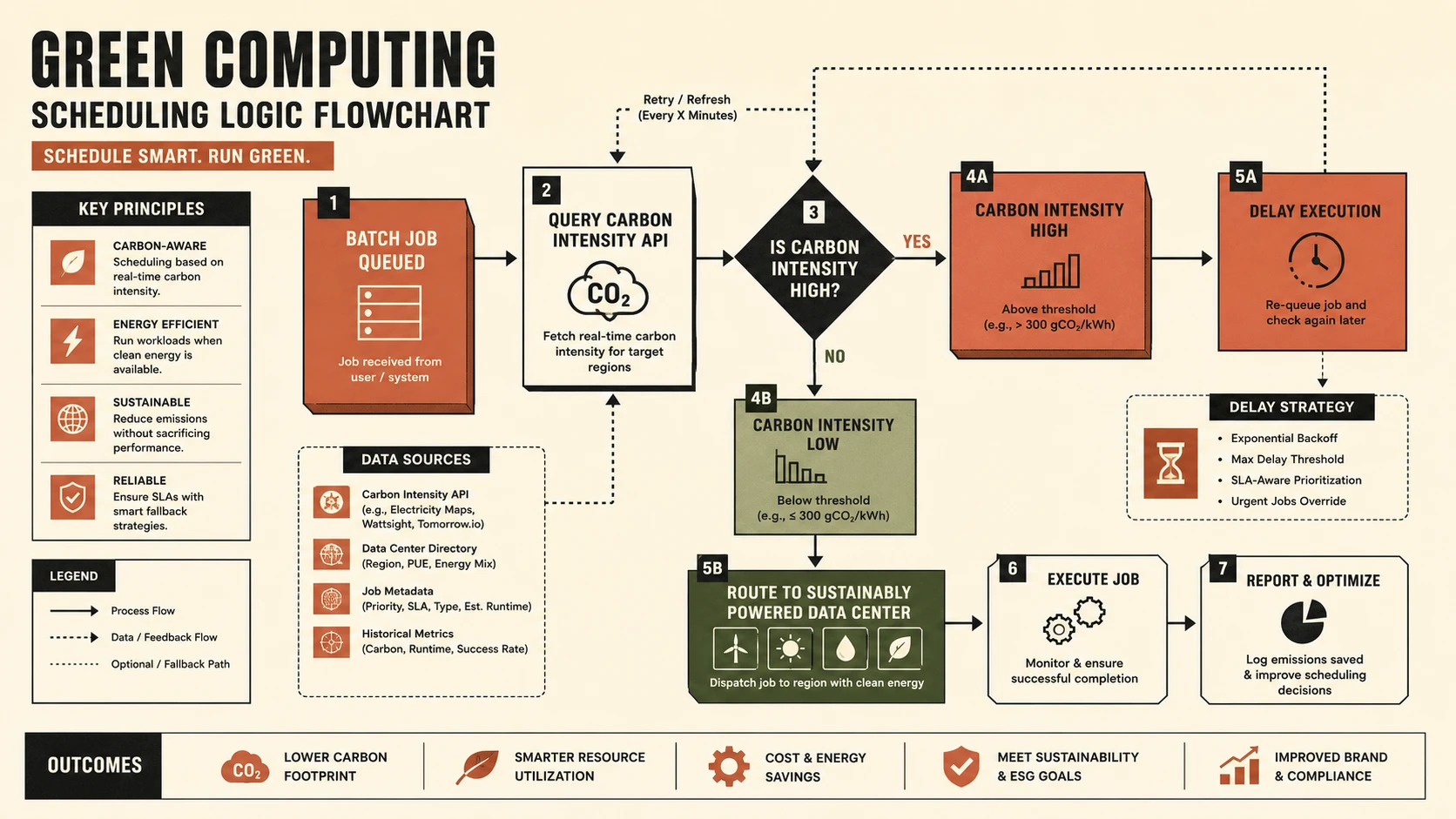
System architecture diagram and conceptual workflow layout for Green Software & Sustainable Architecture.
These metrics support continuous architectural improvement.
Sustainable DevOps
Development pipelines also consume infrastructure resources.
Organizations increasingly optimize:
- ◆Build execution.
- ◆Automated testing.
- ◆Container image size.
- ◆Artifact storage.
- ◆CI/CD resource allocation.
- ◆Pipeline efficiency.
Sustainable engineering extends across the complete software development lifecycle.
How It Works
A simplified architecture workflow appears below.
Business Requirements
        |
Architecture Design
        |
Efficient Application Development
        |
Optimized Cloud Deployment
        |
Continuous Monitoring
        |
Performance + Sustainability Metrics
        |
Continuous Optimization
Engineering teams continuously improve software by balancing performance, scalability, cost efficiency, and responsible infrastructure utilization.
Enterprise Use Cases
Enterprise SaaS Platforms
Cloud applications optimize infrastructure usage through elastic scaling and efficient service architecture.
AI Platforms
Organizations optimize model selection and inference strategies to improve efficiency while maintaining acceptable response quality.
Financial Services
Large transaction platforms reduce unnecessary compute consumption through optimized processing pipelines.
Retail and E-Commerce
Highly seasonal workloads automatically scale infrastructure according to customer demand, reducing idle resource consumption.
Internal Enterprise Systems
Development teams modernize legacy applications to improve infrastructure efficiency while extending application lifespan.
Performance Considerations
Organizations adopting sustainable architecture should evaluate:
- ◆CPU utilization.
- ◆Memory efficiency.
- ◆Infrastructure scaling.
- ◆Database performance.
- ◆Network utilization.
- ◆Cloud resource consumption.
Performance optimization should improve both user experience and resource efficiency.
Security Considerations
Sustainability initiatives should complement—not replace—enterprise security.
Organizations should continue implementing:
- ◆Identity management.
- ◆Role-Based Access Control.
- ◆Encryption.
- ◆Secure software development.
- ◆Infrastructure governance.
- ◆Compliance monitoring.
Secure and sustainable systems are complementary architectural objectives.
Scalability
Green Software Engineering improves enterprise scalability through:
- ◆Better infrastructure utilization.
- ◆Efficient cloud operations.
- ◆Optimized application design.
- ◆Automated resource management.
- ◆Lower operational costs.
- ◆Responsible platform engineering.
Efficient systems often scale more predictably while reducing unnecessary operational overhead.
Best Practices
Organizations adopting Green Software Engineering should:
- ◆Design applications with efficiency as an architectural requirement.
- ◆Continuously monitor infrastructure utilization.
- ◆Right-size cloud resources.
- ◆Optimize database and API performance.
- ◆Reduce unnecessary data movement.
- ◆Build energy-efficient CI/CD pipelines.
- ◆Include sustainability metrics within architecture reviews.
Successful adoption treats sustainability as a continuous engineering discipline rather than a one-time optimization project.
Common Mistakes
| Mistake | Business Impact |
|---|---|
| Equating sustainability solely with reducing cloud costs | Incomplete optimization strategy |
| Overprovisioning infrastructure for predictable workloads | Resource waste |
| Ignoring inefficient application code | Higher operational costs |
| Optimizing only production while neglecting development pipelines | Missed efficiency opportunities |
| Measuring sustainability without operational metrics | Limited architectural insight |
| Treating sustainability as separate from software architecture | Reduced long-term effectiveness |
Organizations should integrate sustainability into architecture, development, operations, and governance rather than treating it as an isolated initiative.
Technology Comparison
| Characteristic | Traditional Cloud Architecture | Sustainable Cloud Architecture |
|---|---|---|
| Primary Objective | Performance and scalability | Performance, scalability, and efficiency |
| Resource Allocation | Often overprovisioned | Right-sized and elastic |
| Monitoring | Performance focused | Performance plus sustainability metrics |
| AI Workloads | Capability focused | Capability with efficiency optimization |
| Infrastructure | Capacity driven | Utilization driven |
| Engineering Success | Speed and availability | Speed, reliability, efficiency, and responsibility |
Sustainable Architecture expands traditional engineering objectives by incorporating responsible resource management alongside established performance goals.
Adoption Strategy
Organizations should adopt Green Software Engineering incrementally.
- 1.Establish baseline infrastructure utilization metrics.
- 2.Identify inefficient applications and workloads.
- 3.Optimize cloud resource allocation.
- 4.Introduce sustainability metrics into architecture reviews.
- 5.Improve application performance through efficient software design.
- 6.Continuously monitor utilization, costs, and operational efficiency.
This phased approach enables organizations to improve sustainability while strengthening operational performance and cost management.
Limitations
As of June 2024, organizations should recognize several considerations.
- ◆Sustainability should be balanced alongside performance, security, availability, and business requirements rather than optimized in isolation.
- ◆Not every workload can be optimized equally, particularly latency-sensitive or regulatory-critical systems.
- ◆Measuring environmental impact remains an evolving discipline, and organizations should use sustainability metrics alongside traditional engineering indicators.
- ◆Responsible AI workloads require continuous evaluation as models and hardware continue evolving.
- ◆Long-term success depends on organizational culture, platform engineering, observability, and continuous optimization rather than isolated infrastructure improvements.
These considerations should guide enterprise sustainability initiatives.
Looking Ahead
From the perspective of June 2024, Green Software Engineering has evolved into an important architectural consideration for modern enterprises. As organizations continue expanding cloud infrastructure, artificial intelligence, and globally distributed digital services, software decisions increasingly influence operational efficiency, infrastructure utilization, and broader sustainability objectives.
The future of enterprise architecture will likely be defined not only by scalability, resilience, and developer productivity, but also by responsible resource management and measurable operational efficiency. Organizations that integrate sustainable engineering practices into platform architecture, cloud operations, AI workloads, and software development lifecycles will be better positioned to deliver high-performance digital services while supporting long-term business resilience and environmental responsibility.