Introduction
Container orchestration has rapidly evolved from supporting stateless web applications to managing complex enterprise platforms that include databases, messaging systems, analytics platforms, monitoring stacks, and machine learning workloads. As organizations increasingly move mission-critical applications into Kubernetes, persistent storage has become one of the most important components of production infrastructure.
Early Kubernetes releases relied on storage plugins that were developed directly inside the Kubernetes source tree. While this approach enabled support for numerous storage systems, it also tightly coupled storage innovation with Kubernetes release cycles. Storage vendors were required to coordinate changes with Kubernetes itself, making feature delivery slower and increasing operational complexity.
The introduction of the Container Storage Interface (CSI) addressed these limitations by defining a standardized interface between Kubernetes and storage systems. With Kubernetes 1.13, CSI reaches General Availability (GA), providing enterprises with a stable foundation for integrating persistent storage into production Kubernetes clusters.
From the perspective of December 2018, CSI represents one of the most important architectural improvements for enterprise Kubernetes adoption because it separates storage innovation from Kubernetes core development while improving portability, maintainability, and operational flexibility.
Industry Background
Enterprise container adoption continues expanding across nearly every industry.
Organizations increasingly deploy:
- ◆Microservices.
- ◆Stateful databases.
- ◆Distributed messaging platforms.
- ◆Analytics platforms.
- ◆Continuous Integration systems.
- ◆Machine learning workloads.
- ◆Enterprise monitoring platforms.
Unlike stateless applications, these workloads require durable storage capable of surviving container restarts and infrastructure changes.
Storage orchestration has therefore become a critical capability for production Kubernetes environments.
The Business Problem
Enterprise storage management introduces several operational challenges.
Organizations commonly encounter:
- ◆Vendor-specific storage integrations.
- ◆Complex plugin maintenance.
- ◆Kubernetes release dependencies.
- ◆Difficult storage upgrades.
- ◆Operational inconsistency.
- ◆Limited portability.
- ◆Slow feature adoption.
Maintaining storage plugins directly inside Kubernetes increased development effort for both storage vendors and Kubernetes maintainers.
CSI addresses these challenges through a standardized plugin architecture.
Understanding the Technology
The Container Storage Interface (CSI) is a vendor-neutral specification that defines how container orchestrators communicate with storage systems.
Rather than embedding storage drivers within Kubernetes itself, CSI enables storage vendors to develop independent drivers that implement a common interface.
Major capabilities include:
- ◆Volume provisioning.
- ◆Volume attachment.
- ◆Volume mounting.
- ◆Volume expansion.
- ◆Snapshot integration where supported.
- ◆Storage lifecycle management.
- ◆Cross-platform storage driver architecture.
By standardizing storage communication, Kubernetes no longer requires direct knowledge of individual storage implementations.
Core Architecture
A simplified CSI architecture appears below.
| Component | Responsibility |
|---|---|
| Kubernetes API Server | Cluster management |
| CSI External Provisioner | Volume provisioning requests |
| CSI Driver | Storage implementation |
| Storage Controller | Vendor storage management |
| Storage Backend | Persistent storage infrastructure |
| Worker Nodes | Execute application pods |
| Persistent Volumes | Durable application storage |
The CSI driver acts as the abstraction layer between Kubernetes and the underlying storage platform.
Key Features
CSI General Availability
The defining milestone of Kubernetes 1.13 is the graduation of the Container Storage Interface to General Availability.
GA status provides enterprise organizations with confidence that the API is stable enough for production deployment and long-term operational planning.
Vendor-Independent Architecture
CSI defines a common interface rather than a storage implementation.
Storage vendors can independently develop CSI-compliant drivers while Kubernetes maintains a consistent integration model.
This significantly reduces coupling between Kubernetes releases and storage innovation.
Independent Release Cycles
Prior storage plugins often required Kubernetes releases before new functionality could become broadly available.
CSI enables storage vendors to release driver updates independently, allowing faster delivery of new storage capabilities.
Standardized Volume Management
CSI standardizes operations including:
- ◆Volume creation.
- ◆Volume attachment.
- ◆Volume mounting.
- ◆Volume removal.
This consistency simplifies enterprise operations across multiple storage platforms.
Persistent Storage for Stateful Workloads
CSI strengthens Kubernetes support for applications requiring durable storage, including:
- ◆Relational databases.
- ◆NoSQL databases.
- ◆Message brokers.
- ◆Enterprise content repositories.
- ◆Logging platforms.
Extensible Storage Ecosystem
The standardized driver model encourages broader ecosystem participation while reducing maintenance overhead within Kubernetes itself.
How It Works
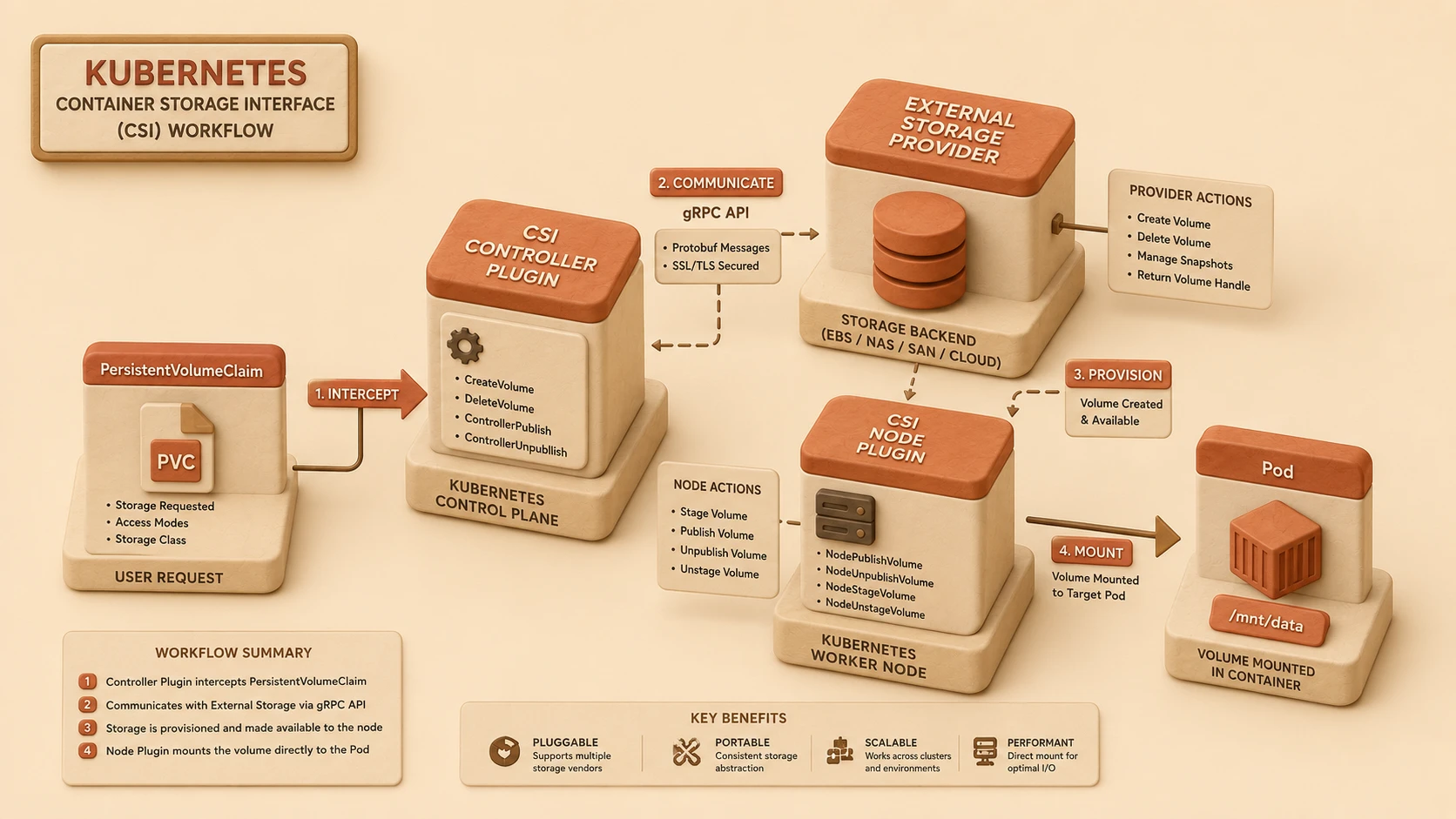
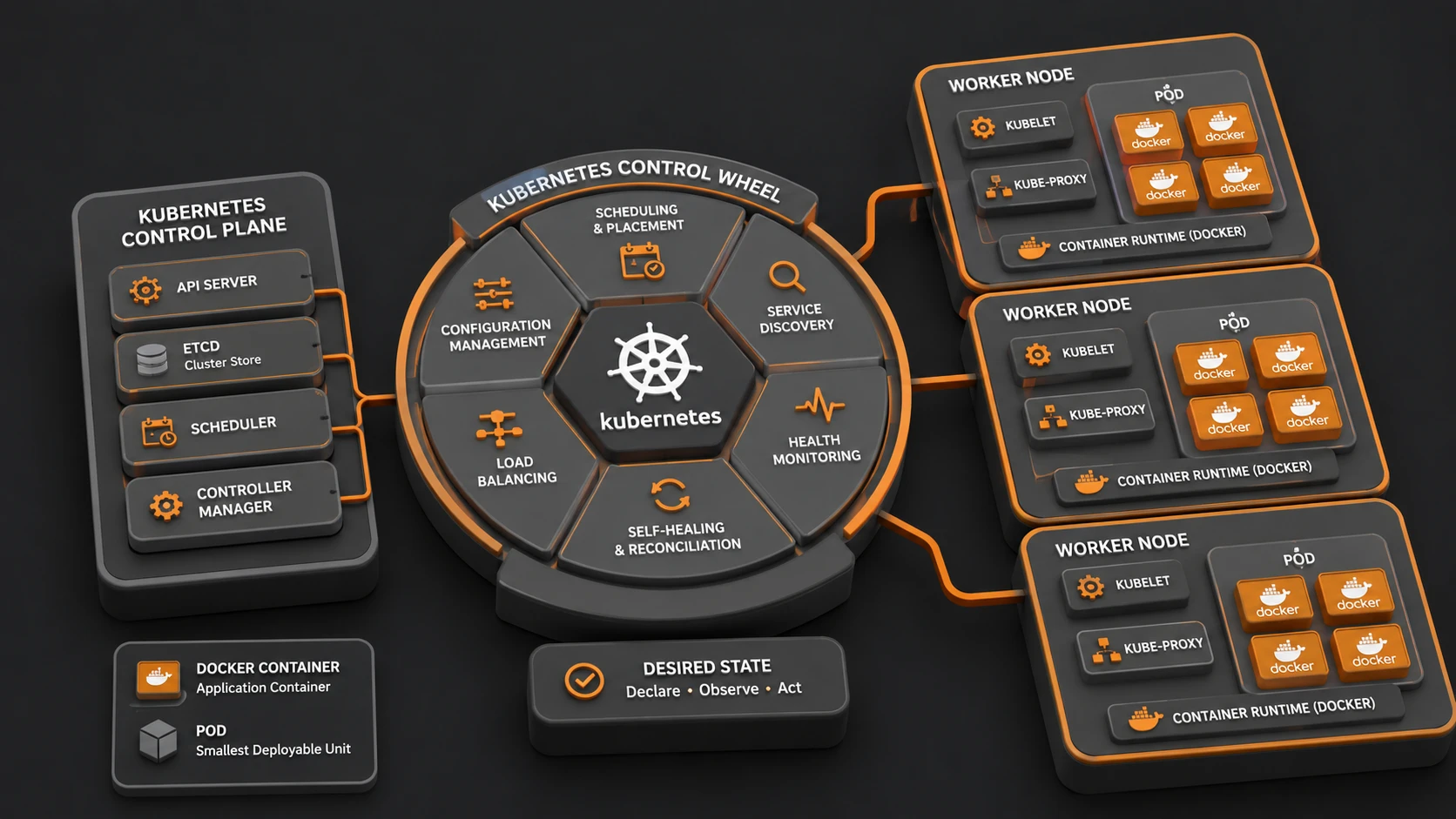
System architecture diagram and conceptual workflow layout for Kubernetes 1.13.
A simplified storage provisioning workflow appears below.
Application Deployment
          |
PersistentVolumeClaim
          |
Kubernetes API Server
          |
CSI External Provisioner
          |
CSI Driver
          |
Storage Backend
          |
Persistent Volume Created
          |
Pod Mounts Volume
Kubernetes communicates with the storage system through the CSI driver rather than interacting directly with vendor-specific implementations.
Enterprise Use Cases
Database Platforms
Enterprise databases require durable storage capable of surviving pod scheduling changes and node failures.
Private Cloud Infrastructure
Platform engineering teams can integrate enterprise storage systems using standardized CSI drivers.
Continuous Integration Platforms
Build systems benefit from persistent workspaces and artifact storage.
Analytics Workloads
Large analytical platforms require scalable persistent storage for processing and reporting.
Hybrid Cloud Deployments
Organizations operating across multiple infrastructure providers gain a consistent storage integration model through CSI.
Performance Considerations
CSI introduces architectural flexibility while maintaining enterprise storage capabilities.
Organizations should evaluate:
- ◆Storage latency.
- ◆Provisioning speed.
- ◆Volume attachment time.
- ◆Storage throughput.
- ◆Network performance.
- ◆Driver implementation quality.
Overall storage performance continues depending primarily on the underlying storage platform and infrastructure architecture.
Security Considerations
Production Kubernetes storage deployments should implement:
- ◆Role-Based Access Control.
- ◆Secure storage credentials.
- ◆Encrypted storage where supported.
- ◆Secure communication between components.
- ◆Namespace isolation.
- ◆Audit logging.
CSI standardizes storage communication but does not replace comprehensive infrastructure security.
Scalability
CSI improves Kubernetes scalability through architectural decoupling.
Advantages include:
- ◆Independent driver releases.
- ◆Vendor-neutral integration.
- ◆Simplified maintenance.
- ◆Greater ecosystem flexibility.
- ◆Improved production stability.
These characteristics support increasingly large enterprise Kubernetes deployments.
Best Practices
Organizations adopting Kubernetes 1.13 should:
- ◆Standardize on CSI-compatible storage drivers.
- ◆Validate vendor-supported CSI implementations.
- ◆Benchmark storage performance under production workloads.
- ◆Automate storage provisioning through Kubernetes manifests.
- ◆Monitor storage capacity continuously.
- ◆Test disaster recovery procedures.
- ◆Keep CSI drivers updated independently of Kubernetes where appropriate.
A disciplined storage strategy improves long-term operational reliability.
Common Mistakes
| Mistake | Business Impact |
|---|---|
| Treating CSI as a storage system rather than an interface | Architectural misunderstanding |
| Ignoring storage performance benchmarking | Capacity planning issues |
| Selecting unsupported storage drivers | Deployment instability |
| Failing to monitor persistent volume utilization | Storage exhaustion |
| Delaying driver updates unnecessarily | Missed vendor improvements |
| Skipping backup and recovery validation | Increased operational risk |
Successful CSI adoption depends upon understanding that Kubernetes manages storage through standardized interfaces rather than vendor-specific implementations.
Technology Comparison
| Characteristic | In-Tree Storage Plugins | CSI Drivers |
|---|---|---|
| Release Cycle | Tied to Kubernetes releases | Independent vendor releases |
| Vendor Development | Kubernetes source tree | External driver implementation |
| Maintenance | Kubernetes maintainers and vendors | Storage vendor responsibility |
| Extensibility | Limited by Kubernetes release cadence | Greater flexibility |
| Production Portability | Platform dependent | Standardized integration model |
CSI modernizes Kubernetes storage architecture by separating storage innovation from Kubernetes core development.
Adoption Strategy
Organizations should adopt CSI through a structured migration strategy.
- 1.Inventory existing storage infrastructure.
- 2.Verify availability of production-ready CSI drivers.
- 3.Benchmark storage performance.
- 4.Validate backup and disaster recovery procedures.
- 5.Standardize PersistentVolume and PersistentVolumeClaim configurations.
- 6.Expand production deployment following operational validation.
This phased approach minimizes infrastructure risk while enabling organizations to benefit from CSI's standardized architecture.
Limitations
As of December 2018, organizations should recognize several considerations.
- ◆CSI adoption depends on vendor driver availability.
- ◆Driver quality may vary between storage providers.
- ◆Existing in-tree storage plugins may continue operating during migration.
- ◆Production validation remains essential before organization-wide deployment.
- ◆Storage architecture should continue following enterprise availability and disaster recovery requirements.
These considerations should guide enterprise storage modernization initiatives.
Looking Ahead
From the perspective of December 2018, the General Availability of the Container Storage Interface represents one of the most significant architectural advancements in Kubernetes since its early production adoption. By defining a stable, vendor-neutral interface between Kubernetes and enterprise storage platforms, CSI enables faster innovation, simplifies long-term maintenance, and provides a stronger foundation for stateful containerized workloads.
Organizations building production Kubernetes platforms should view CSI not simply as another storage feature, but as the strategic standard for future storage integration. As the Kubernetes ecosystem continues expanding across private clouds, public clouds, and hybrid infrastructure, the decoupled architecture introduced by CSI positions enterprise storage to evolve independently while maintaining consistent orchestration across diverse environments.