Introduction
Enterprise software architecture is undergoing a gradual transition from large, monolithic applications toward smaller independently deployable services. Increasing demand for continuous delivery, cloud infrastructure, rapid feature deployment, and independent team ownership has encouraged organizations to decompose business applications into collections of loosely coupled services.
While this architectural approach offers improved flexibility, it introduces new operational challenges. Services must locate one another dynamically, network locations may change as infrastructure scales, and clients should not require knowledge of every individual backend service.
Netflix has addressed many of these challenges through its open-source software ecosystem, commonly referred to as Netflix OSS. Among its most influential projects are Eureka, a service discovery server, and Zuul, an edge gateway responsible for routing requests into a distributed service architecture.
As of February 2015, these projects are attracting considerable attention from organizations designing cloud-native and microservice-based platforms. They provide practical solutions for dynamic service registration, centralized routing, and infrastructure abstraction while remaining compatible with existing HTTP-based services.
Industry Background
Traditional enterprise applications often expose a single deployable unit backed by a centralized relational database. Communication occurs primarily through internal method calls, and infrastructure changes are relatively infrequent.
Distributed architectures introduce a different operating model. Services may be deployed independently, replicated across multiple servers, relocated during scaling operations, or replaced during rolling deployments.
In this environment, static configuration files containing server addresses quickly become difficult to maintain. Organizations increasingly require runtime discovery mechanisms and centralized request routing capable of adapting to changing infrastructure.
Netflix OSS addresses these operational concerns through complementary infrastructure services rather than embedding networking logic into every application.
The Business Problem
Organizations adopting distributed architectures frequently encounter:
- ◆Static service endpoint configuration
- ◆Complex client-side routing
- ◆Difficult service discovery
- ◆Operational challenges during scaling
- ◆Tight coupling between consumers and providers
- ◆Uneven traffic distribution
- ◆Increasing infrastructure complexity
Without centralized discovery and routing, operational maintenance becomes increasingly difficult as the number of services grows.
Understanding Microservices Architecture
Microservices architecture decomposes applications into smaller services aligned with business capabilities.
Each service typically:
- ◆Owns a specific business responsibility
- ◆Can be deployed independently
- ◆Exposes well-defined HTTP APIs
- ◆Maintains its own operational lifecycle
- ◆Communicates through network protocols
This separation allows development teams to evolve services independently while improving deployment flexibility.
Core Architecture
| Component | Responsibility |
|---|---|
| Client Application | Initiates requests |
| Zuul Gateway | Routes incoming traffic |
| Eureka Server | Maintains service registry |
| Service Instance | Implements business functionality |
| REST API | Communication interface |
| Monitoring Platform | Tracks service health |
Separating infrastructure responsibilities from business services improves maintainability and operational consistency.
Understanding Eureka
Eureka functions as a service registry.
Rather than requiring applications to know the physical location of every service, service instances register themselves with Eureka during startup.
The registry maintains information such as:
- ◆Service name
- ◆Network location
- ◆Availability status
- ◆Instance metadata
Clients or infrastructure components can query Eureka to discover available service instances dynamically.
Service Registration
// Spring Cloud Eureka Client registration configuration class annotation
import org.springframework.boot.SpringApplication;
import org.springframework.boot.autoconfigure.SpringBootApplication;
import org.springframework.cloud.netflix.eureka.EnableEurekaClient;

@SpringBootApplication
@EnableEurekaClient // Automatically registers microservice metadata with Netflix Eureka server registry
public class OrderServiceApplication {
    public static void main(String[] args) {
        SpringApplication.run(OrderServiceApplication.class, args);
    }
}
A typical registration workflow proceeds as follows:
- 1.A service instance starts.
- 2.The instance registers with the Eureka server.
- 3.Registration metadata is stored.
- 4.Periodic heartbeat messages confirm availability.
- 5.Other services discover the registered instance through Eureka.
This approach removes the need for manually maintained endpoint configuration.
Health Monitoring
Eureka continuously monitors registered services through heartbeat communication.
If heartbeat messages are no longer received, unavailable instances can be removed from the registry after an appropriate interval.
This enables clients to avoid routing requests toward unhealthy services while maintaining an updated view of the deployment environment.
Understanding Zuul
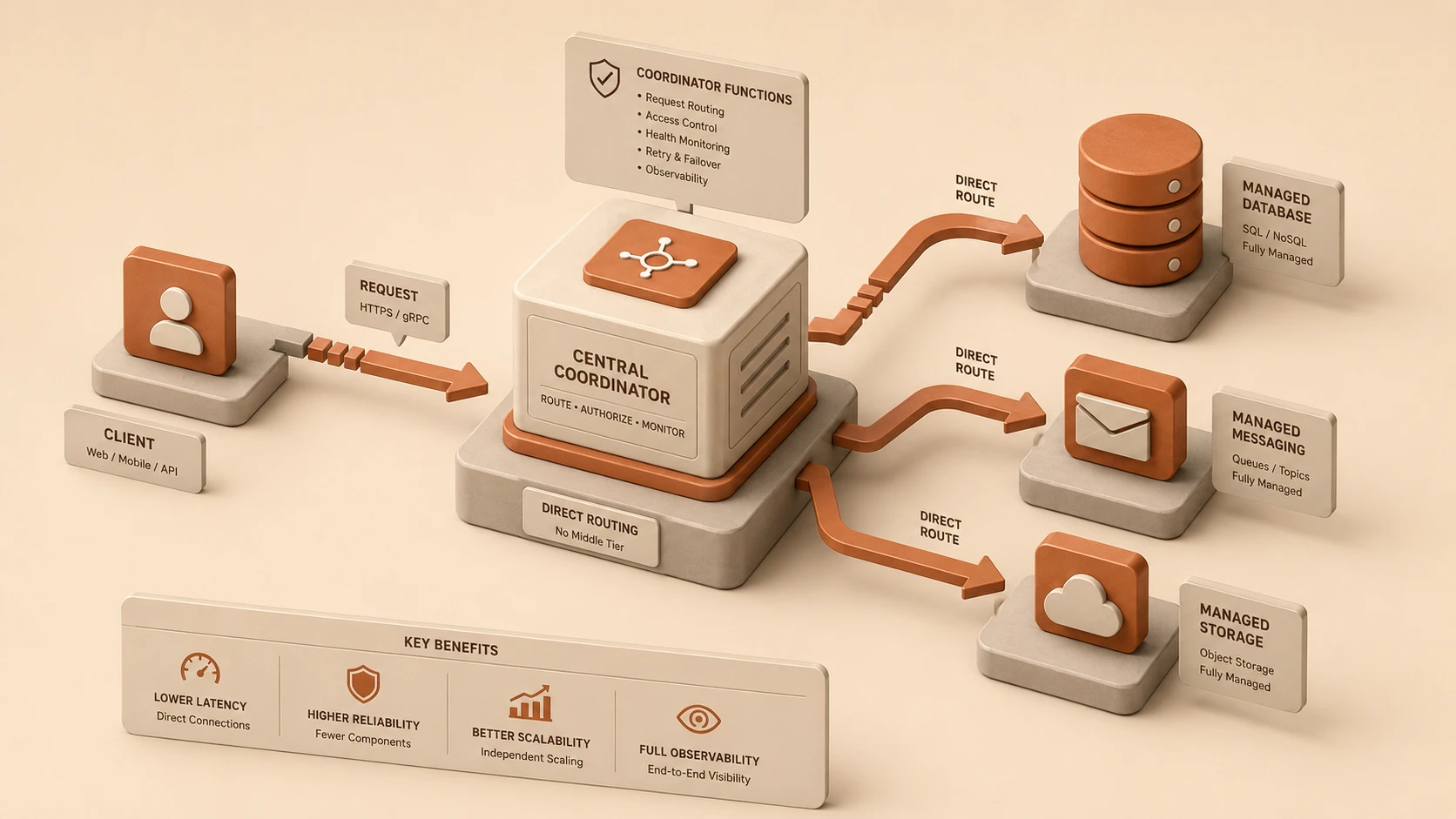
Zuul serves as an edge gateway positioned between clients and backend services.
Instead of exposing numerous internal service endpoints directly, clients communicate with a single gateway responsible for request routing.
Primary responsibilities include:
- ◆Request routing
- ◆Service selection
- ◆Request filtering
- ◆Response handling
- ◆Infrastructure abstraction
This architecture simplifies client implementation while centralizing cross-cutting concerns.
Request Routing
A typical request flow includes:
- 1.The client sends an HTTP request.
- 2.Zuul receives the request.
- 3.Zuul queries Eureka for available service instances.
- 4.An appropriate backend instance is selected.
- 5.The request is forwarded.
- 6.The response is returned to the client.
Clients remain unaware of the physical location or number of backend service instances.
API Gateway Pattern
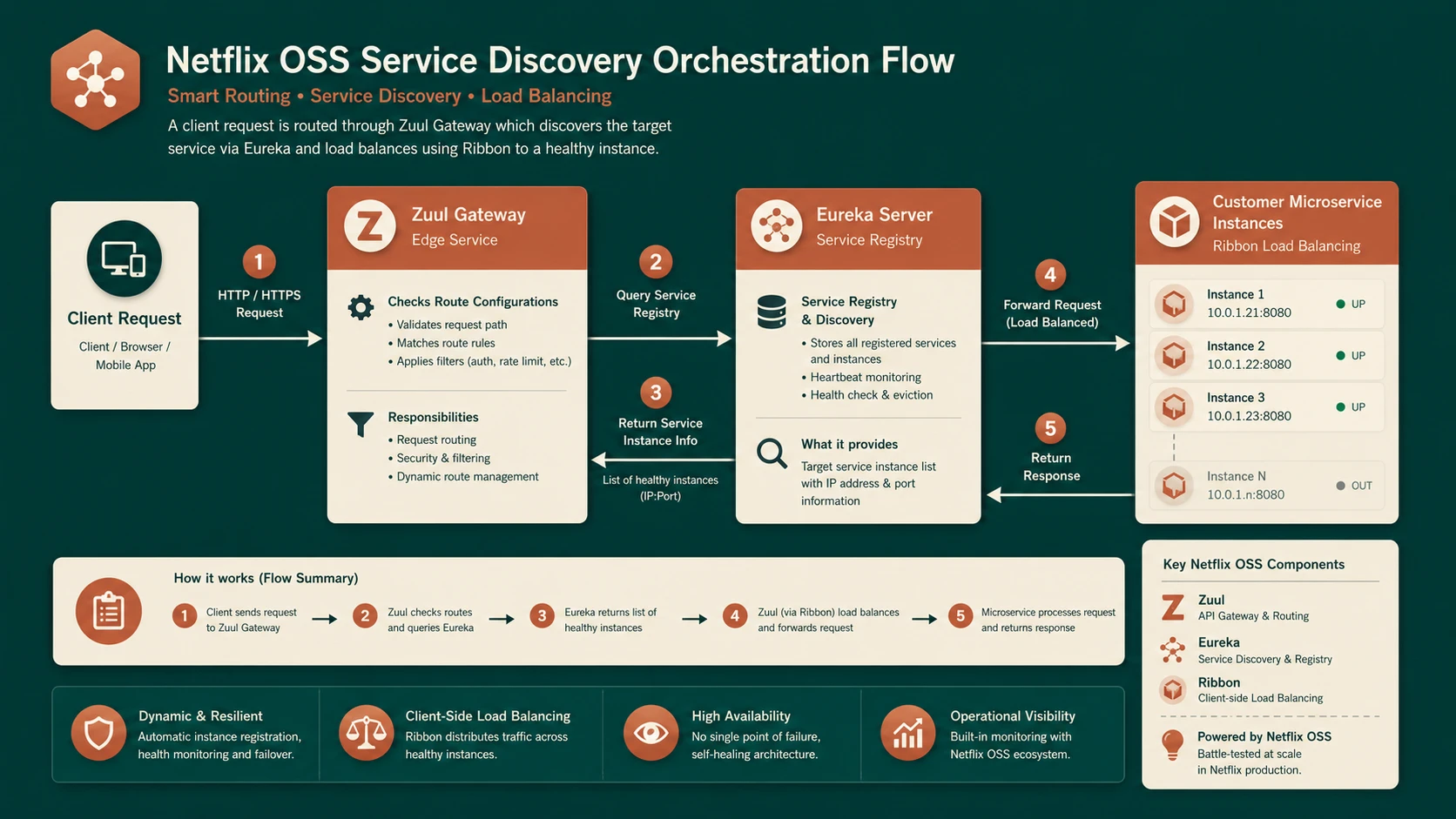
System architecture diagram and conceptual workflow layout for Microservices Architecture.
The API gateway pattern provides several architectural advantages.
Benefits include:
- ◆Centralized routing
- ◆Reduced client complexity
- ◆Unified external interface
- ◆Easier infrastructure evolution
- ◆Simplified security integration
The gateway becomes the primary entry point for external consumers while backend services remain internally focused.
Service Discovery Benefits
Dynamic service discovery improves operational flexibility by:
- ◆Eliminating hard-coded endpoints
- ◆Supporting automatic scaling
- ◆Simplifying infrastructure changes
- ◆Reducing deployment coordination
- ◆Improving resilience during instance replacement
Applications become less dependent on static infrastructure configuration.
Enterprise Use Cases
| Scenario | Benefit |
|---|---|
| SaaS Platforms | Dynamic service scaling |
| Enterprise APIs | Centralized routing |
| Customer Portals | Simplified backend integration |
| Cloud Applications | Automatic service discovery |
| Mobile Backends | Unified API access |
| Business Service Platforms | Independent service deployment |
Organizations building distributed systems benefit from infrastructure components that reduce operational complexity.
Performance Considerations
Gateway and discovery services become important infrastructure components and should be designed carefully.
Performance planning should evaluate:
- ◆Routing latency
- ◆Registry lookup efficiency
- ◆Gateway throughput
- ◆Network utilization
- ◆Request concurrency
Regular monitoring helps ensure these shared services do not become bottlenecks.
Security Considerations
Although Eureka and Zuul primarily address infrastructure concerns, enterprise deployments should incorporate:
- ◆HTTPS communication
- ◆Authentication
- ◆Authorization
- ◆Secure service registration
- ◆Administrative access controls
- ◆Request auditing
Centralizing gateway functionality may simplify enforcement of consistent security policies.
Scalability
Netflix OSS supports horizontal scaling by allowing multiple service instances to register dynamically.
Scalability advantages include:
- ◆Independent service replication
- ◆Dynamic discovery
- ◆Flexible request routing
- ◆Infrastructure abstraction
- ◆Improved operational agility
Applications can expand incrementally without requiring clients to update endpoint configurations.
Best Practices
Organizations evaluating Eureka and Zuul should:
- ◆Register every service consistently.
- ◆Use logical service names rather than physical addresses.
- ◆Keep business logic separate from infrastructure concerns.
- ◆Monitor registry health continuously.
- ◆Design stateless services where practical.
- ◆Automate deployments.
- ◆Document service contracts.
- ◆Test failure scenarios regularly.
Operational discipline is essential for distributed systems.
Common Mistakes
Common implementation issues include:
- ◆Hard-coding service locations.
- ◆Treating the gateway as a business logic layer.
- ◆Ignoring service health monitoring.
- ◆Allowing inconsistent service registration.
- ◆Failing to test infrastructure failures.
- ◆Coupling clients directly to backend services.
Thoughtful architectural boundaries help maintain long-term flexibility.
Technology Comparison
| Capability | Static Configuration | Eureka and Zuul |
|---|---|---|
| Service Discovery | Manual | Dynamic |
| Client Routing | Direct | Gateway-based |
| Infrastructure Flexibility | Limited | Improved |
| Scaling Support | Manual updates | Automatic discovery |
| Endpoint Management | Distributed | Centralized |
| Operational Maintainability | Moderate | Improved |
Dynamic discovery and centralized routing reduce operational overhead as service ecosystems grow.
Adoption Strategy
Organizations considering microservices should introduce supporting infrastructure gradually.
A practical approach includes:
- 1.Identify services suitable for independent deployment.
- 2.Deploy a Eureka registry.
- 3.Register selected services.
- 4.Introduce Zuul as the external gateway.
- 5.Validate routing and service discovery.
- 6.Monitor production behavior.
- 7.Expand adoption across additional services as operational maturity increases.
Incremental adoption reduces migration risk while allowing engineering teams to gain operational experience.
Limitations
Although Netflix OSS provides valuable infrastructure capabilities, organizations should recognize several considerations.
Current observations include:
- ◆Distributed systems introduce greater operational complexity than monolithic applications.
- ◆Additional infrastructure services require monitoring and maintenance.
- ◆Service boundaries must be designed carefully.
- ◆Network communication introduces latency compared with in-process method calls.
- ◆Operational tooling becomes increasingly important as service counts grow.
Microservices should be adopted to address genuine architectural requirements rather than as a default design choice.
Looking Ahead
As of February 2015, Netflix OSS is helping shape practical approaches to building distributed cloud applications. Eureka provides a dynamic service registry that reduces dependency on static configuration, while Zuul offers a centralized gateway capable of routing requests into a changing service landscape.
Organizations exploring microservices should view these technologies as foundational infrastructure components that support scalable service discovery and intelligent request routing. When combined with disciplined service design, automated deployment, and comprehensive operational monitoring, Eureka and Zuul provide a strong architectural foundation for enterprise systems transitioning toward distributed application architectures.