Introduction
Web application development is undergoing a significant architectural shift. Traditional multi-page websites continue to serve many business needs, but increasingly interactive enterprise applications are demanding richer user experiences that resemble desktop software rather than conventional web pages.
Single Page Applications (SPAs) have emerged as a promising solution by allowing client-side JavaScript to manage navigation, rendering, and user interaction without requiring complete page reloads. AngularJS 1.0, recently released by Google, introduces a comprehensive framework designed specifically for building these applications.
From the perspective of July 2012, AngularJS represents one of the most ambitious attempts to standardize client-side application development using familiar web technologies while reducing the complexity of large JavaScript codebases.
Industry Background
Modern browsers have become substantially more capable over the past several years. Faster JavaScript engines, improved HTML5 support, and widespread adoption of AJAX have enabled developers to build highly interactive browser applications.
Many organizations currently rely on:
- ◆jQuery for DOM manipulation.
- ◆Server-side rendering using ASP.NET, PHP, Java, or Ruby.
- ◆Custom JavaScript libraries.
- ◆Template engines.
- ◆Manual AJAX implementations.
Although these technologies remain effective, large applications often become difficult to maintain as JavaScript code grows without a structured architectural pattern.
Frameworks such as Backbone.js, Ember.js, and Knockout have introduced client-side architectural concepts, but AngularJS attempts to provide a more complete development platform.
The Business Problem
Enterprise web applications frequently encounter several development challenges.
- ◆Large JavaScript codebases.
- ◆Tight coupling between UI and business logic.
- ◆Manual DOM manipulation.
- ◆Complex event handling.
- ◆Inconsistent data synchronization.
- ◆Difficult testing.
- ◆Slow feature development.
These problems increase maintenance costs and reduce developer productivity.
AngularJS seeks to address these issues through declarative programming, dependency injection, modular application design, and automatic data binding.
Understanding the Technology
AngularJS extends HTML by introducing custom directives, expressions, and two-way data binding.
Rather than manually manipulating page elements using JavaScript, developers define application behavior declaratively within HTML templates.
Major framework components include:
- ◆Modules.
- ◆Controllers.
- ◆Directives.
- ◆Services.
- ◆Filters.
- ◆Dependency Injection.
- ◆Data Binding.
- ◆Routing.
This architecture encourages separation of concerns while reducing repetitive client-side programming.
Core Architecture
AngularJS follows an MVC-inspired architecture where templates, controllers, and services cooperate to manage application state.
| Component | Responsibility |
|---|---|
| HTML Templates | User interface |
| Directives | Extend HTML behavior |
| Controllers | Presentation logic |
| Services | Shared business functionality |
| Models | Application data |
| Dependency Injection | Component management |
| Routing | Navigation between views |
The framework automatically synchronizes data between models and user interface elements through two-way binding.
Key Features
Two-Way Data Binding
AngularJS automatically synchronizes application data with user interface components, reducing manual DOM updates.
Dependency Injection
Built-in dependency injection improves modularity and simplifies component testing.
Directives
Developers can extend HTML with reusable components that encapsulate presentation behavior.
MVC-Inspired Organization
Applications become easier to structure by separating interface logic from business functionality.
Template Expressions
Dynamic data can be rendered directly within HTML using concise expression syntax.
Routing Support
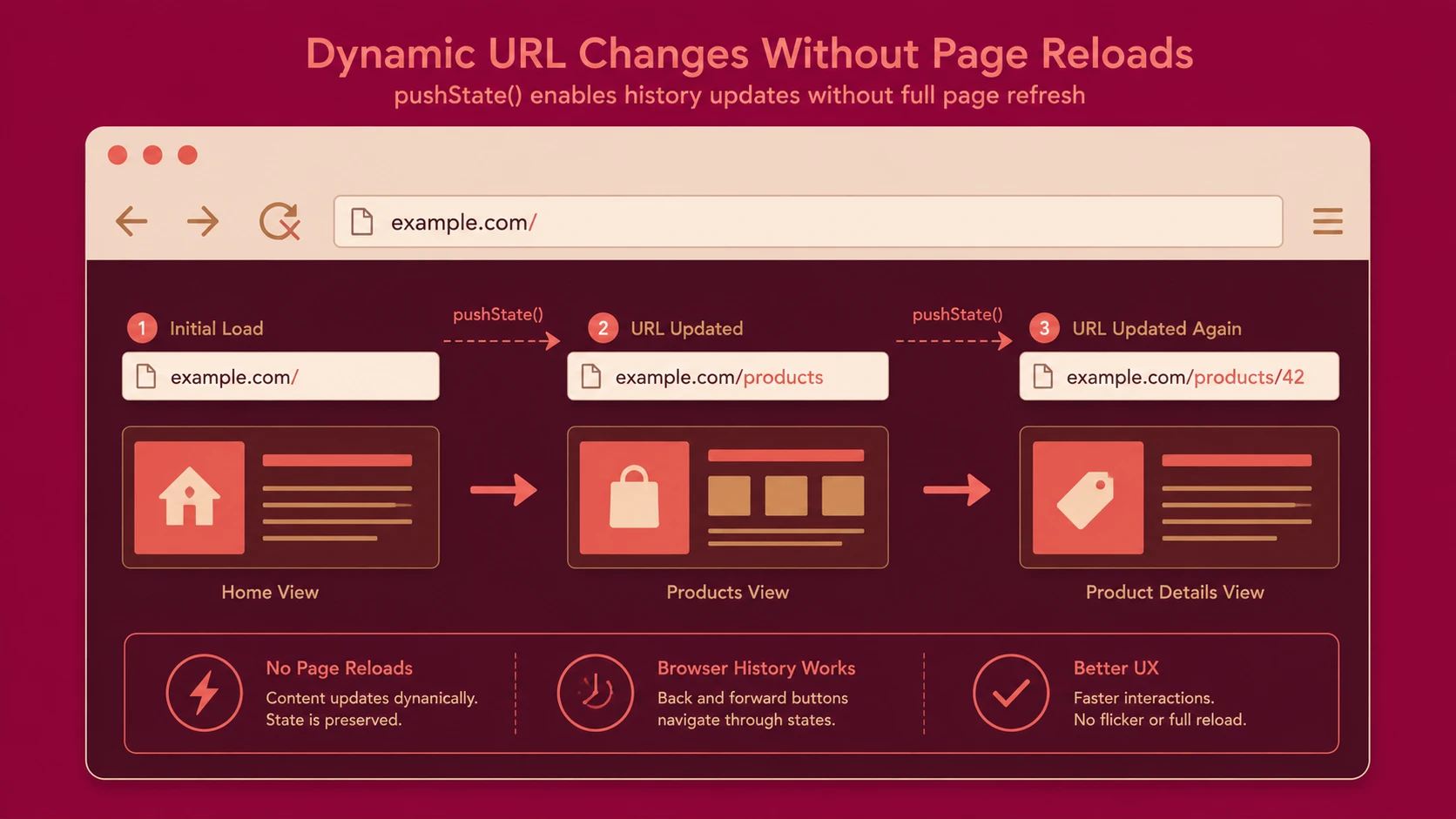
Client-side navigation enables applications to transition between views without full page refreshes.
How It Works
A simplified AngularJS request lifecycle appears as follows.
Browser
     |
HTML Template
     |
AngularJS Framework
     |
Controller
     |
Service
     |
REST API
     |
Application Data
     |
Automatic View Update
When application data changes, AngularJS updates the interface automatically through its data-binding mechanism.
Enterprise Use Cases
AngularJS is particularly well suited for business applications requiring rich user interaction.
Enterprise Dashboards
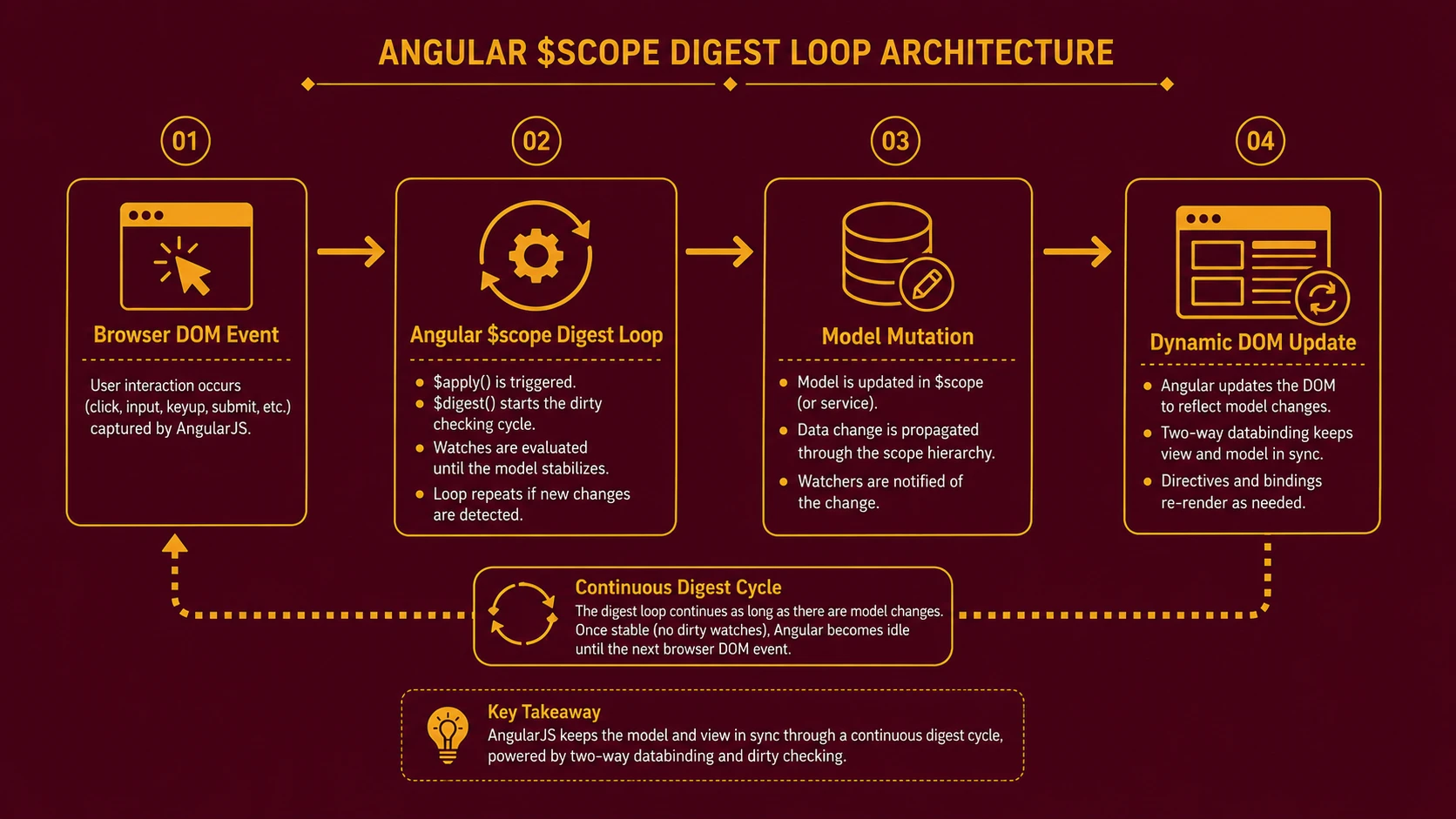
System architecture diagram and conceptual workflow layout for Single Page Apps.
Interactive dashboards can update dynamically without requiring complete page refreshes.
Customer Relationship Management
CRM interfaces often benefit from responsive forms, dynamic tables, and client-side validation.
Project Management Systems
Applications involving multiple views and extensive user interaction align well with the SPA model.
Internal Business Portals
Organizations can modernize employee portals using responsive client-side interfaces.
REST-Based Applications
AngularJS integrates naturally with web services that expose JSON over HTTP.
Performance Considerations
Single Page Applications reduce repeated page downloads but introduce new performance considerations.
Important factors include:
- ◆JavaScript execution speed.
- ◆Browser memory consumption.
- ◆Template complexity.
- ◆Network latency.
- ◆API efficiency.
Developers should avoid excessive watchers, optimize data retrieval, and minimize unnecessary DOM updates in large applications.
Security Considerations
Although AngularJS simplifies client-side development, security remains a server-side responsibility.
Organizations should implement:
- ◆Input validation.
- ◆Secure authentication.
- ◆Authorization controls.
- ◆HTTPS communication.
- ◆Protection against cross-site scripting.
- ◆Secure session management.
Sensitive business logic should remain on the server rather than within client-side JavaScript.
Scalability
AngularJS promotes modular development, making larger applications easier to organize.
Scalable practices include:
- ◆Modular application design.
- ◆Reusable directives.
- ◆Shared services.
- ◆RESTful service integration.
- ◆Component isolation.
As applications expand, maintaining clear separation between presentation and business logic becomes increasingly important.
Best Practices
Development teams adopting AngularJS should:
- ◆Organize applications into modules.
- ◆Keep controllers lightweight.
- ◆Place reusable logic inside services.
- ◆Design reusable directives.
- ◆Consume RESTful APIs.
- ◆Maintain consistent coding standards.
- ◆Write automated unit tests where practical.
These practices improve maintainability as projects grow.
Common Mistakes
| Mistake | Impact |
|---|---|
| Excessive controller logic | Difficult maintenance |
| Direct DOM manipulation | Reduced framework benefits |
| Large monolithic modules | Lower scalability |
| Ignoring dependency injection | Tight coupling |
| Mixing business logic with templates | Reduced readability |
| Overusing watchers | Performance degradation |
Following established architectural patterns helps preserve long-term application quality.
Technology Comparison
| Framework | Primary Strength | Architecture |
|---|---|---|
| AngularJS 1.0 | Complete SPA framework | MVC-inspired |
| Backbone.js | Lightweight application structure | Models and Views |
| Knockout.js | Declarative data binding | MVVM concepts |
| jQuery | DOM manipulation | Library rather than framework |
AngularJS distinguishes itself by combining templating, dependency injection, routing, directives, and data binding into a unified development platform.
Adoption Strategy
Organizations considering AngularJS should begin with applications requiring significant client-side interaction.
Recommended approach:
- 1.Identify suitable web applications.
- 2.Introduce REST-based service architecture.
- 3.Train development teams on AngularJS concepts.
- 4.Standardize project structure.
- 5.Establish coding guidelines.
- 6.Evaluate browser compatibility requirements.
Incremental adoption allows teams to build expertise while minimizing project risk.
Limitations
Despite its capabilities, AngularJS presents several considerations.
- ◆Development teams must learn new architectural concepts.
- ◆Large applications require disciplined module organization.
- ◆Search engine indexing for client-rendered applications may require additional planning.
- ◆Existing server-rendered applications may require significant redesign.
- ◆Browser performance varies depending on application complexity.
These trade-offs should be evaluated during project planning.
Looking Ahead
From the perspective of July 2012, AngularJS 1.0 represents one of the most comprehensive frameworks available for developing Single Page Applications. By combining declarative templates, dependency injection, modular architecture, and automatic data binding, it offers an attractive alternative to traditional JavaScript development techniques.
As organizations continue building increasingly interactive web applications and REST-based services become more common, frameworks like AngularJS are well positioned to influence enterprise front-end architecture. Whether AngularJS becomes the preferred choice across the industry will depend on developer adoption, ecosystem growth, tooling maturity, and its ability to support large-scale enterprise applications over time.