Why Fine-Tuning Matters for Enterprise AI
Foundation models provide impressive general intelligence, but enterprise applications require much more than broad knowledge. Organizations need AI systems that understand internal terminology, business workflows, regulatory requirements, and industry-specific decision-making.
Fine-tuning Hermes 3 enables enterprises to transform a capable open-weight model into a domain expert tailored to their unique operational needs. Instead of repeatedly relying on complex prompts, organizations can embed domain knowledge directly into the model, improving consistency, accuracy, and reasoning quality.
Architecture Principle: Bring the model closer to your business instead of forcing your business to adapt to a generic model.
---
Why Hermes 3?
Hermes 3 is designed as an open-weight instruction-following model, making it well suited for enterprise customization.
Its advantages include:
- ◆Open-weight flexibility
- ◆Strong instruction following
- ◆Tool-use capabilities
- ◆Enterprise deployment support
- ◆On-premise hosting
- ◆Cost-efficient inference
- ◆Transparent customization
These characteristics make Hermes 3 an attractive choice for organizations seeking greater control over their AI infrastructure.
---
Enterprise Fine-Tuning Pipeline
A production-ready fine-tuning workflow typically includes:
Business Knowledge
        │
        ▼
Dataset Collection
        │
Data Cleaning
        │
Instruction Dataset
        │
LoRA Fine-Tuning
        │
Hermes 3 Training
        │
Evaluation
        │
Production Deployment
Each stage contributes to improving model quality while preserving the underlying capabilities of the base model.
---
Preparing Domain Data
The quality of a fine-tuned model depends heavily on the quality of its training data.
Useful enterprise sources include:
- ◆Internal documentation
- ◆Standard operating procedures
- ◆Product manuals
- ◆Knowledge bases
- ◆Technical documentation
- ◆Customer support conversations
- ◆Business policies
- ◆Historical workflows
Well-curated datasets produce more reliable and predictable model behavior.
---
LoRA-Based Fine-Tuning
Low-Rank Adaptation (LoRA) has become one of the most efficient methods for customizing large language models.
Benefits include:
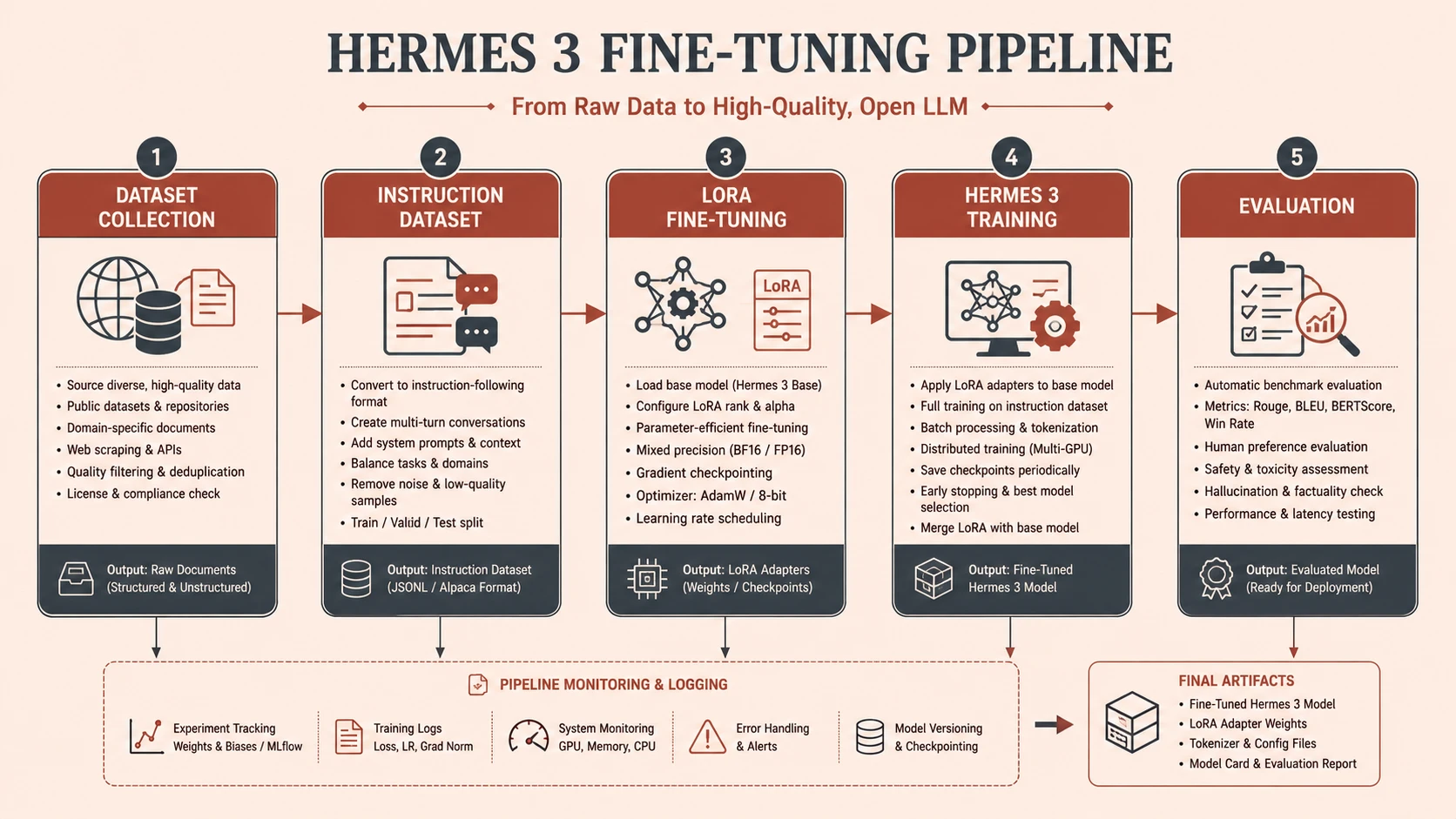
System architecture diagram and conceptual workflow layout for Fine-Tuning Hermes 3.
- ◆Lower GPU requirements
- ◆Faster training
- ◆Smaller checkpoints
- ◆Reduced infrastructure cost
- ◆Easier experimentation
- ◆Faster deployment
Rather than retraining the entire model, LoRA updates a small set of trainable parameters while preserving the original model weights.
---
Evaluation Before Deployment
Every fine-tuned model should be validated before entering production.
Evaluation typically measures:
- ◆Domain accuracy
- ◆Instruction following
- ◆Hallucination rate
- ◆Safety compliance
- ◆Response consistency
- ◆Latency
- ◆Token efficiency
- ◆Business task performance
Continuous evaluation ensures the model remains reliable as enterprise knowledge evolves.
---
Infrastructure Considerations
Enterprise fine-tuning commonly relies on:
- ◆GPU clusters
- ◆Distributed training
- ◆Experiment tracking
- ◆Model registry
- ◆Dataset versioning
- ◆Checkpoint management
- ◆Automated evaluation
- ◆CI/CD pipelines
These components simplify model lifecycle management at scale.
---
Security and Governance
Enterprise AI customization must also address governance.
Recommended practices include:
- ◆Private datasets
- ◆Role-based access control
- ◆Training audit logs
- ◆Dataset lineage
- ◆Secure model storage
- ◆Compliance validation
- ◆Version control
- ◆Human review
Governance ensures customized models remain secure and trustworthy.
---
Best Practices
| Area | Best Practice |
|---|---|
| Training | LoRA Fine-Tuning |
| Data | Curated Enterprise Knowledge |
| Infrastructure | Distributed GPU Training |
| Evaluation | Automated Benchmarking |
| Deployment | Versioned Model Registry |
| Security | Private Enterprise Data |
| Governance | Continuous Validation |
| Operations | MLOps Automation |
---
Building Enterprise Intelligence
Fine-tuning Hermes 3 allows organizations to create AI systems that reflect their unique expertise instead of relying solely on general-purpose models. By combining high-quality datasets, efficient fine-tuning techniques, rigorous evaluation, and strong governance, enterprises can build domain-specific AI solutions that deliver more accurate reasoning, consistent decision-making, and long-term business value.